What does 1 Samuel 14:27 mean?
"But Jonathan heard not when his father charged the people with the oath: wherefore he put forth the end of the rod that was in his hand, and dipped it in an honeycomb, and put his hand to his mouth; and his eyes were enlightened." - 1 Samuel 14:27
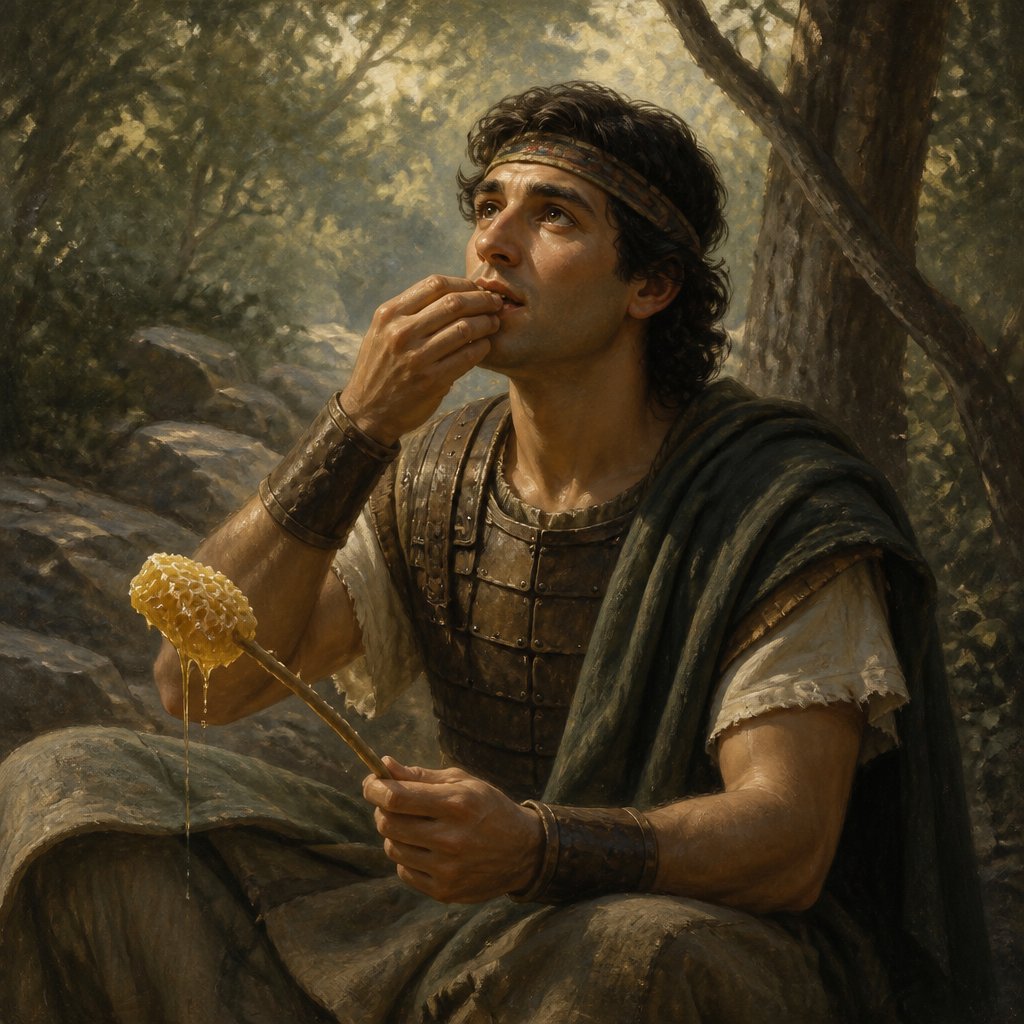
1 Samuel 14:27 (KJV): "But Jonathan heard not when his father charged the people with the oath: wherefore he put forth the end of the rod that was in his hand, and dipped it in an honeycomb, and put his hand to his mouth; and his eyes were enlightened."
This verse comes from the Old Testament book of 1 Samuel, a historical and prophetic book that tells the story of the transition from the period of the judges to the establishment of the monarchy in Israel. The specific passage takes place during a time of conflict between the Israelites and the Philistines, when the young warrior Jonathan, son of King Saul, is leading a small band of men against a garrison of Philistines.
The verse begins by recounting how Jonathan was unaware of the oath his father, King Saul, had made with the people. Then, it describes how Jonathan took the end of his rod, dipped it in a honeycomb, and put it to his mouth, causing his eyes to be enlightened.
One theme found in this verse is the idea of divine intervention and unexpected sources of sustenance. Jonathan's action of using honey to refresh himself can be seen as a metaphor for how God can provide for His people in surprising and miraculous ways, even in the midst of adversity and conflict. This theme is consistent with other biblical accounts of God providing for His people in times of need, such as the story of the Israelites being sustained by manna in the wilderness.
Another theme present in this verse is the idea of disobedience and its consequences. Jonathan's failure to hear his father's charge and his subsequent oath could be seen as a form of disobedience, whether intentional or unintentional. This theme of disobedience and its consequences is a recurring motif throughout the Bible, serving as a cautionary reminder of the importance of heeding God's commands and the authority of those placed over us.
The context of this verse is also significant in understanding its meaning. The broader narrative of 1 Samuel depicts a period of turmoil and transition for the nation of Israel, as they grapple with the challenges of leadership, faithfulness to God, and the threat of enemy nations. In this particular passage, the actions of Jonathan carry symbolic weight as a reflection of the choices and character of the leadership of Israel during this pivotal time in their history.
Symbolism can also be found in this verse, particularly in the act of Jonathan dipping his rod in honey. Honey is often associated with sweetness, sustenance, and spiritual enlightenment in the Bible. The act of Jonathan partaking of the honey can be seen as a metaphor for finding spiritual nourishment and insight in unexpected places, as well as a symbol of the sweetness and light that comes from following God's will.
In conclusion, 1 Samuel 14:27 is a rich and multi-layered verse that conveys themes of divine provision, disobedience, and the complexities of leadership. It is a testament to the enduring relevance and depth of meaning found in the biblical text, offering insights and guidance that remain relevant for believers today. The passage serves as a reminder of the importance of heeding God's commands, seeking spiritual sustenance in unexpected places, and remaining faithful in times of trial and uncertainty.
Have questions about 1 Samuel 14:27?
Dive deeper into this scripture with Bible Chat — an AI-powered tool for exploring God's Word through conversation. Ask questions, get context, and grow in your understanding of the Bible.
Get Our Apps


1 Samuel 14:27 Artwork

1 Samuel 14:27

1 Samuel 14:27 - "But Jonathan heard not when his father charged the people with the oath: wherefore he put forth the end of the rod that was in his hand, and dipped it in an honeycomb, and put his hand to his mouth; and his eyes were enlightened."
"But Jonathan heard not when his father charged the people with the oath: wherefore he put forth the end of the rod that was in his hand, and dipped it in an honeycomb, and put his hand to his mouth; and his eyes were enlightened." - 1 Samuel 14:27

1 Samuel 20:27-29
1 Samuel 20:27-30

2 Samuel 1. 17-27

2 Samuel 14:27 - "And unto Absalom there were born three sons, and one daughter, whose name was Tamar: she was a woman of a fair countenance."

1 Samuel 15:27 - "And as Samuel turned about to go away, he laid hold upon the skirt of his mantle, and it rent."

Psalm 27:13-14

1 Samuel 14:6

2 Samuel 1:27 - "How are the mighty fallen, and the weapons of war perished!"

1 Samuel 14:7

1 Samuel 27:4 - "And it was told Saul that David was fled to Gath: and he sought no more again for him."

2 Samuel 6:14

1 Samuel 1:27 - "For this child I prayed; and the LORD hath given me my petition which I asked of him:"

1 Samuel 11:14 - "Then said Samuel to the people, Come, and let us go to Gilgal, and renew the kingdom there."

1 Samuel 27:7 - "And the time that David dwelt in the country of the Philistines was a full year and four months."

1 Samuel 17:14 - "And David was the youngest: and the three eldest followed Saul."

1 Samuel 23:27 - "¶ But there came a messenger unto Saul, saying, Haste thee, and come; for the Philistines have invaded the land."

1 Samuel 15:14 - "And Samuel said, What meaneth then this bleating of the sheep in mine ears, and the lowing of the oxen which I hear?"

1 Samuel 17:27 - "And the people answered him after this manner, saying, So shall it be done to the man that killeth him."

1 Samuel 14:51 - "And Kish was the father of Saul; and Ner the father of Abner was the son of Abiel."

1 Samuel 27:6 - "Then Achish gave him Ziklag that day: wherefore Ziklag pertaineth unto the kings of Judah unto this day."

1 Samuel 14:25 - "And all they of the land came to a wood; and there was honey upon the ground."

1 Samuel 9:27 - "And as they were going down to the end of the city, Samuel said to Saul, Bid the servant pass on before us, (and he passed on,) but stand thou still a while, that I may shew thee the word of God."

1 Samuel 30:27 - "To them which were in Beth-el, and to them which were in south Ramoth, and to them which were in Jattir,"

1 Samuel 9:14 - "And they went up into the city: and when they were come into the city, behold, Samuel came out against them, for to go up to the high place."

1 Samuel 19:14 - "And when Saul sent messengers to take David, she said, He is sick."

1 Samuel 14:46 - "Then Saul went up from following the Philistines: and the Philistines went to their own place."

"How are the mighty fallen, and the weapons of war perished!" - 2 Samuel 1:27