What does 1 Samuel 13:12 mean?
"Therefore said I, The Philistines will come down now upon me to Gilgal, and I have not made supplication unto the LORD: I forced myself therefore, and offered a burnt offering." - 1 Samuel 13:12
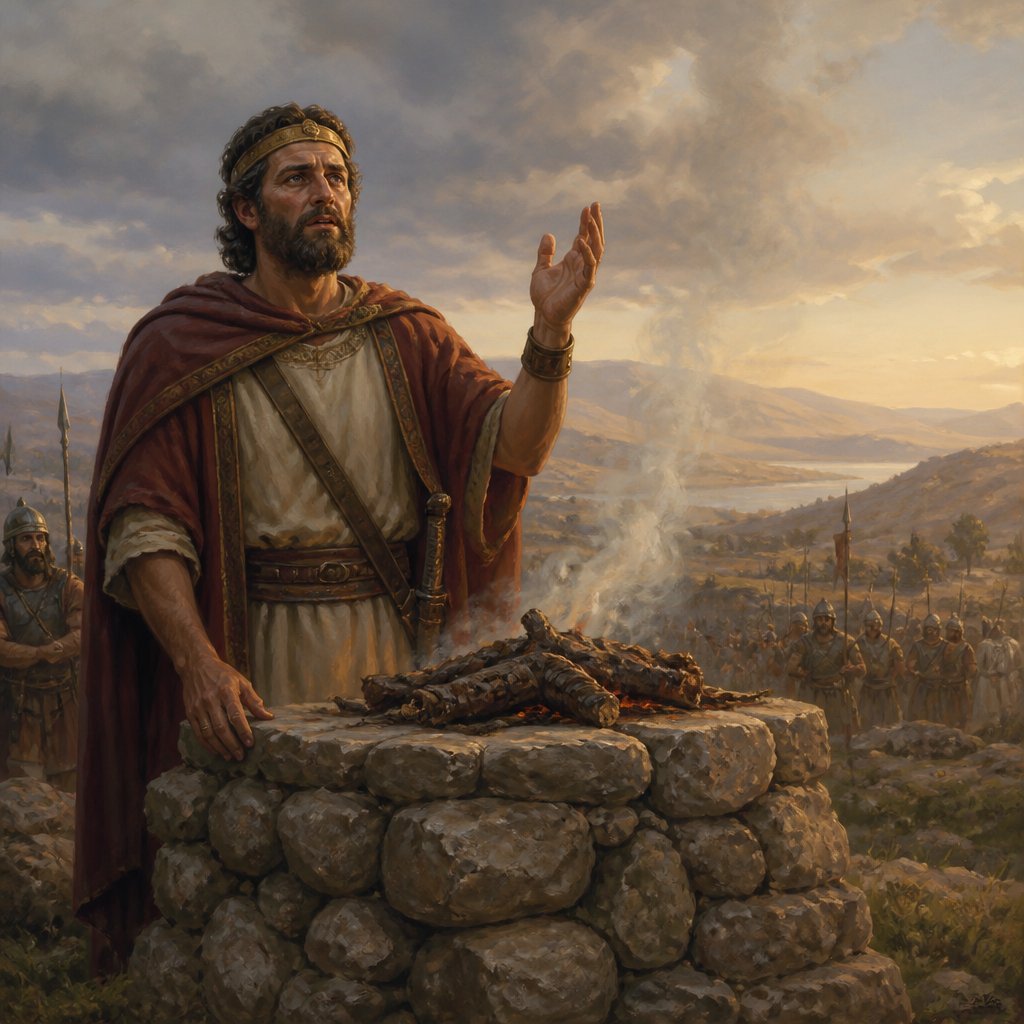
The Bible verse 1 Samuel 13:12 in the King James Version (KJV) reads: "Therefore said I, The Philistines will come down now upon me to Gilgal, and I have not made supplication unto the Lord: I forced myself therefore, and offered a burnt offering."
This verse comes from the Old Testament and is part of the story of Saul, the first king of Israel. In this particular verse, Saul is justifying his decision to offer a burnt offering to God without waiting for the prophet Samuel to do it. To truly understand the meaning and significance of this verse, it is important to explore the themes, context, and symbolism within the larger narrative of 1 Samuel.
The book of 1 Samuel is a historical narrative that tells the story of the transition from the time of the judges to the time of the kings in Israel. It captures the rise and fall of the first king, Saul, and the anointing of the second king, David. The verse 1 Samuel 13:12 occurs early in Saul's reign, shortly after he had been anointed as king by the prophet Samuel.
One of the prominent themes in the book of 1 Samuel is the tension between human leadership and divine authority. Saul's decision to offer a burnt offering without the presence of Samuel reflects this tension. In ancient Israelite society, the offering of sacrifices and burnt offerings was reserved for priests and prophets, who served as intermediaries between the people and God. By taking on this role himself, Saul was asserting his own authority and disregarding the established religious order.
The context of this verse is also crucial to understanding its significance. At the time, the Israelites were engaged in an ongoing struggle with the Philistines, a powerful enemy. In the preceding verses, Samuel had instructed Saul to wait for him at Gilgal for seven days, after which Samuel would offer a burnt offering and provide guidance for the upcoming battle. However, when Samuel did not arrive within the expected time, Saul became anxious and fearful of the Philistine threat.
In his fear and impatience, Saul took matters into his own hands and offered the burnt offering himself. This action not only demonstrated Saul's lack of trust in God's timing and Samuel's authority, but also revealed his arrogant and impulsive nature. Instead of seeking God's guidance and waiting for the appointed time, Saul relied on his own strength and understanding.
The symbolism in 1 Samuel 13:12 is rich and multi-layered. The burnt offering itself was a significant symbol in ancient Israelite worship, representing atonement, dedication, and surrender to God. By offering the burnt offering without proper authorization, Saul demonstrated a lack of reverence for the sacred rituals and a disregard for God's ordained order.
Additionally, Saul's actions foreshadowed his eventual downfall as king. His impulsive disobedience laid the foundation for the eventual rejection of his kingship by God. This verse serves as a warning about the dangers of pride, impatience, and self-reliance. It highlights the importance of obedience, faith, and trust in God's plans and timing.
In conclusion, 1 Samuel 13:12 holds profound meaning within the larger narrative of Saul's reign and the overall themes of divine authority and human leadership in 1 Samuel. It serves as a cautionary tale about the consequences of straying from God's commands and the dangers of self-reliance. Through its themes, context, and symbolism, this verse offers timeless lessons about faith, obedience, and the nature of true leadership.
Have questions about 1 Samuel 13:12?
Dive deeper into this scripture with Bible Chat — an AI-powered tool for exploring God's Word through conversation. Ask questions, get context, and grow in your understanding of the Bible.
Get Our Apps


1 Samuel 13:12 Artwork

1 Samuel 13:12 No face of persons

1 Samuel 13:12 Saul's disobedience

1 Samuel 13:12 - "Therefore said I, The Philistines will come down now upon me to Gilgal, and I have not made supplication unto the LORD: I forced myself therefore, and offered a burnt offering."
"Therefore said I, The Philistines will come down now upon me to Gilgal, and I have not made supplication unto the LORD: I forced myself therefore, and offered a burnt offering." - 1 Samuel 13:12

1 Samuel 12:13

1 Samuel 12:13

1 Sam 31: 12-13

1 Samuel 12:13 - "Now therefore behold the king whom ye have chosen, and whom ye have desired! and, behold, the LORD hath set a king over you."

1 Samuel 12:13 KJV (13) Now therefore behold the king whom ye have chosen, and whom ye have desired! and, behold, the LORD hath set a king over you.

1 Samuel 12:13 KJV (13) Now therefore behold the king whom ye have chosen, and whom ye have desired! and, behold, the LORD hath set a king over you.

1 Samuel 12:13 KJV (13) Now therefore behold the king whom ye have chosen, and whom ye have desired! and, behold, the LORD hath set a king over you.

1 Samuel 12:13 KJV (13) Now therefore behold the king whom ye have chosen, and whom ye have desired! and, behold, the LORD hath set a king over you.

1 Samuel 12:13 KJV (13) Now therefore behold the king whom ye have chosen, and whom ye have desired! and, behold, the LORD hath set a king over you.

1 Samuel 12

1 Samuel 4:12

1 Samuel 16:1–13

1 Samuel 2:12

1 Corinthians 12:12-13

1 Samuel 12:18 - "So Samuel called unto the LORD; and the LORD sent thunder and rain that day: and all the people greatly feared the LORD and Samuel."

1 Samuel 22:11-13

1 Samuel 15:13 - "And Samuel came to Saul: and Saul said unto him, Blessed be thou of the LORD: I have performed the commandment of the LORD."

1 Samuel 13:8 - "¶ And he tarried seven days, according to the set time that Samuel had appointed: but Samuel came not to Gilgal; and the people were scattered from him."

1 Samuel 13:23 - "And the garrison of the Philistines went out to the passage of Michmash."

2 Samuel 13:12 - "And she answered him, Nay, my brother, do not force me; for no such thing ought to be done in Israel: do not thou this folly."

1 Samuel 13:1 - "Saul reigned one year; and when he had reigned two years over Israel,"

1 Samuel 13:13 - "And Samuel said to Saul, Thou hast done foolishly: thou hast not kept the commandment of the LORD thy God, which he commanded thee: for now would the LORD have established thy kingdom upon Israel for ever."

1 Samuel 7:13 - "¶ So the Philistines were subdued, and they came no more into the coast of Israel: and the hand of the LORD was against the Philistines all the days of Samuel."

1 Samuel 8:13 - "And he will take your daughters to be confectionaries, and to be cooks, and to be bakers."

1 Samuel 12:6 - "¶ And Samuel said unto the people, It is the LORD that advanced Moses and Aaron, and that brought your fathers up out of the land of Egypt."

1 Samuel 1:12 - "And it came to pass, as she continued praying before the LORD, that Eli marked her mouth."