What does 1 Kings 2:25 mean?
"And king Solomon sent by the hand of Benaiah the son of Jehoiada; and he fell upon him that he died." - 1 Kings 2:25

The verse 1 Kings 2:25 from the King James Version of the Bible reads, "And king Solomon sent by the hand of Benaiah the son of Jehoiada; and he fell upon him that he died."
This verse comes from a passage that describes the events following King David's death and the ascension of his son Solomon to the throne of Israel. In the verses leading up to this one, Solomon is consolidating his power by eliminating potential threats to his rule. Adonijah, the brother of Solomon, had conspired to usurp the throne, and Solomon had him executed. The verse in question details another execution, this time of a man named Joab.
Joab was a loyal general to King David, but his loyalty wavered as Solomon's rule was established. Joab feared that Solomon would seek retribution for his part in Adonijah's rebellion, and so he sought refuge by clinging to the altar. However, Solomon saw Joab as a threat and ordered Benaiah to strike him down.
The verse speaks to the theme of power and the lengths to which rulers will go to maintain it. It also serves as a reminder of the consequences of betraying the king, as Solomon's decisive actions establish his authority over any potential dissenters.
From a historical context, this verse illustrates the brutal and unyielding nature of power in ancient monarchies. It also serves to establish Solomon as a strong and assertive leader, willing to take decisive action to maintain control over his kingdom.
Symbolically, this verse can be seen as a representation of the struggle for power and the elimination of threats within any governing body. It also carries a warning about the consequences of disloyalty and betrayal. In a broader sense, it can be interpreted as a cautionary tale about the corrupting nature of power and the lengths to which individuals will go to hold onto it.
It is important to note that the Bible, particularly the Old Testament, is a complex and multi-layered text. While on the surface, this verse may appear to simply recount a historical event, it can also be interpreted from a moral, ethical, and philosophical standpoint. Some may view Solomon's actions as necessary for maintaining order, while others may see them as a display of excessive force and a lack of mercy.
In conclusion, 1 Kings 2:25 is a verse that delves into the themes of power, loyalty, and betrayal. It provides historical context for the establishment of Solomon's rule and can be seen as a symbolic representation of the struggles inherent in any ruling authority. Its interpretation can vary widely depending on the reader's perspective, making it a verse that invites deep reflection and contemplation.
Have questions about 1 Kings 2:25?
Dive deeper into this scripture with Bible Chat — an AI-powered tool for exploring God's Word through conversation. Ask questions, get context, and grow in your understanding of the Bible.
Get Our Apps


1 Kings 2:25 Artwork

1 Kings 2:25 - "And king Solomon sent by the hand of Benaiah the son of Jehoiada; and he fell upon him that he died."

"And king Solomon sent by the hand of Benaiah the son of Jehoiada; and he fell upon him that he died." - 1 Kings 2:25

2 Kings 25:1 show King Nebuchadnezzar in war zone

2 Kings 25:1 show King Nebuchadnezzar and the army and the Temple

2 Kings 25:2 - "And the city was besieged unto the eleventh year of king Zedekiah."

2 Kings 2:25 - "And he went from thence to mount Carmel, and from thence he returned to Samaria."

2 Kings 21:25 - "Now the rest of the acts of Amon which he did, are they not written in the book of the chronicles of the kings of Judah?"

2 Kings 25:28 - "And he spake kindly to him, and set his throne above the throne of the kings that were with him in Babylon;"

2 Kings 25:12 - "But the captain of the guard left of the poor of the land to be vinedressers and husbandmen."

Proverbs 25:2 - "It is the glory of God to conceal a thing: but the honour of kings is to search out a matter."

2 Kings 25:20 - "And Nebuzar-adan captain of the guard took these, and brought them to the king of Babylon to Riblah:"
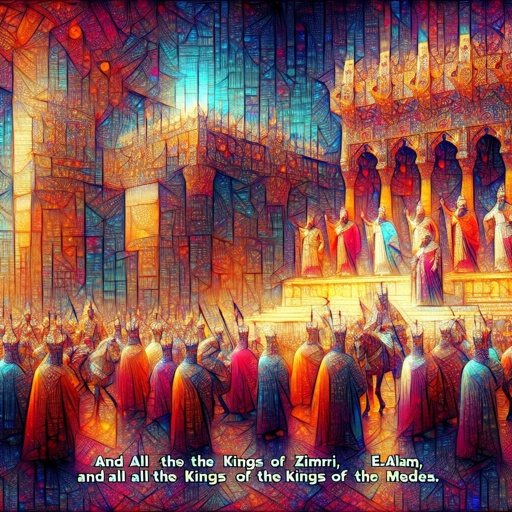
Jeremiah 25:25 - "And all the kings of Zimri, and all the kings of Elam, and all the kings of the Medes,"

"And the city was besieged unto the eleventh year of king Zedekiah." - 2 Kings 25:2

2 Kings 25:3 - "And on the ninth day of the fourth month the famine prevailed in the city, and there was no bread for the people of the land."

2 Kings 25:1 - "And it came to pass in the ninth year of his reign, in the tenth month, in the tenth day of the month, that Nebuchadnezzar king of Babylon came, he, and all his host, against Jerusalem, and pitched against it; and they built forts against it round about."

2 Kings 25:6 - "So they took the king, and brought him up to the king of Babylon to Riblah; and they gave judgment upon him."

2 Kings 25:14 - "And the pots, and the shovels, and the snuffers, and the spoons, and all the vessels of brass wherewith they ministered, took they away."

1 Kings 3:25 - "And the king said, Divide the living child in two, and give half to the one, and half to the other."

"And he went from thence to mount Carmel, and from thence he returned to Samaria." - 2 Kings 2:25

2 Kings 25:10 - "And all the army of the Chaldees, that were with the captain of the guard, brake down the walls of Jerusalem round about."

2 Kings 25:18 - "¶ And the captain of the guard took Seraiah the chief priest, and Zephaniah the second priest, and the three keepers of the door:"

2 Chronicles 25:26 - "Now the rest of the acts of Amaziah, first and last, behold, are they not written in the book of the kings of Judah and Israel?"

2 Kings 25:15 - "And the firepans, and the bowls, and such things as were of gold, in gold, and of silver, in silver, the captain of the guard took away."

Jehoiachin is released from Babylonian jail 2 kings 25: 27

1 Kings 14:25 - "¶ And it came to pass in the fifth year of king Rehoboam, that Shishak king of Egypt came up against Jerusalem:"

2 Kings 8:25 - "¶ In the twelfth year of Joram the son of Ahab king of Israel did Ahaziah the son of Jehoram king of Judah begin to reign."

1 Kings 6:25 - "And the other cherub was ten cubits: both the cherubims were of one measure and one size."

2 Kings 25:26 - "And all the people, both small and great, and the captains of the armies, arose, and came to Egypt: for they were afraid of the Chaldees."

2 Kings 25:30 - "And his allowance was a continual allowance given him of the king, a daily rate for every day, all the days of his life."

2 Kings 25:25 - "But it came to pass in the seventh month, that Ishmael the son of Nethaniah, the son of Elishama, of the seed royal, came, and ten men with him, and smote Gedaliah, that he died, and the Jews and the Chaldees that were with him at Mizpah."