What does 1 Kings 12:12 mean?
"¶ So Jeroboam and all the people came to Rehoboam the third day, as the king had appointed, saying, Come to me again the third day." - 1 Kings 12:12
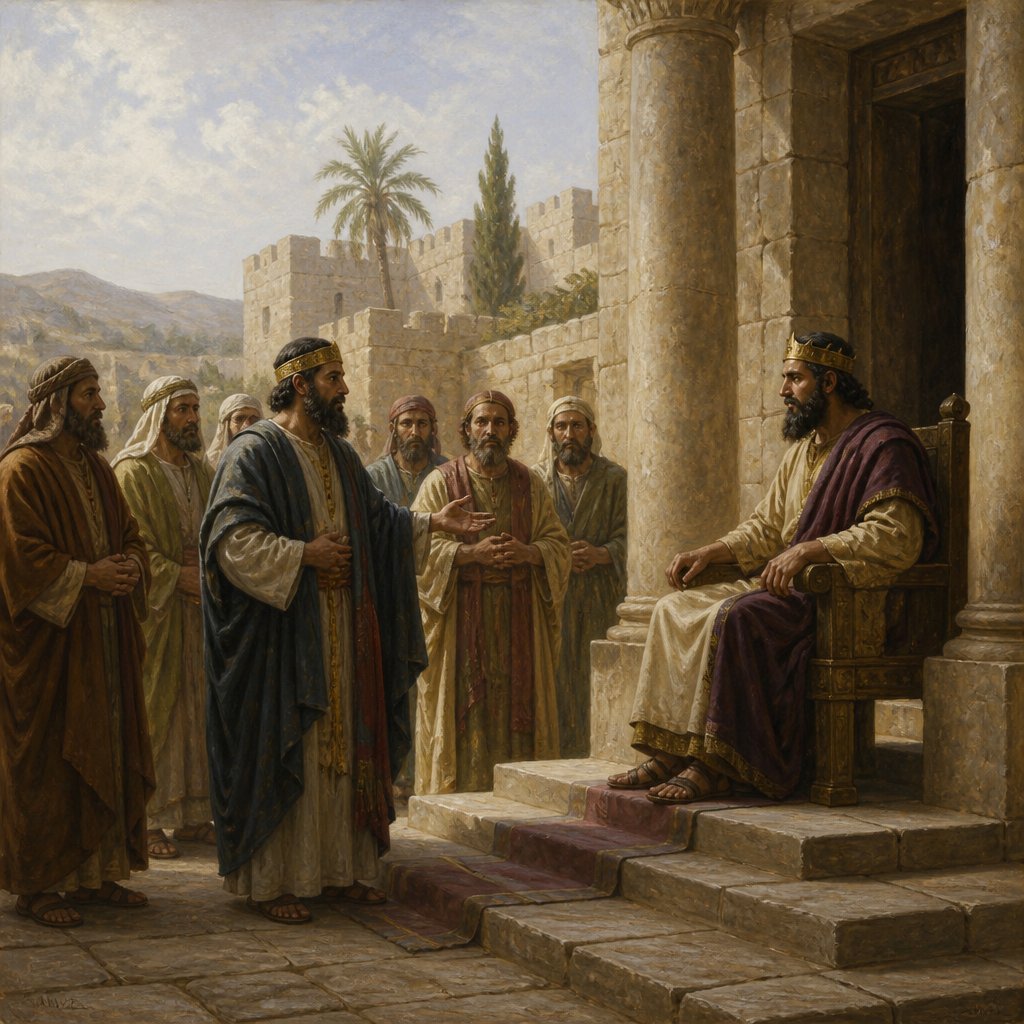
1 Kings 12:12 (KJV) speaks to a pivotal moment in the history of Israel. This verse is part of a larger narrative in which the newly crowned king Rehoboam faces a crisis that threatens to divide the kingdom. The verse reads:
“So Jeroboam and all the people came to Rehoboam the third day, as the king had appointed, saying, Come to me again the third day.”
To truly understand the significance of this verse, it is necessary to examine the context in which it occurs. King Solomon, Rehoboam's father, had ruled Israel with great wisdom and success. However, during his reign, he heavily taxed the people and conscripted them into forced labor to build the grand projects that were to exemplify his glorious reign. These policies were resented by the people, who yearned for relief from the heavy burdens placed upon them.
After King Solomon's death, the people approached his son Rehoboam, who had just ascended to the throne, and pleaded for relief from the heavy taxes and labor demands that had been placed upon them. In response, Rehoboam consulted with the elders who had served his father, and also with the younger advisors who had grown up with him. The older advisors counselled Rehoboam to show compassion and humility, and to ease the burden on the people. However, the younger advisors encouraged Rehoboam to lead with an even heavier hand, promising to make the people serve him even more harshly. This internal conflict and Rehoboam’s subsequent response would profoundly impact the fate of the kingdom.
Rehoboam chooses to follow the advice of his young friends, and he responds to the people harshly, as recorded in 1 Kings 12:12. Rehoboam's response reflects his arrogance and lack of concern for the welfare of his subjects. This critical decision results in the ten northern tribes of Israel breaking away from Rehoboam's rule, establishing their own kingdom under Jeroboam. This event marks the beginning of the division of the once unified kingdom of Israel into the northern kingdom of Israel and the southern kingdom of Judah.
This verse reflects themes of leadership, wisdom, and the consequences of one’s actions. Rehoboam's decision to turn away from the counsel of the older, wiser advisors reveals a lack of understanding and humility that ultimately leads to the fracture of the kingdom. It serves as a cautionary tale about the destructive power of pride and the importance of seeking wise counsel when making important decisions.
Symbolically, the division of the kingdom serves as a metaphor for the consequences of arrogance and the impact of leadership on a nation. Rehoboam's refusal to heed the advice of the elders symbolizes the dangers of arrogance and the pitfalls of pride. The division of the kingdom represents the consequences of flawed leadership and the ripple effects of one's actions.
The story of Rehoboam's response to the people also carries broader implications for leadership and governance. This episode serves as a warning about the dangers of oppressive rule and the importance of leaders serving the best interest of their people. It underscores the need for leaders to listen to the concerns of those they govern and to exercise wisdom and compassion in their decision-making.
In conclusion, 1 Kings 12:12 is an integral part of a cautionary tale about the consequences of pride and the impact of leadership decisions. The verse serves as a powerful reminder of the importance of humility, wisdom, and compassion in governance. It also highlights the profound implications of one's actions on both personal and national levels. As such, it continues to resonate as a poignant and timeless lesson for leaders and individuals alike.
Have questions about 1 Kings 12:12?
Dive deeper into this scripture with Bible Chat — an AI-powered tool for exploring God's Word through conversation. Ask questions, get context, and grow in your understanding of the Bible.
Get Our Apps


1 Kings 12:12 Artwork

1 Kings 12:12 - "¶ So Jeroboam and all the people came to Rehoboam the third day, as the king had appointed, saying, Come to me again the third day."
"¶ So Jeroboam and all the people came to Rehoboam the third day, as the king had appointed, saying, Come to me again the third day." - 1 Kings 12:12

1 Kings 12:11

1 Kings 12:11

1 Kings 12:10

1 Kings 12:10

1 kings 3:12

1 Kings 12:10

1 Kings 12:11

1 Kings 12:10
1 Kings 12:11

1 Kings 12:14

1 Kings 12:14

1 Kings 12:11

1 Kings 12:1 - "And Rehoboam went to Shechem: for all Israel were come to Shechem to make him king."

1 Kings 21:12 - "They proclaimed a fast, and set Naboth on high among the people."

1 Kings 12:19 - "So Israel rebelled against the house of David unto this day."

1 Kings 12:22 - "But the word of God came unto Shemaiah the man of God, saying,"

1 Kings 12:13 - "And the king answered the people roughly, and forsook the old men's counsel that they gave him;"

1 Kings 12:29 - "And he set the one in Beth-el, and the other put he in Dan."

1 Kings 8:12 - "¶ Then spake Solomon, The LORD said that he would dwell in the thick darkness."

1 Kings 19:12 - "And after the earthquake a fire; but the LORD was not in the fire: and after the fire a still small voice."

1 Kings 12:17 - "But as for the children of Israel which dwelt in the cities of Judah, Rehoboam reigned over them."

1 Kings 12:26 - "And Jeroboam said in his heart, Now shall the kingdom return to the house of David:"

1 Kings 2:12 - "¶ Then sat Solomon upon the throne of David his father; and his kingdom was established greatly."

1 Kings 12:30 - "And this thing became a sin: for the people went to worship before the one, even unto Dan."

1 Kings 12:3 - "That they sent and called him. And Jeroboam and all the congregation of Israel came, and spake unto Rehoboam, saying,"

1 Kings 15:12 - "And he took away the sodomites out of the land, and removed all the idols that his fathers had made."

1 Kings 12:31 - "And he made an house of high places, and made priests of the lowest of the people, which were not of the sons of Levi."

1 Kings 12:25 - "¶ Then Jeroboam built Shechem in mount Ephraim, and dwelt therein; and went out from thence, and built Penuel."