What does 1 Chronicles 6:56 mean?
"But the fields of the city, and the villages thereof, they gave to Caleb the son of Jephunneh." - 1 Chronicles 6:56
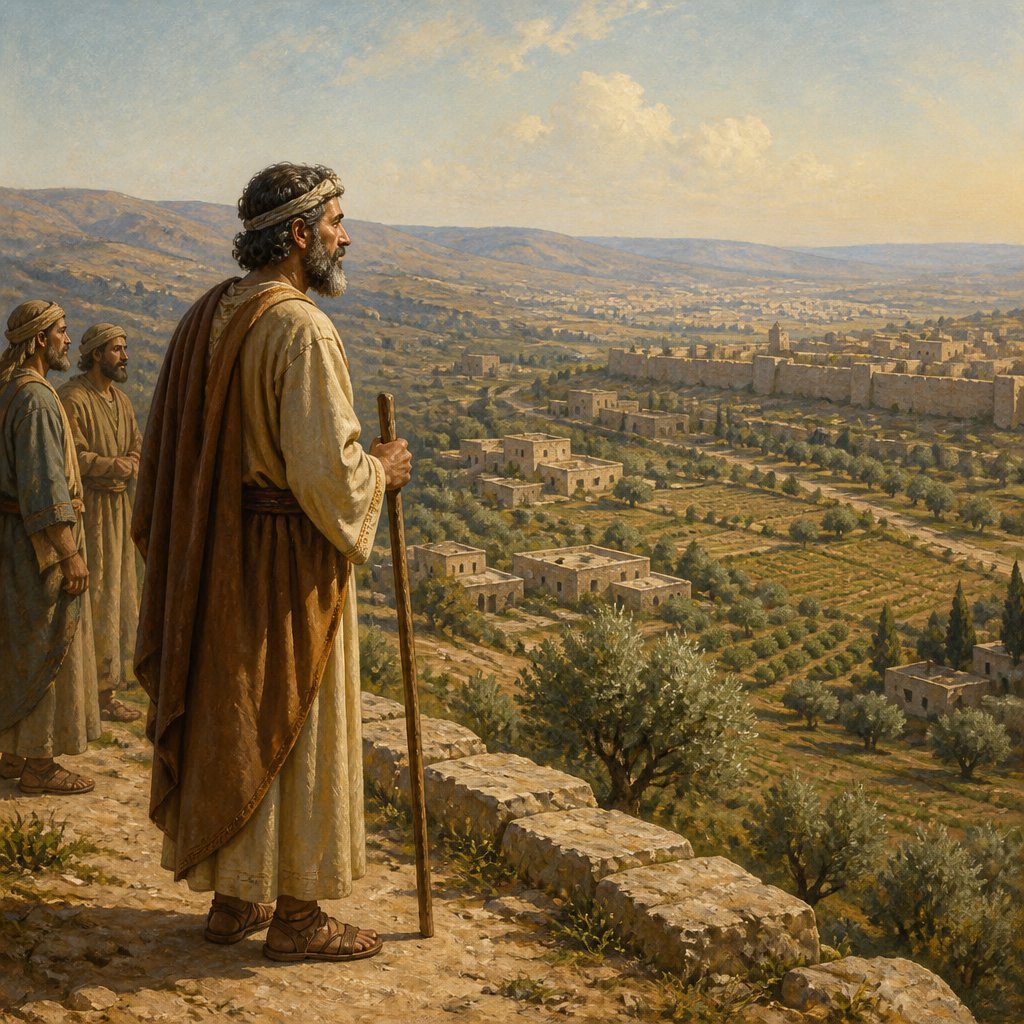
1 Chronicles 6:56 (KJV) states, "But the fields of the city, and the villages thereof, they gave to Caleb the son of Jephunneh."
This verse is found within the Old Testament, specifically in the book of 1 Chronicles, which is a historical account of the lineage and history of the Israelites, from Adam to the time of David. The specific verse here is part of a longer passage describing the territory given to the tribe of Levi, who were the designated priests and caretakers of the tabernacle and later the temple.
One of the significant themes in this verse is the concept of inheritances and the importance of land in the ancient Israelite culture. The allocation of land was closely tied to their identity and prosperity as a community. Here, we see the city and villages being given to Caleb, who was from the tribe of Judah. Additionally, Caleb is also a prominent figure in the Old Testament, known for his bravery and faith in God during the conquest of Canaan.
Contextually, this verse is situated within a larger narrative of the division of the land among the tribes of Israel, as outlined in the book of Joshua. This inheritance was a fulfillment of the promise that God had made to the Israelites to give them the land of Canaan. Each tribe received its portion, and the Levites, being the priestly class, were not given a traditional inheritance of land; instead, they were given cities from the other tribes for their dwelling and sustenance.
Symbolically, the giving of fields and villages to Caleb represents the fulfillment of God's promises to his people, as specified in the book of Deuteronomy. It signifies not only the physical possession of the land but also the spiritual inheritance and blessings that God bestows upon those who are faithful and obedient to Him. Caleb, in particular, is an embodiment of unwavering faith and the perseverance of God's chosen people.
Furthermore, this verse also reflects the idea of God's faithfulness and the importance of honoring His covenant. The land was considered a precious gift from God, and the allocation of land to each tribe was a reflection of God's grace and provision. It is a reminder to the Israelites, and to modern-day readers, of the significance of staying true to their faith and acknowledging God's role as the ultimate provider and sustainer.
In the broader theological context, the verse also serves as a precursor to the coming of Jesus Christ, who is often referred to as the ultimate inheritance for believers. The land given to the Israelites can be seen as a foreshadowing of the spiritual inheritance that is promised to all who believe in God, as mentioned in the New Testament.
In conclusion, 1 Chronicles 6:56, in its historical and cultural context, serves as a testament to God's faithfulness in fulfilling His promises. It also highlights the concept of inheritance and the importance of remaining steadfast in faith. Symbolically, it points to the spiritual legacy that is available to all who faithfully follow God. This verse, like many others in the Bible, offers a rich and significant message that resonates across time and culture.
Have questions about 1 Chronicles 6:56?
Dive deeper into this scripture with Bible Chat — an AI-powered tool for exploring God's Word through conversation. Ask questions, get context, and grow in your understanding of the Bible.
Get Our Apps


1 Chronicles 6:56 Artwork

1 Chronicles 6:56 - "But the fields of the city, and the villages thereof, they gave to Caleb the son of Jephunneh."
"But the fields of the city, and the villages thereof, they gave to Caleb the son of Jephunneh." - 1 Chronicles 6:56

Isaiah 56:3-5

John 6:56 - "He that eateth my flesh, and drinketh my blood, dwelleth in me, and I in him."

Psalms 56:6 - "They gather themselves together, they hide themselves, they mark my steps, when they wait for my soul."

1 Chronicles 6:6 - "And Uzzi begat Zerahiah, and Zerahiah begat Meraioth,"

1 Chronicles 1:6 - "And the sons of Gomer; Ashchenaz, and Riphath, and Togarmah."

1 Chronicles 6:1 - "The sons of Levi; Gershon, Kohath, and Merari."

1 Chronicles 14:6 - "And Nogah, and Nepheg, and Japhia,"

1 Corinthians 15:56 - "The sting of death is sin; and the strength of sin is the law."

1 Chronicles 3:6 - "Ibhar also, and Elishama, and Eliphelet,"

1 Chronicles 6:25 - "And the sons of Elkanah; Amasai, and Ahimoth."

1 Samuel 17:56 - "And the king said, Enquire thou whose son the stripling is."

1 Chronicles 6:16 - "¶ The sons of Levi; Gershom, Kohath, and Merari."

1 Chronicles 6:17 - "And these be the names of the sons of Gershom; Libni, and Shimei."

1 Chronicles 6:28 - "And the sons of Samuel; the firstborn Vashni, and Abiah."

1 Chronicles 6:58 - "And Hilen with her suburbs, Debir with her suburbs,"

1 Chronicles 6:12 - "And Ahitub begat Zadok, and Zadok begat Shallum,"

1 Chronicles 6:45 - "The son of Hashabiah, the son of Amaziah, the son of Hilkiah,"

1 Chronicles 6:11 - "And Azariah begat Amariah, and Amariah begat Ahitub,"

1 Chronicles 6:14 - "And Azariah begat Seraiah, and Seraiah begat Jehozadak,"

1 Chronicles 7:6 - "¶ The sons of Benjamin; Bela, and Becher, and Jediael, three."

1 Chronicles 6:53 - "Zadok his son, Ahimaaz his son."

1 Chronicles 6:5 - "And Abishua begat Bukki, and Bukki begat Uzzi,"

1 Chronicles 6:9 - "And Ahimaaz begat Azariah, and Azariah begat Johanan,"

1 Chronicles 6:41 - "The son of Ethni, the son of Zerah, the son of Adaiah,"

1 Chronicles 6:40 - "The son of Michael, the son of Baaseiah, the son of Malchiah,"

1 Chronicles 12:6 - "Elkanah, and Jesiah, and Azareel, and Joezer, and Jashobeam, the Korhites,"

1 Chronicles 6:8 - "And Ahitub begat Zadok, and Zadok begat Ahimaaz,"

1 Chronicles 6:7 - "Meraioth begat Amariah, and Amariah begat Ahitub,"