What does 1 Chronicles 22:11 mean?
"Now, my son, the LORD be with thee; and prosper thou, and build the house of the LORD thy God, as he hath said of thee." - 1 Chronicles 22:11
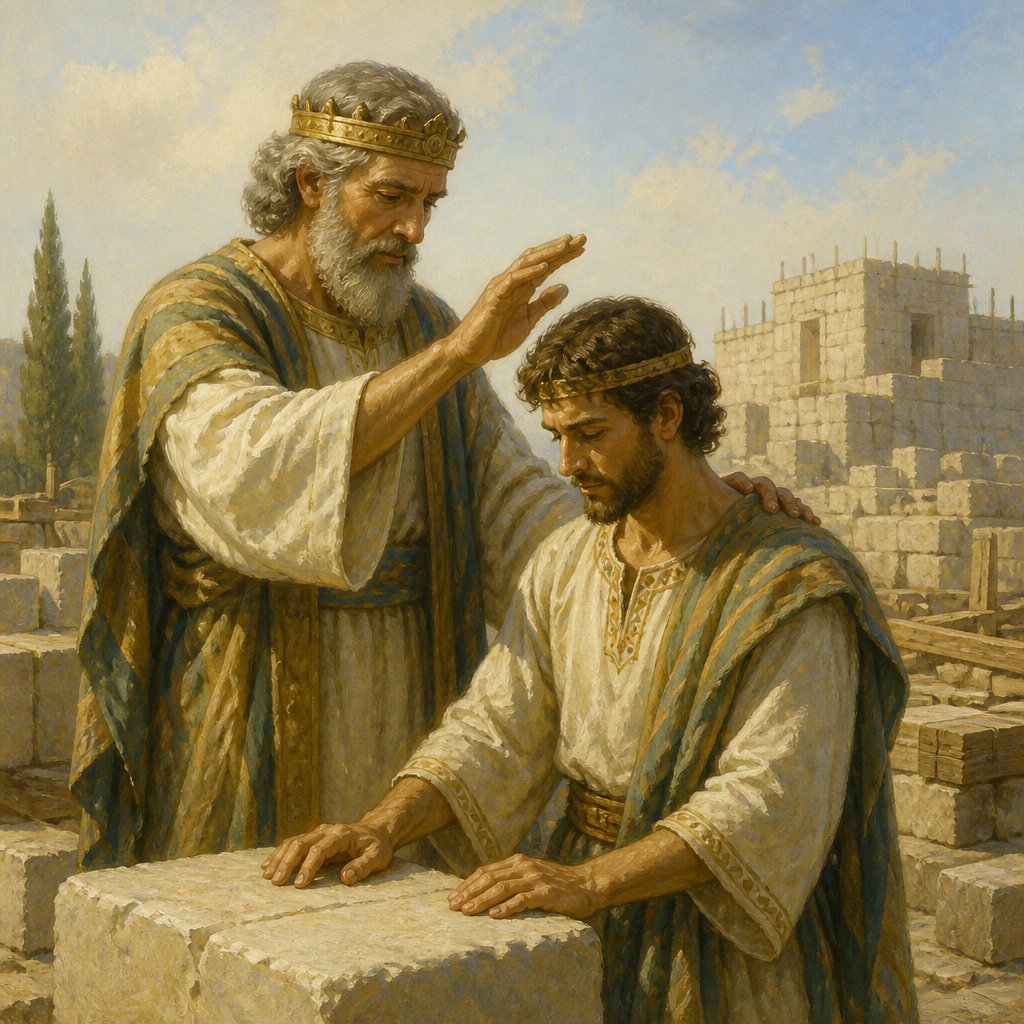
1 Chronicles 22:11 (KJV) declares: "Now, my son, the Lord be with thee; and prosper thou, and build the house of the Lord thy God, as he hath said of thee."
This verse is part of a larger passage in which King David, near the end of his life, is preparing his son Solomon to take the throne and build the temple of the Lord. David had desired to build the temple himself, but God had instructed him that this task would be carried out by his son Solomon. In this verse, David is giving Solomon his blessing and encouragement for the monumental task that lies ahead of him.
The themes of this verse encompass the passing of the baton from one generation to the next, the fulfillment of God's promises, and the importance of building a place of worship for the Lord. It encapsulates the idea of succession and the transfer of responsibility and authority from one leader to another, highlighting the continuation of God's work through the obedience and faithfulness of His servants.
The context of this verse is crucial to understanding its significance. Throughout the Old Testament, the temple is a central symbol of God's presence among His people. It is a place of worship, sacrifice, and encounter with the divine. The temple represents the covenant relationship between God and His chosen people, and its construction was a pivotal moment in Israel's history. The building of the temple signified the establishment of a permanent dwelling place for God and a center for the Israelite community to gather in worship.
David's words to Solomon convey a deep trust in God's plan and an unwavering belief in His promises. David acknowledges that it is the Lord who will be with Solomon and grant him success in the monumental task of building the temple. This reflects the understanding that all human accomplishments are ultimately dependent on God's favor and blessing. By exhorting Solomon to build the house of the Lord as God had said of him, David emphasizes the importance of aligning one's actions with God's will and purpose.
Symbolically, this verse represents the transmission of spiritual authority and the continuation of God's work through successive generations. It serves as a reminder of the faithfulness of God in fulfilling His promises and the responsibility of His people to honor Him in their actions. The temple, as a physical structure, also symbolizes the spiritual dwelling place of God in the hearts of believers. This verse speaks to the importance of creating spaces for worship and encounter with God, both physically and spiritually.
In a broader theological sense, this verse points to the anticipation of the ultimate fulfillment of God's promises through the coming of Jesus Christ. The temple, as a central institution in Israelite religion, foreshadows the incarnation of Christ as the true dwelling place of God among humanity. This verse echoes the expectation of the Messiah who would establish a new covenant and build a spiritual temple not made with human hands.
In conclusion, 1 Chronicles 22:11 from the King James Version carries profound significance in its themes of succession, divine promises, and the construction of the temple. Its context within the larger narrative of Israelite history underscores its importance in the establishment of God's presence among His people. Symbolically, it represents the passing of spiritual authority and the expectation of God's ultimate fulfillment of His promises through His Son. This verse continues to inspire believers to align themselves with God's will and to participate in the building of His kingdom.
Have questions about 1 Chronicles 22:11?
Dive deeper into this scripture with Bible Chat — an AI-powered tool for exploring God's Word through conversation. Ask questions, get context, and grow in your understanding of the Bible.
Get Our Apps


1 Chronicles 22:11 Artwork

1 Chronicles 22:11 - "Now, my son, the LORD be with thee; and prosper thou, and build the house of the LORD thy God, as he hath said of thee."
"Now, my son, the LORD be with thee; and prosper thou, and build the house of the LORD thy God, as he hath said of thee." - 1 Chronicles 22:11

1 Chronicles 1:22 - "And Ebal, and Abimael, and Sheba,"

2 Chronicles 4:22

1 Chronicles 11:22 - "Benaiah the son of Jehoiada, the son of a valiant man of Kabzeel, who had done many acts; he slew two lionlike men of Moab: also he went down and slew a lion in a pit in a snowy day."

1 Chronicles 8:22 - "And Ishpan, and Heber, and Eliel,"

1 Chronicles 24:22 - "Of the Izharites; Shelomoth: of the sons of Shelomoth; Jahath."

1 Chronicles 22:1 - "Then David said, This is the house of the LORD God, and this is the altar of the burnt offering for Israel."

2 Chronicles 11:22 - "And Rehoboam made Abijah the son of Maachah the chief, to be ruler among his brethren: for he thought to make him king."

"And Ebal, and Abimael, and Sheba," - 1 Chronicles 1:22

1 Chronicles 1:11 - "And Mizraim begat Ludim, and Anamim, and Lehabim, and Naphtuhim,"

1 Chronicles 11:29 - "Sibbecai the Hushathite, Ilai the Ahohite,"

1 Chronicles 12:11 - "Attai the sixth, Eliel the seventh,"

1 Chronicles 24:11 - "The ninth to Jeshua, the tenth to Shecaniah,"

1 Chronicles 11:40 - "Ira the Ithrite, Gareb the Ithrite,"

1 Chronicles 11:27 - "Shammoth the Harorite, Helez the Pelonite,"

1 Chronicles 11:36 - "Hepher the Mecherathite, Ahijah the Pelonite,"

1 Samuel 22:11-13

1 Chronicles 11:47 - "Eliel, and Obed, and Jasiel the Mesobaite."

1 Chronicles 11:33 - "Azmaveth the Baharumite, Eliahba the Shaalbonite,"

1 Chronicles 16:22 - "Saying, Touch not mine anointed, and do my prophets no harm."

1 Chronicles 27:22 - "Of Dan, Azareel the son of Jeroham. These were the princes of the tribes of Israel."

1 Chronicles 8:11 - "And of Hushim he begat Abitub, and Elpaal."

1 Chronicles 11:43 - "Hanan the son of Maachah, and Joshaphat the Mithnite,"

1 Chronicles 11:32 - "Hurai of the brooks of Gaash, Abiel the Arbathite,"

1 Chronicles 11:41 - "Uriah the Hittite, Zabad the son of Ahlai,"

1 Chronicles 11:37 - "Hezro the Carmelite, Naarai the son of Ezbai,"

1 Chronicles 22:17 - "¶ David also commanded all the princes of Israel to help Solomon his son, saying,"

1 Chronicles 25:22 - "The fifteenth to Jeremoth, he, his sons, and his brethren, were twelve:"

"And Ishpan, and Heber, and Eliel," - 1 Chronicles 8:22