What does 1 Chronicles 1:9 mean?
"And the sons of Cush; Seba, and Havilah, and Sabta, and Raamah, and Sabtecha. And the sons of Raamah; Sheba, and Dedan." - 1 Chronicles 1:9
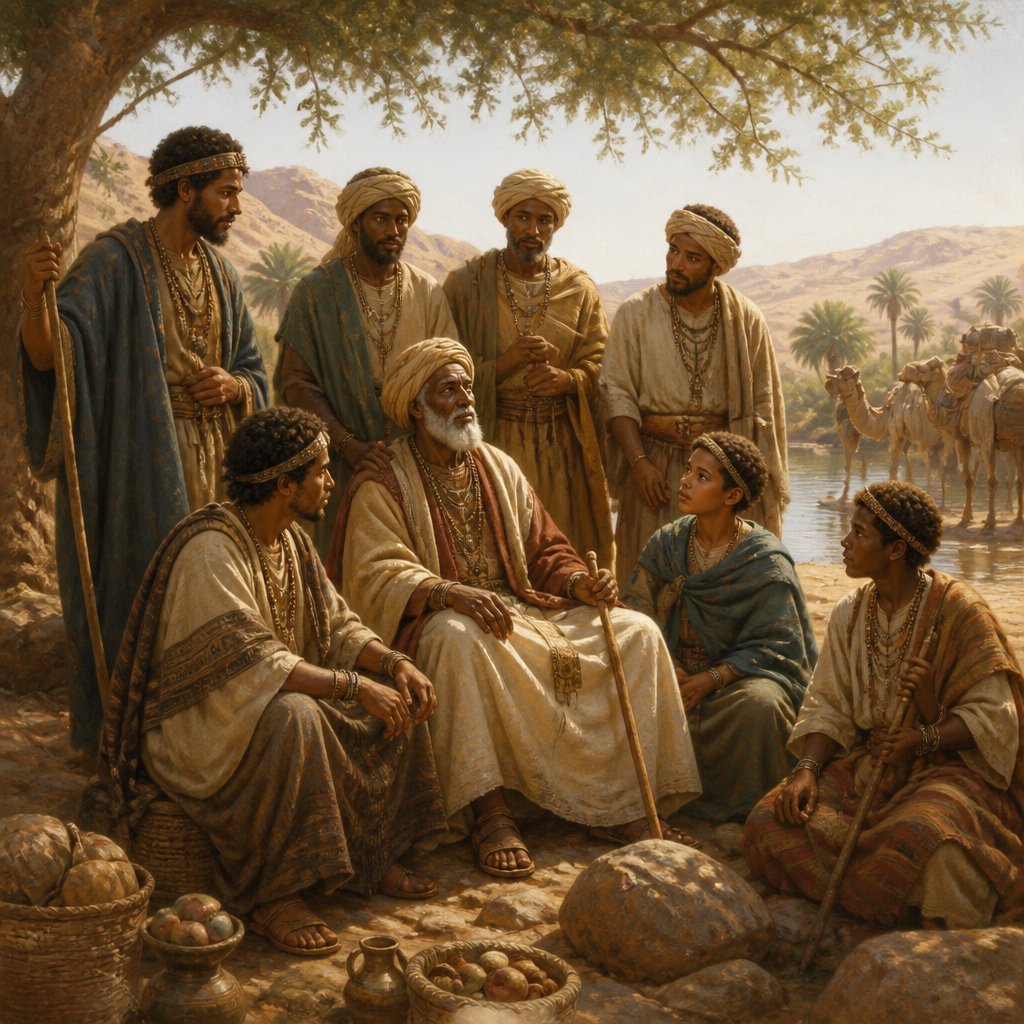
1 Chronicles 1:9 (KJV) reads, "And the sons of Cush; Seba, and Havilah, and Sabta, and Raamah, and Sabtecha. And the sons of Raamah; Sheba, and Dedan."
1 Chronicles 1:1-8 is a genealogy tracing the descendants of Adam through Noah's son Shem. The listing of the descendants continues in verse 9 with the sons of Cush. This passage is part of the introduction to the book of 1 Chronicles, which is a historical record that focuses on the lineage of King David and the kings of Judah. The book serves as a link between the history found in Genesis through 2 Kings and the fulfillment of God's promises in the New Testament.
The lineage of Cush, the son of Ham and grandson of Noah, is significant as it connects to the broader theme of God's faithfulness in preserving and fulfilling His promises. It also plays a role in demonstrating God's plan for redemption through His chosen people.
The mention of Seba, Havilah, Sabta, Raamah, Sabteca, Sheba, and Dedan in this verse holds deeper symbolism and meaning. These names not only represent actual descendants of Cush but also have symbolic significance in the broader biblical narrative.
Seba is often associated with the region of modern-day Ethiopia and is mentioned in Psalms 72:10 as a place bringing tribute to King Solomon. This could be seen as a foreshadowing of the inclusion of the Gentiles in the kingdom of God.
Havilah is identified in the Bible as a region known for its abundance of gold, bdellium, and onyx stones (Genesis 2:11-12). This portrayal of Havilah as a place of great wealth and blessing can be seen as a foreshadowing of the promised land and the abundance that God has in store for His people.
Sabta and Sabteca are not further mentioned in the Bible, but they are believed to represent peoples or regions that were significant in the ancient world.
Raamah is associated with the region of modern-day Yemen and is mentioned in Ezekiel 27:22 in reference to trade and commerce. This could be seen as a message of the global reach of God's plan for salvation and the inclusion of all nations in His redemptive work.
Sheba and Dedan are also mentioned in Ezekiel 27:22 in connection with trade and commerce. Additionally, the queen of Sheba is referenced in 1 Kings 10, where she visits King Solomon to test his wisdom. This story can be interpreted as a foreshadowing of the nations coming to seek and acknowledge the wisdom and glory of God.
The genealogy of Cush's descendants not only serves as a historical record but also carries spiritual significance. It points to the fulfillment of God's promise to Abraham that all the nations of the earth would be blessed through his offspring (Genesis 22:18). It also underscores the universal scope of God's redemptive plan, encompassing all peoples and nations.
In conclusion, 1 Chronicles 1:9, while appearing as a simple genealogical list, holds deep symbolic meaning and spiritual significance. It underscores the universal scope of God's redemptive plan and the inclusivity of His blessings to all peoples and nations. This verse serves as a reminder of God's faithfulness in preserving and fulfilling His promises, as well as His plan for the redemption of humanity through His chosen people.
Have questions about 1 Chronicles 1:9?
Dive deeper into this scripture with Bible Chat — an AI-powered tool for exploring God's Word through conversation. Ask questions, get context, and grow in your understanding of the Bible.
Get Our Apps


1 Chronicles 1:9 Artwork

1 Chronicles 1:9 - "And the sons of Cush; Seba, and Havilah, and Sabta, and Raamah, and Sabtecha. And the sons of Raamah; Sheba, and Dedan."
"And the sons of Cush; Seba, and Havilah, and Sabta, and Raamah, and Sabtecha. And the sons of Raamah; Sheba, and Dedan." - 1 Chronicles 1:9

1 Chronicles 9:37 - "And Gedor, and Ahio, and Zechariah, and Mikloth."

1 Chronicles 9:10 - "¶ And of the priests; Jedaiah, and Jehoiarib, and Jachin,"

1 Chronicles 24:9 - "The fifth to Malchijah, the sixth to Mijamin,"

1 Chronicles 9:5 - "And of the Shilonites; Asaiah the firstborn, and his sons."

1 Chronicles 9:30 - "And some of the sons of the priests made the ointment of the spices."

1 Chronicles 6:9 - "And Ahimaaz begat Azariah, and Azariah begat Johanan,"

1 Chronicles 12:9 - "Ezer the first, Obadiah the second, Eliab the third,"

1 Chronicles 14:9 - "And the Philistines came and spread themselves in the valley of Rephaim."

1 Chronicles 26:9 - "And Meshelemiah had sons and brethren, strong men, eighteen."

1 Chronicles 9:41 - "And the sons of Micah were, Pithon, and Melech, and Tahrea, and Ahaz."

1 Chronicles 21:9 - "¶ And the LORD spake unto Gad, David's seer, saying,"

1 Chronicles 9:6 - "And of the sons of Zerah; Jeuel, and their brethren, six hundred and ninety."

1 Chronicles 15:9 - "Of the sons of Hebron; Eliel the chief, and his brethren fourscore:"

1 Chronicles 9:21 - "And Zechariah the son of Meshelemiah was porter of the door of the tabernacle of the congregation."

1 Chronicles 9:40 - "And the son of Jonathan was Merib-baal: and Merib-baal begat Micah."

1 Chronicles 11:9 - "So David waxed greater and greater: for the LORD of hosts was with him."

1 Chronicles 9:9 - "And their brethren, according to their generations, nine hundred and fifty and six. All these men were chief of the fathers in the house of their fathers."

1 Chronicles 8:9 - "And he begat of Hodesh his wife, Jobab, and Zibia, and Mesha, and Malcham,"

1 Chronicles 9:34 - "These chief fathers of the Levites were chief throughout their generations; these dwelt at Jerusalem."

1 Chronicles 9:24 - "In four quarters were the porters, toward the east, west, north, and south."

1 Chronicles 9:36 - "And his firstborn son Abdon, then Zur, and Kish, and Baal, and Ner, and Nadab,"

1 Chronicles 3:9 - "These were all the sons of David, beside the sons of the concubines, and Tamar their sister."

1 Chronicles 9:35 - "¶ And in Gibeon dwelt the father of Gibeon, Jehiel, whose wife's name was Maachah:"

1 Chronicles 9:17 - "And the porters were, Shallum, and Akkub, and Talmon, and Ahiman, and their brethren: Shallum was the chief;"

1 Chronicles 9:7 - "And of the sons of Benjamin; Sallu the son of Meshullam, the son of Hodaviah, the son of Hasenuah,"

1 Chronicles 9:3 - "And in Jerusalem dwelt of the children of Judah, and of the children of Benjamin, and of the children of Ephraim, and Manasseh;"

1 Chronicles 9:14 - "And of the Levites; Shemaiah the son of Hasshub, the son of Azrikam, the son of Hashabiah, of the sons of Merari;"

1 Chronicles 9:32 - "And other of their brethren, of the sons of the Kohathites, were over the shewbread, to prepare it every sabbath."