What does 1 Chronicles 1:46 mean?
"And when Husham was dead, Hadad the son of Bedad, which smote Midian in the field of Moab, reigned in his stead: and the name of his city was Avith." - 1 Chronicles 1:46
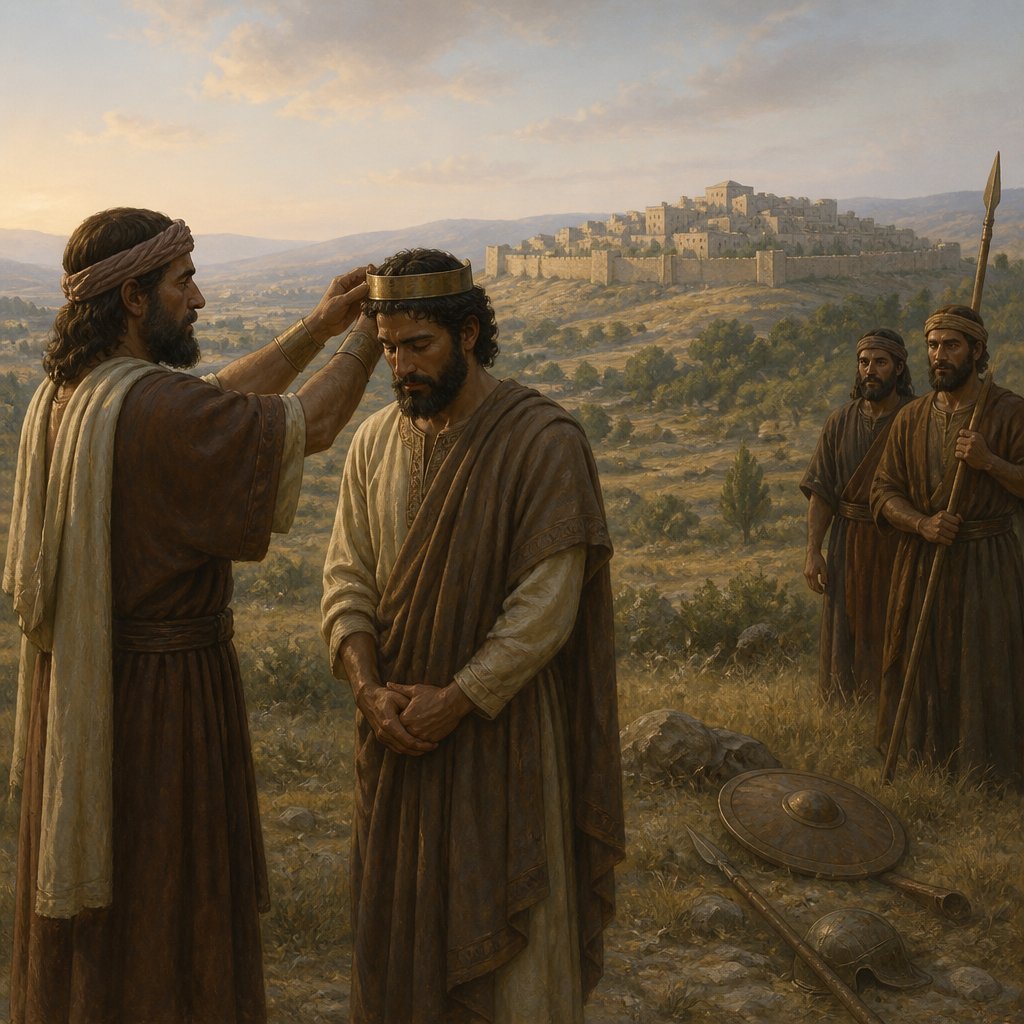
1 Chronicles 1:46 (KJV) reads: "And when Hushim was dead, Hadad the son of Bedad, which smote Midian in the field of Moab, reigned in his stead: and the name of his city was Avith."
This verse is part of a genealogy that traces the descendants of Adam through to the time of King David. As we examine this verse, we can uncover several themes, contexts, and symbols that are present.
First, let's explore the theme of lineage and succession. The book of 1 Chronicles is known for its detailed genealogies, which serve to establish the continuity of God's people from the time of creation to the time of David. In this verse, we see the theme of succession as Hadad takes over rulership after the death of Hushim. This theme of passing on leadership and authority from one generation to the next is a significant aspect of the biblical narrative, as it emphasizes the importance of preserving the covenant and promises of God through continued lineage.
Another theme present in this verse is that of conquest and power. The mention of Hadad, the son of Bedad, who "smote Midian in the field of Moab," indicates a shift in power and authority within the region. This is significant because it highlights the geopolitical context of the ancient Near East, where kingdoms and nations vied for control and dominance. It also points to the idea of God's sovereignty, as he uses individuals and nations to fulfill his purposes and bring about his plans.
The city of Avith is also mentioned in this verse, and it serves as a symbol of identity and heritage. Cities in the ancient world were not just centers of population and commerce, but they also represented the collective identity and history of a people. The naming of Avith underscores the importance of place and belonging, as it signifies the establishment of a kingdom and the presence of a community with its own customs and traditions.
Moreover, the mention of Midian and Moab in this verse contextualizes the narrative within the broader biblical landscape. These were well-known territories in the ancient Near East, and they are also mentioned in other parts of the Bible, particularly in the narratives of the Exodus and the wilderness wanderings of the Israelites. By referencing these locations, the verse establishes a connection to larger biblical events and themes, such as God's deliverance and judgment upon the nations.
In conclusion, 1 Chronicles 1:46 (KJV) may appear as a brief and somewhat obscure verse within the larger genealogy of 1 Chronicles. However, upon deeper examination, we find that it is rich with themes, context, and symbolism that are integral to the biblical narrative. It speaks to the themes of lineage and succession, conquest and power, and the importance of place and belonging. Furthermore, its references to specific territories tie it to the broader biblical landscape, connecting it to the larger story of God's redemptive work in the world. As we delve into this verse, we gain a deeper understanding of the intricate tapestry of God's unfolding plan throughout history.
Have questions about 1 Chronicles 1:46?
Dive deeper into this scripture with Bible Chat — an AI-powered tool for exploring God's Word through conversation. Ask questions, get context, and grow in your understanding of the Bible.
Get Our Apps


1 Chronicles 1:46 Artwork

1 Chronicles 1:46 - "And when Husham was dead, Hadad the son of Bedad, which smote Midian in the field of Moab, reigned in his stead: and the name of his city was Avith."
"And when Husham was dead, Hadad the son of Bedad, which smote Midian in the field of Moab, reigned in his stead: and the name of his city was Avith." - 1 Chronicles 1:46

1 Chronicles 6:46 - "The son of Amzi, the son of Bani, the son of Shamer,"

1 Chronicles 11:46 - "Eliel the Mahavite, and Jeribai, and Joshaviah, the sons of Elnaam, and Ithmah the Moabite,"

1 Chronicles 2:46 - "And Ephah, Caleb's concubine, bare Haran, and Moza, and Gazez: and Haran begat Gazez."
"The son of Amzi, the son of Bani, the son of Shamer," - 1 Chronicles 6:46
"Eliel the Mahavite, and Jeribai, and Joshaviah, the sons of Elnaam, and Ithmah the Moabite," - 1 Chronicles 11:46
"And Ephah, Caleb's concubine, bare Haran, and Moza, and Gazez: and Haran begat Gazez." - 1 Chronicles 2:46

1 Kings 1:46 - "And also Solomon sitteth on the throne of the kingdom."

acts 10:44-46

Jeremiah 46:1 - "The word of the LORD which came to Jeremiah the prophet against the Gentiles;"

God is within her she will not fall Psalm 46:5

"And also Solomon sitteth on the throne of the kingdom." - 1 Kings 1:46

Luke 1:46 - "And Mary said, My soul doth magnify the Lord,"

1 Corinthians 15:46 - "Howbeit that was not first which is spiritual, but that which is natural; and afterward that which is spiritual."

1 Chronicles 1:15

1 Chronicles 1:15

Psalms 46:1 - "God is our refuge and strength, a very present help in trouble."

Deuteronomy 1:46 - "So ye abode in Kadesh many days, according unto the days that ye abode there."

1 Kings 7:46 - "In the plain of Jordan did the king cast them, in the clay ground between Succoth and Zarthan."

1 Chronicles 1:1 - "Adam, Sheth, Enosh,"

Numbers 1:46 - "Even all they that were numbered were six hundred thousand and three thousand and five hundred and fifty."

1 Chronicles 1:24 - "¶ Shem, Arphaxad, Shelah,"

1 Chronicles 1:3 - "Henoch, Methuselah, Lamech,"

1 Chronicles 1:2 - "Kenan, Mahalaleel, Jered,"

1 Samuel 14:46 - "Then Saul went up from following the Philistines: and the Philistines went to their own place."

1 Chronicles 14:6 - "And Nogah, and Nepheg, and Japhia,"

1 Kings 18:46 - "And the hand of the LORD was on Elijah; and he girded up his loins, and ran before Ahab to the entrance of Jezreel."

1 Chronicles 1:25 - "Eber, Peleg, Reu,"

1 Chronicles 1:26 - "Serug, Nahor, Terah,"