What does 1 Chronicles 10:8 mean?
"¶ And it came to pass on the morrow, when the Philistines came to strip the slain, that they found Saul and his sons fallen in mount Gilboa." - 1 Chronicles 10:8
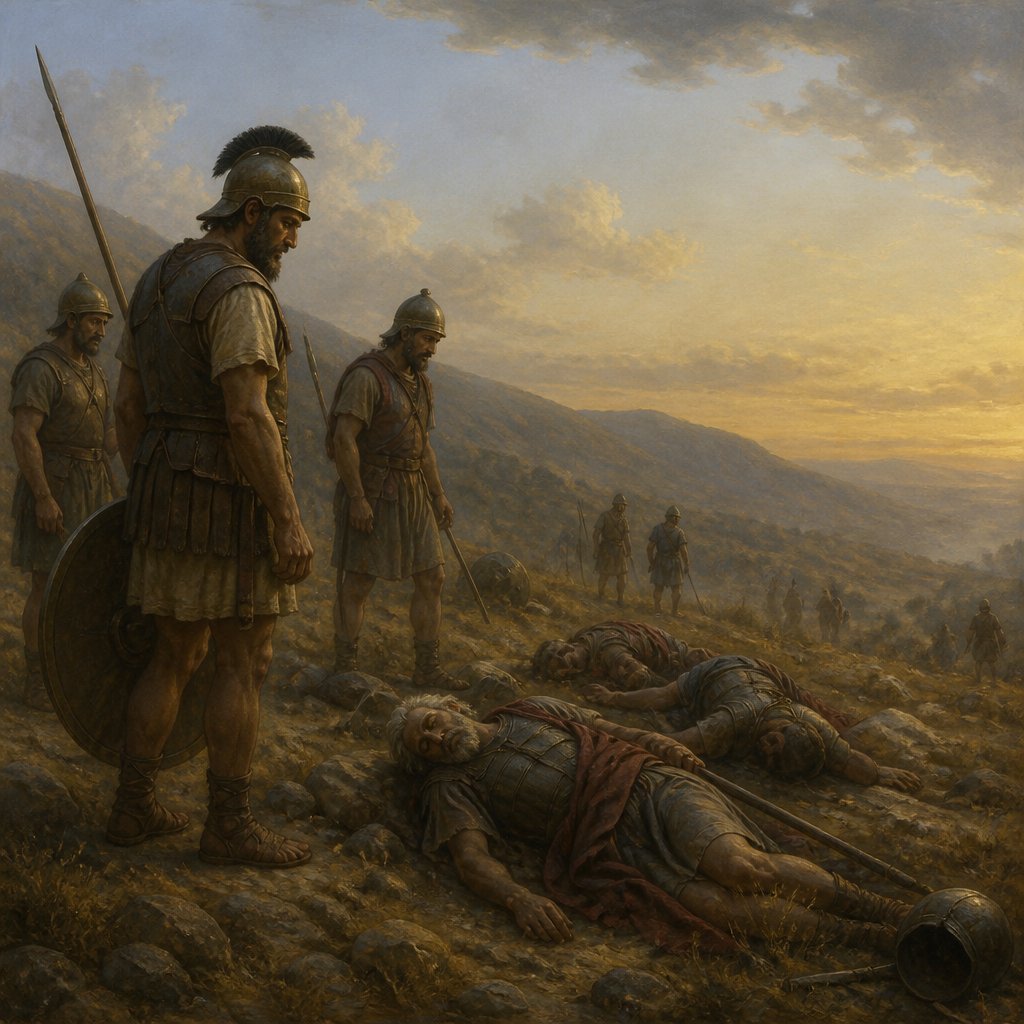
1 Chronicles 10:8 (KJV) reads: “And it came to pass on the morrow, when the Philistines came to strip the slain, that they found Saul and his sons fallen in mount Gilboa.”
This verse is part of the historical account of the death of King Saul, the first king of Israel. The Philistines had engaged in a battle with Israel and had the upper hand, causing Saul and his sons to fall in battle. This verse marks the moment when the Philistines discovered Saul and his sons' bodies on Mount Gilboa.
The underlying theme of this verse is the ultimate consequence of disobedience to God. Saul was appointed as king by God, but he continuously disobeyed God's commands. He turned away from God and consulted a medium for guidance instead of seeking God's counsel. As a result, God's favor departed from him, and he fell in battle. This serves as a reminder that when we turn away from God and His will for our lives, we are vulnerable to the enemy's attack and ultimately face the consequences of our actions.
The context of this verse is significant in understanding the broader narrative of Israel's history and the dynamics of their relationship with neighboring nations. The Philistines were a constant adversary of Israel, and their presence in this account signifies the ongoing struggle and conflict between the two nations. The defeat of Saul and his sons also marked a turning point in Israel's history, as it paved the way for David, a man after God's heart, to rise to power and lead the nation.
Symbolism plays a crucial role in this verse, particularly in the location where Saul and his sons were found. Mount Gilboa holds significance as the place where the final battle took place and where the downfall of Saul's reign was sealed. This mountaintop location serves as a symbolic representation of the height of power and the subsequent fall from grace. It serves as a cautionary reminder of the consequences of pride, disobedience, and turning away from God.
Additionally, the Philistines stripping the slain carries symbolic weight as well. In ancient warfare, stripping the slain was a common practice to desecrate the bodies and plunder their possessions. This act symbolizes the humiliating defeat and the triumph of the enemy over Israel. It serves as a stark reminder of the consequences of disobedience and the vulnerability that comes with turning away from God.
In conclusion, 1 Chronicles 10:8 captures a pivotal moment in Israel's history, marked by the tragic end of Saul and his sons. The themes of disobedience, consequences, and the sovereignty of God are prominent in this verse. The context of ongoing conflict with the Philistines and the symbolism of Mount Gilboa and the stripping of the slain add depth to the narrative. Ultimately, this verse serves as a sobering reminder of the importance of obedience to God and the dire consequences of turning away from His will.
Have questions about 1 Chronicles 10:8?
Dive deeper into this scripture with Bible Chat — an AI-powered tool for exploring God's Word through conversation. Ask questions, get context, and grow in your understanding of the Bible.
Get Our Apps


1 Chronicles 10:8 Artwork

1 Chronicles 10:8 - "¶ And it came to pass on the morrow, when the Philistines came to strip the slain, that they found Saul and his sons fallen in mount Gilboa."
"¶ And it came to pass on the morrow, when the Philistines came to strip the slain, that they found Saul and his sons fallen in mount Gilboa." - 1 Chronicles 10:8

1 Chronicles 8:10 - "And Jeuz, and Shachia, and Mirma. These were his sons, heads of the fathers."
"And Jeuz, and Shachia, and Mirma. These were his sons, heads of the fathers." - 1 Chronicles 8:10

2 Chronicles 10:8 - "But he forsook the counsel which the old men gave him, and took counsel with the young men that were brought up with him, that stood before him."

1 Chronicles 1:8 - "¶ The sons of Ham; Cush, and Mizraim, Put, and Canaan."

1 chronicles 12:8

1 Chronicles 4 : 10

1 Chronicles 8:31 - "And Gedor, and Ahio, and Zacher."

1 Chronicles 8:20 - "And Elienai, and Zilthai, and Eliel,"

1 Chronicles 8:19 - "And Jakim, and Zichri, and Zabdi,"

1 Chronicles 8:24 - "And Hananiah, and Elam, and Antothijah,"

1 Chronicles 8:5 - "And Gera, and Shephuphan, and Huram."

1 Chronicles 8:26 - "And Shamsherai, and Shehariah, and Athaliah,"

1 Chronicles 8:22 - "And Ishpan, and Heber, and Eliel,"

1 Chronicles 8:14 - "And Ahio, Shashak, and Jeremoth,"

1 Chronicles 2:8 - "And the sons of Ethan; Azariah."

1 Chronicles 8:23 - "And Abdon, and Zichri, and Hanan,"

1 Chronicles 8:4 - "And Abishua, and Naaman, and Ahoah,"

1 Chronicles 8:15 - "And Zebadiah, and Arad, and Ader,"

1 Chronicles 10:10 - "And they put his armour in the house of their gods, and fastened his head in the temple of Dagon."

1 Chronicles 8:2 - "Nohah the fourth, and Rapha the fifth."

1 Chronicles 3:8 - "And Elishama, and Eliada, and Eliphelet, nine."

2 Chronicles 8:10 - "And these were the chief of king Solomon's officers, even two hundred and fifty, that bare rule over the people."

1 Chronicles 9:10 - "¶ And of the priests; Jedaiah, and Jehoiarib, and Jachin,"

1 Chronicles 1:10 - "And Cush begat Nimrod: he began to be mighty upon the earth."

1 Chronicles 12:10 - "Mishmannah the fourth, Jeremiah the fifth,"

1 Chronicles 24:10 - "The seventh to Hakkoz, the eighth to Abijah,"

1 Chronicles 8:17 - "And Zebadiah, and Meshullam, and Hezeki, and Heber,"

1 Chronicles 24:8 - "The third to Harim, the fourth to Seorim,"