What does 1 Chronicles 10:4 mean?
"Then said Saul to his armourbearer, Draw thy sword, and thrust me through therewith; lest these uncircumcised come and abuse me. But his armourbearer would not; for he was sore afraid. So Saul took a sword, and fell upon it." - 1 Chronicles 10:4
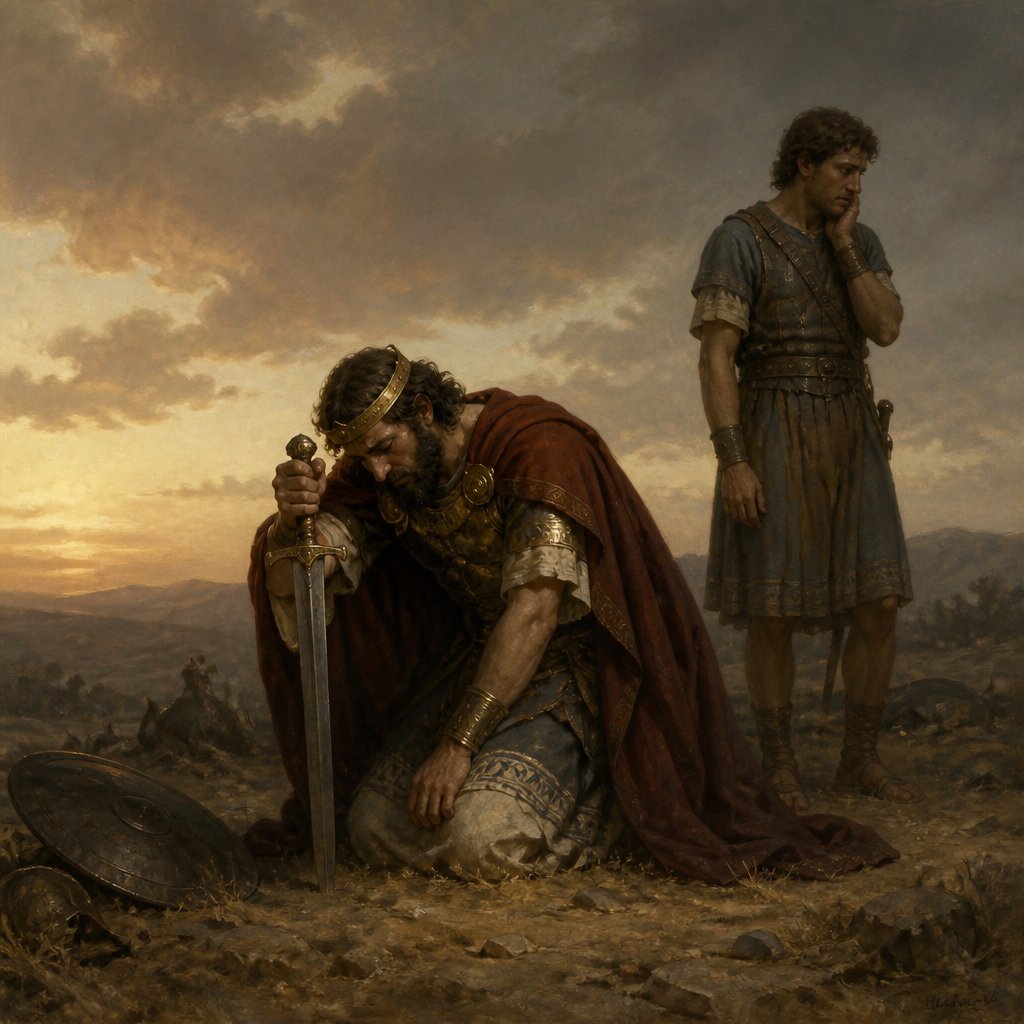
1 Chronicles 10:4 (KJV) reads:
"Then said Saul to his armourbearer, Draw thy sword, and thrust me through therewith; lest these uncircumcised come and abuse me. But his armourbearer would not; for he was sore afraid. So Saul took a sword, and fell upon it."
This verse comes from the Old Testament and recounts the death of King Saul, the first king of Israel. The passage is a solemn and tragic moment in the history of Israel, marking the end of Saul's reign and the beginning of David's rise to power.
The verse begins with Saul's command to his armor-bearer to draw his sword and kill him. Saul's decision to take his own life rather than face capture at the hands of the Philistines reveals the depth of his despair and humiliation. He is aware that if he falls into the hands of the uncircumcised, they will likely mistreat him, a reflection of the brutal treatment often inflicted on defeated enemies in ancient warfare.
Saul's armor-bearer, a loyal and courageous servant, refuses to carry out the king's request because of his fear. This refusal shows a tension between obedience to authority and moral conviction. Despite his loyalty to Saul, the armor-bearer recognizes the gravity of the situation and hesitates to take the life of his own king. His fear is also a symbol of the impending doom that looms over the Israelite army as they face the Philistine forces.
Ultimately, Saul takes matters into his own hands and falls on his own sword, choosing death over the dishonor of capture and abuse. This tragic end of Saul's life serves as a dramatic conclusion to his reign as king and sets the stage for the rise of David, who will bring a new era of prosperity and unity to the nation of Israel.
One of the prominent themes in this passage is the consequences of disobedience and moral failure. Saul's downfall can be traced back to his disobedience to God's commands, as outlined in earlier passages in 1 Samuel. His impatience, pride, and lack of faith led to his ultimate demise. The refusal of the armor-bearer to carry out Saul's command could be seen as an act of moral integrity, juxtaposed against Saul's own moral failure.
Another notable theme is the contrast between fear and courage. Both Saul and his armor-bearer face fearful circumstances, but their responses differ. Saul succumbs to despair and chooses to end his own life out of fear, while the armor-bearer, despite his fear, remains steadfast in his refusal to obey an unjust command. This contrast highlights the distinction between moral courage and cowardice in the face of adversity.
The symbolism in this verse is also significant. Saul's death, by falling on his sword, represents the tragic end of a once-great king who succumbed to his own pride and disobedience. The sword itself is a symbol of warfare and death, reflecting the grim reality of the battlefield and the high stakes of the conflict between the Israelites and the Philistines.
In conclusion, 1 Chronicles 10:4 captures a pivotal moment in the history of Israel, marking the end of Saul's reign and the beginning of a new era under David's leadership. The verse conveys themes of disobedience, moral failure, fear, and courage, and is rich in symbolism that underscores the tragic and dramatic nature of Saul's downfall. As a result, this passage serves as a poignant reminder of the consequences of unfaithfulness and the enduring struggle between good and evil.
Have questions about 1 Chronicles 10:4?
Dive deeper into this scripture with Bible Chat — an AI-powered tool for exploring God's Word through conversation. Ask questions, get context, and grow in your understanding of the Bible.
Get Our Apps


1 Chronicles 10:4 Artwork

1 Chronicles 10:4 - "Then said Saul to his armourbearer, Draw thy sword, and thrust me through therewith; lest these uncircumcised come and abuse me. But his armourbearer would not; for he was sore afraid. So Saul took a sword, and fell upon it."
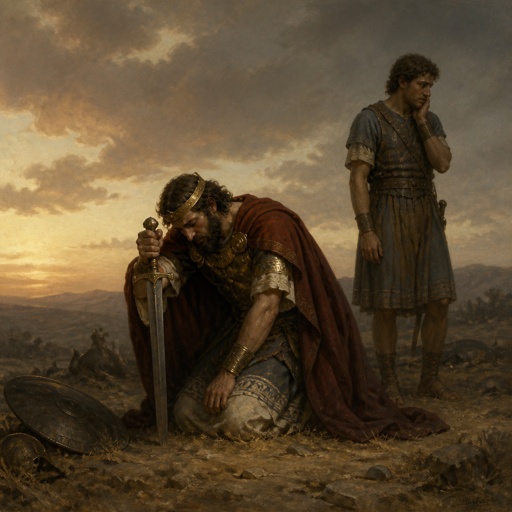
"Then said Saul to his armourbearer, Draw thy sword, and thrust me through therewith; lest these uncircumcised come and abuse me. But his armourbearer would not; for he was sore afraid. So Saul took a sword, and fell upon it." - 1 Chronicles 10:4

1 Chronicles 4 : 10

2 Chronicles 10:4 - "Thy father made our yoke grievous: now therefore ease thou somewhat the grievous servitude of thy father, and his heavy yoke that he put upon us, and we will serve thee."

2 Chronicles 4:10 - "And he set the sea on the right side of the east end, over against the south."

1 Chronicles 1:4 - "Noah, Shem, Ham, and Japheth."

1 Chronicles 10:10 - "And they put his armour in the house of their gods, and fastened his head in the temple of Dagon."

1 Chronicles 9:10 - "¶ And of the priests; Jedaiah, and Jehoiarib, and Jachin,"

2 Chronicles 4:22

1 Chronicles 1:10 - "And Cush begat Nimrod: he began to be mighty upon the earth."

1 Chronicles 12:10 - "Mishmannah the fourth, Jeremiah the fifth,"

1 Chronicles 24:10 - "The seventh to Hakkoz, the eighth to Abijah,"

1 Chronicles 10:6 - "So Saul died, and his three sons, and all his house died together."

1 Chronicles 4:29 - "And at Bilhah, and at Ezem, and at Tolad,"

1 Chronicles 4:30 - "And at Bethuel, and at Hormah, and at Ziklag,"

1 Chronicles 8:4 - "And Abishua, and Naaman, and Ahoah,"

1 Chronicles 4:1 - "The sons of Judah; Pharez, Hezron, and Carmi, and Hur, and Shobal."

1 Chronicles 10:11 - "¶ And when all Jabesh-gilead heard all that the Philistines had done to Saul,"

1 Chronicles 15:4 - "And David assembled the children of Aaron, and the Levites:"

1 Chronicles 4:34 - "And Meshobab, and Jamlech, and Joshah the son of Amaziah,"

1 Chronicles 10:5 - "And when his armourbearer saw that Saul was dead, he fell likewise on the sword, and died."

1 Chronicles 4:10 - "And Jabez called on the God of Israel, saying, Oh that thou wouldest bless me indeed, and enlarge my coast, and that thine hand might be with me, and that thou wouldest keep me from evil, that it may not grieve me! And God granted him that which he requested."

1 Chronicles 4:28 - "And they dwelt at Beer-sheba, and Moladah, and Hazar-shual,"

1 Chronicles 4:16 - "And the sons of Jehaleleel; Ziph, and Ziphah, Tiria, and Asareel."

1 Chronicles 4:7 - "And the sons of Helah were, Zereth, and Jezoar, and Ethnan."

1 Chronicles 6:4 - "¶ Eleazar begat Phinehas, Phinehas begat Abishua,"

1 Chronicles 15:10 - "Of the sons of Uzziel; Amminadab the chief, and his brethren an hundred and twelve."

1 Chronicles 8:10 - "And Jeuz, and Shachia, and Mirma. These were his sons, heads of the fathers."

1 Chronicles 4:4 - "And Penuel the father of Gedor, and Ezer the father of Hushah. These are the sons of Hur, the firstborn of Ephratah, the father of Beth-lehem."

1 Chronicles 10:3 - "And the battle went sore against Saul, and the archers hit him, and he was wounded of the archers."