The Unveiling of Hearts: Embracing Vulnerability in the Pursuit of Love
"The watchmen that went about the city found me, they smote me, they wounded me; the keepers of the walls took away my veil from me." - Song of Solomon 5:7

In the beautiful poetic backdrop of the Song of Solomon, we encounter a poignant verse that resonates with our experiences in love and vulnerability: "The watchmen that went about the city found me, they smote me, they wounded me; the keepers of the walls took away my veil from me" (Song of Solomon 5:7 KJV). This verse invites us to reflect not only on romantic love but also on the depth of personal and spiritual encounters that come with seeking true intimacy.
The speaker in this passage, presumably the Shulammite woman, finds herself amidst the city, a metaphorical space that may represent society’s norms, expectations, and watchful scrutiny. The phrase "the watchmen that went about the city found me" suggests an encounter with those who serve as guardians, be it societal judgments or external forces that keep us from our true selves. The watchmen are present in our everyday lives, often pointing out our flaws, whispering fears and insecurities that arise when we present our true selves in relationships.
These watchmen act not as protectors, but as adversaries; they "smote" and "wounded" her. Their actions resonate with the pain that comes from judgment and rejection. How often do we feel the sting of others' opinions, wounding us at our most vulnerable? This physical and emotional assault can leave lingering scars, echoing in our hearts long after the initial blow. We must confront the reality of how societal expectations can force us to wear veils—masks that hide our true identity and desires, shielding us from the potential of deeper relationships.
Interestingly, the phrase, "the keepers of the walls took away my veil from me," indicates an act of unveiling—a stripping away of the facade that may both frighten and liberate us. As we navigate love, whether romantic or divine, vulnerability often plays a crucial role. It takes great courage to lay down our defenses and allow someone to see us fully. In this moment of despair, we must reflect on the paradox: in our truest moments of pain, when we feel exposed and wounded, there lies the potential for profound healing and intimacy.
In another light, the veil symbolizes not only protection but also the aspects of ourselves we keep hidden. It stands for the tenderness of our hearts that we are often reluctant to expose. Just like the Shulammite, we might find ourselves surrounded by walls that society has constructed—walls that dictate who to love, how to love, and to what extent. Yet, God invites us to break free from those constraints. When we feel wounded by perceptions and judgments, it's crucial to turn to Him, our ultimate healer, who understands our plight and nurtures our heart with grace.
In reflective prayer, we can ask, "Lord, help me to see the beauty in being vulnerable. Grant me the strength to remove my veil and trust in Your unwavering love. May I learn to love others not through the lens of fear and invalidation but through the lens of Your mercy and kindness. Teach me to be the keeper of walls that protects and cares rather than those that wound and judge."
As we meditate on this verse, let us embrace the journey of unveiling, understanding that with each revelation comes both risk and reward. True love does not cower from the ache of exposure; it thrums in the pulse of shared truth and mutual understanding. Let us remember that sometimes in our deepest wounds, God hastens to cover us—He stitches our hearts with threads of love, renewing us and leading us towards relationships that are built on the foundation of His grace.
In closing, as we reflect on Song of Solomon 5:7, we are reminded that the vulnerability of our hearts, though sometimes painful, is an integral pathway to discovering the richness of true companionship, both with one another and with our Creator.
Want to reflect more on Song of Solomon 5:7?
Continue your spiritual journey with Bible Chat — an AI-powered tool for exploring God's Word through conversation. Ask questions, discover connections, and deepen your understanding.
Get Our Apps


Song of Solomon 5:7 Artwork
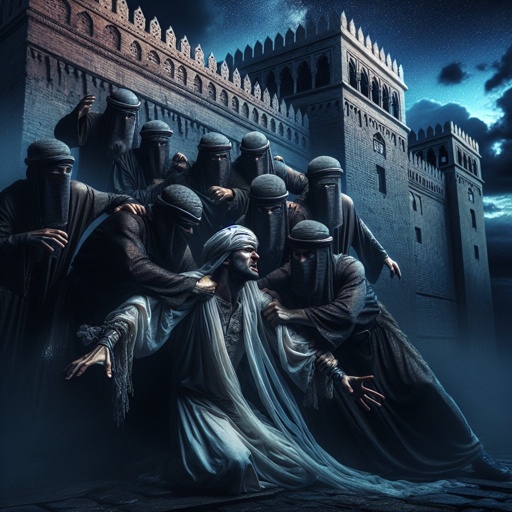
Song of Solomon 5:7 - "The watchmen that went about the city found me, they smote me, they wounded me; the keepers of the walls took away my veil from me."

"The watchmen that went about the city found me, they smote me, they wounded me; the keepers of the walls took away my veil from me." - Song of Solomon 5:7

Song of Solomon 5:11

Song of Solomon 7:5 - "Thine head upon thee is like Carmel, and the hair of thine head like purple; the king is held in the galleries."

Song of Solomon 5:10 - "My beloved is white and ruddy, the chiefest among ten thousand."

Song of Solomon 1:5 - "I am black, but comely, O ye daughters of Jerusalem, as the tents of Kedar, as the curtains of Solomon."

Song of Solomon 7:7 - "This thy stature is like to a palm tree, and thy breasts to clusters of grapes."

Song of Solomon 5:11 - "His head is as the most fine gold, his locks are bushy, and black as a raven."

Song of Solomon 6:7 - "As a piece of a pomegranate are thy temples within thy locks."

"My beloved is white and ruddy, the chiefest among ten thousand." - Song of Solomon 5:10

Song of Solomon 5:12 - "His eyes are as the eyes of doves by the rivers of waters, washed with milk, and fitly set."

Song of Solomon 5:14 - "His hands are as gold rings set with the beryl: his belly is as bright ivory overlaid with sapphires."

Song of Solomon 5:4 - "My beloved put in his hand by the hole of the door, and my bowels were moved for him."

Song of Solomon 5:13 - "His cheeks are as a bed of spices, as sweet flowers: his lips like lilies, dropping sweet smelling myrrh."

Song of Solomon 4:7 - "Thou art all fair, my love; there is no spot in thee."

Song of Solomon 7:3 - "Thy two breasts are like two young roes that are twins."

Song of Solomon 7:10 - "¶ I am my beloved's, and his desire is toward me."

Song of Solomon 7:6 - "How fair and how pleasant art thou, O love, for delights!"

Song of Solomon 3:7 - "Behold his bed, which is Solomon's; threescore valiant men are about it, of the valiant of Israel."

Song of Solomon 2:5 - "Stay me with flagons, comfort me with apples: for I am sick of love."

Song of Solomon 5:15 - "His legs are as pillars of marble, set upon sockets of fine gold: his countenance is as Lebanon, excellent as the cedars."

Song of Solomon 5:8 - "I charge you, O daughters of Jerusalem, if ye find my beloved, that ye tell him, that I am sick of love."

Song of Solomon 5:3 - "I have put off my coat; how shall I put it on? I have washed my feet; how shall I defile them?"

Song of Solomon 5:16 - "His mouth is most sweet: yea, he is altogether lovely. This is my beloved, and this is my friend, O daughters of Jerusalem."

Song of Solomon 7:11 - "Come, my beloved, let us go forth into the field; let us lodge in the villages."

Song of Solomon 4:5 - "Thy two breasts are like two young roes that are twins, which feed among the lilies."

Song of Solomon 1:1 - "The song of songs, which is Solomon's."

Song of Solomon 5:5 - "I rose up to open to my beloved; and my hands dropped with myrrh, and my fingers with sweet smelling myrrh, upon the handles of the lock."

Song of Solomon 5:11 Please follow scripture descriptions of raven black hair and add in an element of royal purple
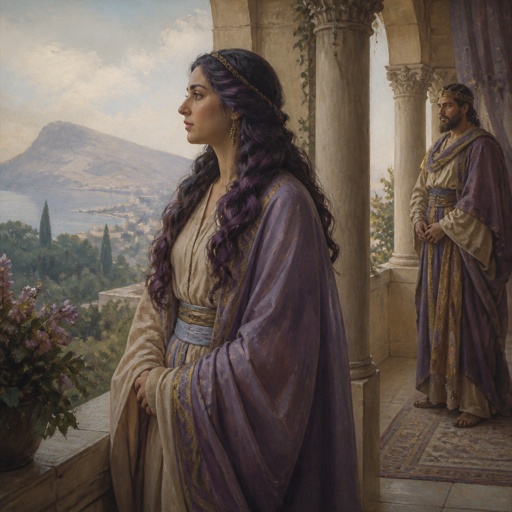
"Thine head upon thee is like Carmel, and the hair of thine head like purple; the king is held in the galleries." - Song of Solomon 7:5