The Heart of the Law: Love as Our Guiding Principle
"For this, Thou shalt not commit adultery, Thou shalt not kill, Thou shalt not steal, Thou shalt not bear false witness, Thou shalt not covet; and if there be any other commandment, it is briefly comprehended in this saying, namely, Thou shalt love thy neighbour as thyself." - Romans 13:9

In Romans 13:9, the Apostle Paul brings to life the profound essence of the law when he writes, "For this, Thou shalt not commit adultery, Thou shalt not kill, Thou shalt not steal, Thou shalt not bear false witness, Thou shalt not covet; and if there be any other commandment, it is briefly comprehended in this saying, namely, Thou shalt love thy neighbour as thyself." This verse masterfully encapsulates the moral compass that God has given us, illustrating that all commandments find their completion in love.
To understand what this means in the context of our lives, we must first recognize that love supersedes mere compliance with rules. When Paul refers to the commandments, he is not suggesting a checklist of do's and don’ts to be followed through rigorous self-discipline. Instead, he suggests that love should be our motivational force. Love seeks the best for others; it is self-sacrificing and attentive to the needs of those around us. Adultery, murder, stealing, falsehood, and covetousness are all actions that violate the fundamental principles of love and respect for others.
When we commit adultery, we violate the trust and commitment we have vowed to our spouse, hurting not just them but also ourselves and perhaps even our family. When one takes another’s life, it is the ultimate disregard for the sanctity of life—a drastic deviation from love that denies the inherent value found in every human being. Likewise, stealing is fundamentally an act of selfishness, showing a lack of respect for what belongs to others. Bearing false witness corrupts relationships and destroys trust, and coveting breeds discontent and resentment in our hearts.
Each of these actions ultimately stems from a heart that lacks love. The commandments serve as a protective barrier that, when adhered to with love as a guiding principle, leads us toward healthier relationships with ourselves, with others, and with God. Paul distills the essence of these laws into loving one’s neighbor. By loving others as we love ourselves, we actively fulfill the laws of God.
But what does it mean to love one’s neighbor as oneself? First, it requires self-awareness and self-compassion. We must recognize our own needs, struggles, and imperfections in order to approach others with empathy and kindness. Loving ourselves appropriately—acknowledging our humanity and the grace we need—teaches us to extend that same grace outward. It prompts us to offer forgiveness rather than harbor grudges, understanding rather than judgment, and support rather than indifference.
In daily interactions, this love can manifest in simple, yet profound ways. Rather than opting for a fleeting moment of anger in a disagreement, we can choose to communicate with compassion. Instead of ignoring a neighbor’s need, we can offer help in practical ways, embodying the love that Paul speaks of. Loving our neighbor also means standing against injustice and advocating for those who cannot speak for themselves. It is living a life that empowers others and encourages them to reach their destinies in God’s vision.
Imagine a world where everyone embraced this principle of love. We would witness an extraordinary shift in how we interact with one another. Communities would flourish with kindness, compassion, and understanding. There would be no room for hatred, resentment, or strife—only a rich tapestry of thriving relationships built upon the foundation of love.
As we reflect on Romans 13:9, let us seek to embody this immense truth in our daily lives. Let love guide all our thoughts and actions. In every interaction, may we pause and consider how our words and behaviors either reflect the love of Christ or stray from it. Let us strive to be vessels of love, ensuring that in everything we do, we point others towards the love that has first been shown to us by our Savior.
Want to reflect more on Romans 13:9?
Continue your spiritual journey with Bible Chat — an AI-powered tool for exploring God's Word through conversation. Ask questions, discover connections, and deepen your understanding.
Get Our Apps


Romans 13:9 Artwork
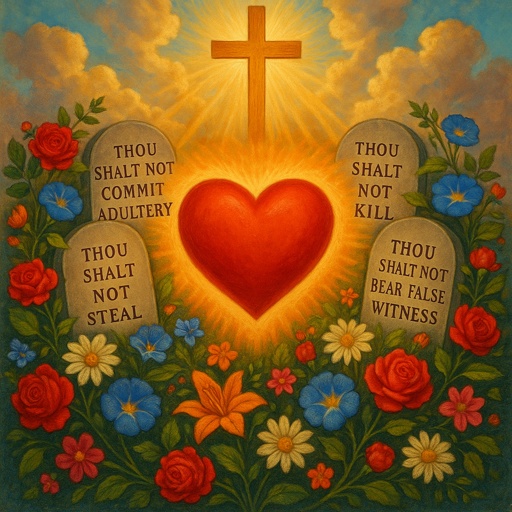
"For this, Thou shalt not commit adultery, Thou shalt not kill, Thou shalt not steal, Thou shalt not bear false witness, Thou shalt not covet; and if there be any other commandment, it is briefly comprehended in this saying, namely, Thou shalt love thy neighbour as thyself." - Romans 13:9

Romans 13:9 - "For this, Thou shalt not commit adultery, Thou shalt not kill, Thou shalt not steal, Thou shalt not bear false witness, Thou shalt not covet; and if there be any other commandment, it is briefly comprehended in this saying, namely, Thou shalt love thy neighbour as thyself."

"For this, Thou shalt not commit adultery, Thou shalt not kill, Thou shalt not steal, Thou shalt not bear false witness, Thou shalt not covet; and if there be any other commandment, it is briefly comprehended in this saying, namely, Thou shalt love thy neighbour as thyself." - Romans 13:9

Romans 9:13 - "As it is written, Jacob have I loved, but Esau have I hated."

"As it is written, Jacob have I loved, but Esau have I hated." - Romans 9:13

Romans 13:8

Romans 13:8

Romans 10:9

Romans 10:9

Romans 10:13-15

Romans 9:9 - "For this is the word of promise, At this time will I come, and Sara shall have a son."

Romans 13:13 - "Let us walk honestly, as in the day; not in rioting and drunkenness, not in chambering and wantonness, not in strife and envying."

Romans 12:13 - "Distributing to the necessity of saints; given to hospitality."

Romans 16:13 - "Salute Rufus chosen in the Lord, and his mother and mine."

depict the theme of Romans 13:8-14

Romans 9:12 - "It was said unto her, The elder shall serve the younger."

Romans 10:13 - "For whosoever shall call upon the name of the Lord shall be saved."

Romans 5:13 - "(For until the law sin was in the world: but sin is not imputed when there is no law."

Romans 9:14 - "What shall we say then? Is there unrighteousness with God? God forbid."

Romans 13:10 - "Love worketh no ill to his neighbour: therefore love is the fulfilling of the law."

Romans 2:13 - "(For not the hearers of the law are just before God, but the doers of the law shall be justified."

Romans 16:9 - "Salute Urbane, our helper in Christ, and Stachys my beloved."

Romans 9:2 - "That I have great heaviness and continual sorrow in my heart."

Romans 9:8 - "That is, They which are the children of the flesh, these are not the children of God: but the children of the promise are counted for the seed."

Combine the authority theme described in Romans 13:1-7 and Revelation 13:1-10.

Romans 13:5 - "Wherefore ye must needs be subject, not only for wrath, but also for conscience sake."

Romans 12:9-13 - "Love must be sincere. Hate what is evil; cling to what is good. Be devoted to one another in love. Honor one another above yourselves. Never be lacking in zeal, but keep your spiritual fervor, serving the Lord. Be joyful in hope, patient in affliction, faithful in prayer. Share with the Lord's people who are in need. Practice hospitality."

Romans 9:32 - "Wherefore? Because they sought it not by faith, but as it were by the works of the law. For they stumbled at that stumblingstone;"

Romans 9:16 - "So then it is not of him that willeth, nor of him that runneth, but of God that sheweth mercy."

Romans 3:13 - "Their throat is an open sepulchre; with their tongues they have used deceit; the poison of asps is under their lips:"