Standing on the Stairs: A Call to Worship and Responsibility
"¶ Then stood up upon the stairs, of the Levites, Jeshua, and Bani, Kadmiel, Shebaniah, Bunni, Sherebiah, Bani, and Chenani, and cried with a loud voice unto the LORD their God." - Nehemiah 9:4
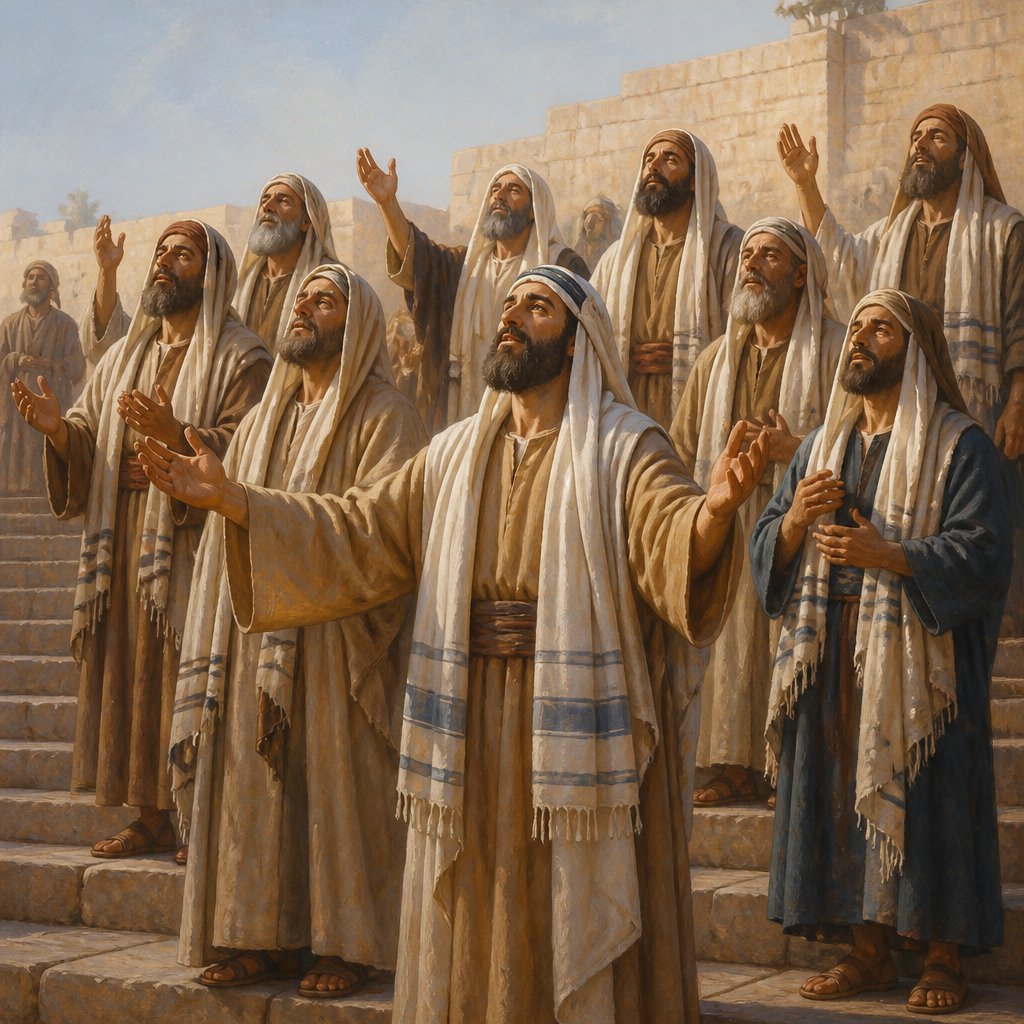
As we delve into Nehemiah 9:4, we confront a moment steeped in reverence and communal identity. The verse reads, "Then stood up upon the stairs, of the Levites, Jeshua, and Bani, Kadmiel, Shebaniah, Bunni, Sherebiah, Bani, and Chenani, and cried with a loud voice unto the LORD their God." From the very outset, we note that it is not just one individual crying out; rather, it is a collective—a tapestry of voices raised toward Heaven—a vital reminder of the power and necessity of community in worship and faith.
Israel has a rich and tumultuous history, and by the time we reach this moment in Nehemiah, the nation is far removed from its former glory. Jerusalem lies in ruins, the walls broken down, and the people are returning from exile, seeking to restore not just their city but their connection with God. This is a turning point—not merely a physical reconstruction but a spiritual renaissance. The gathering of the Levites, leaders consecrated for the purpose of worship and service in God’s house, symbolizes the importance of leadership in worship. These men, standing on the stairs—the place where they could be seen and heard, represent the embodiment of the service to God, calling us to recognize the importance of leaders in our own lives who guide us toward fervent worship and living testimonies of faith.
In this passage, they do not whisper; they cry out with a loud voice. The Hebrew people understood the weight of their situation due to their disobedience. They cried out in recognition of what God means to them and what they had surrendered through sin. Their loudness points to the observance of the gravity of the moment—the sacredness of standing before God when one seeks forgiveness, restoration, and a return to His ways. Are our prayers ever offered in such a passionate plea? Are we as vocal in our worship? In an era where silence often reigns within our prayers and churches, this example confronts us. God desires not only that we engage in quiet reflection but that we proclaim boldly our love and need for Him.
Yet, this loud cry is not void of understanding or context. The Levites were not merely roused to shout; they were calling back to a covenant, to the history of their forefathers, to a God who had been faithful in ways that were often overlooked due to their hardheartedness. The act of standing together was not just symbolic proximity; it was also an acknowledgment of their covenantal relationship with God—reminding the people that regardless of circumstances, God is the source of their redemptive story. When we gather to worship, we stand not only in our individuality but as part of a greater picture—the body of Christ. This unison strengthens our voice as we cry out to God, recognizing His past faithfulness and present promises.
We must also consider the significance of the location of this moment. The stairs were a place of elevation, a boundary between the earthly and the divine, lending itself to a place of intimacy with God. It reminds us that while we may feel distant at times in our sins, there is always a higher place—the presence of the Lord—where we are welcomed to come and lift our voices unto Him.
As we meditate on this verse, consider your own life: Are you standing on the stairs, ready to raise your voice to God? Do you seek a community of Levites around you—those who will inspire you to move closer to Him? Let your worship be a loud acknowledgment of His sovereign role in your life, much like the Levites did. In their cry, they not only sought God but also invited others into the sanctity of the moment. May our worship echo against the walls of our hearts and communities, calling all to witness the glory of the Lord our God.
Want to reflect more on Nehemiah 9:4?
Continue your spiritual journey with Bible Chat — an AI-powered tool for exploring God's Word through conversation. Ask questions, discover connections, and deepen your understanding.
Get Our Apps


Nehemiah 9:4 Artwork

Nehemiah 9:4 - "¶ Then stood up upon the stairs, of the Levites, Jeshua, and Bani, Kadmiel, Shebaniah, Bunni, Sherebiah, Bani, and Chenani, and cried with a loud voice unto the LORD their God."
"¶ Then stood up upon the stairs, of the Levites, Jeshua, and Bani, Kadmiel, Shebaniah, Bunni, Sherebiah, Bani, and Chenani, and cried with a loud voice unto the LORD their God." - Nehemiah 9:4

Nehemiah 4:9 - "Nevertheless we made our prayer unto our God, and set a watch against them day and night, because of them."

Nehemiah 6:9

Nehemiah 4:6

Nehemiah 4:6

Nehemiah 4:6

Nehemiah 9:9 - "And didst see the affliction of our fathers in Egypt, and heardest their cry by the Red sea;"

Nehemiah 12:4 - "Iddo, Ginnetho, Abijah,"

Nehemiah 10:4 - "Hattush, Shebaniah, Malluch,"

Nehemiah 7:9 - "The children of Shephatiah, three hundred seventy and two."

Nehemiah 9:16 - "But they and our fathers dealt proudly, and hardened their necks, and hearkened not to thy commandments,"

Nehemiah 12:9 - "Also Bakbukiah and Unni, their brethren, were over against them in the watches."

Nehemiah 10:9 - "And the Levites: both Jeshua the son of Azaniah, Binnui of the sons of Henadad, Kadmiel;"
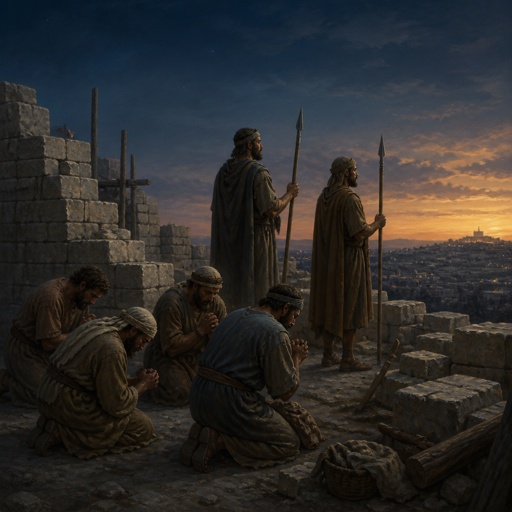
"Nevertheless we made our prayer unto our God, and set a watch against them day and night, because of them." - Nehemiah 4:9

Nehemiah 11:9 - "And Joel the son of Zichri was their overseer: and Judah the son of Senuah was second over the city."

"Iddo, Ginnetho, Abijah," - Nehemiah 12:4

"Hattush, Shebaniah, Malluch," - Nehemiah 10:4

Nehemiah 4:4 - "Hear, O our God; for we are despised: and turn their reproach upon their own head, and give them for a prey in the land of captivity:"

Nehemiah 3:9 - "And next unto them repaired Rephaiah the son of Hur, the ruler of the half part of Jerusalem."

Nehemiah 4:8 - "And conspired all of them together to come and to fight against Jerusalem, and to hinder it."

Nehemiah 9:2 - "And the seed of Israel separated themselves from all strangers, and stood and confessed their sins, and the iniquities of their fathers."

Nehemiah 8:9 - "¶ And Nehemiah, which is the Tirshatha, and Ezra the priest the scribe, and the Levites that taught the people, said unto all the people, This day is holy unto the LORD your God; mourn not, nor weep. For all the people wept, when they heard the words of the law."

Nehemiah 4:17 – "Those who carried materials did their work with one hand and held a weapon in the other."

Nehemiah 9:38 - "And because of all this we make a sure covenant, and write it; and our princes, Levites, and priests, seal unto it."

"And didst see the affliction of our fathers in Egypt, and heardest their cry by the Red sea;" - Nehemiah 9:9

Nehemiah 7:4 - "Now the city was large and great: but the people were few therein, and the houses were not builded."

Nehemiah 13:9 - "Then I commanded, and they cleansed the chambers: and thither brought I again the vessels of the house of God, with the meat offering and the frankincense."

Nehemiah 4:17 – "Those who carried materials did their work with one hand and held a weapon in the other."

"The children of Shephatiah, three hundred seventy and two." - Nehemiah 7:9