Rebuilding with Purpose: The Example of Shallum
"And next unto him repaired Shallum the son of Halohesh, the ruler of the half part of Jerusalem, he and his daughters." - Nehemiah 3:12
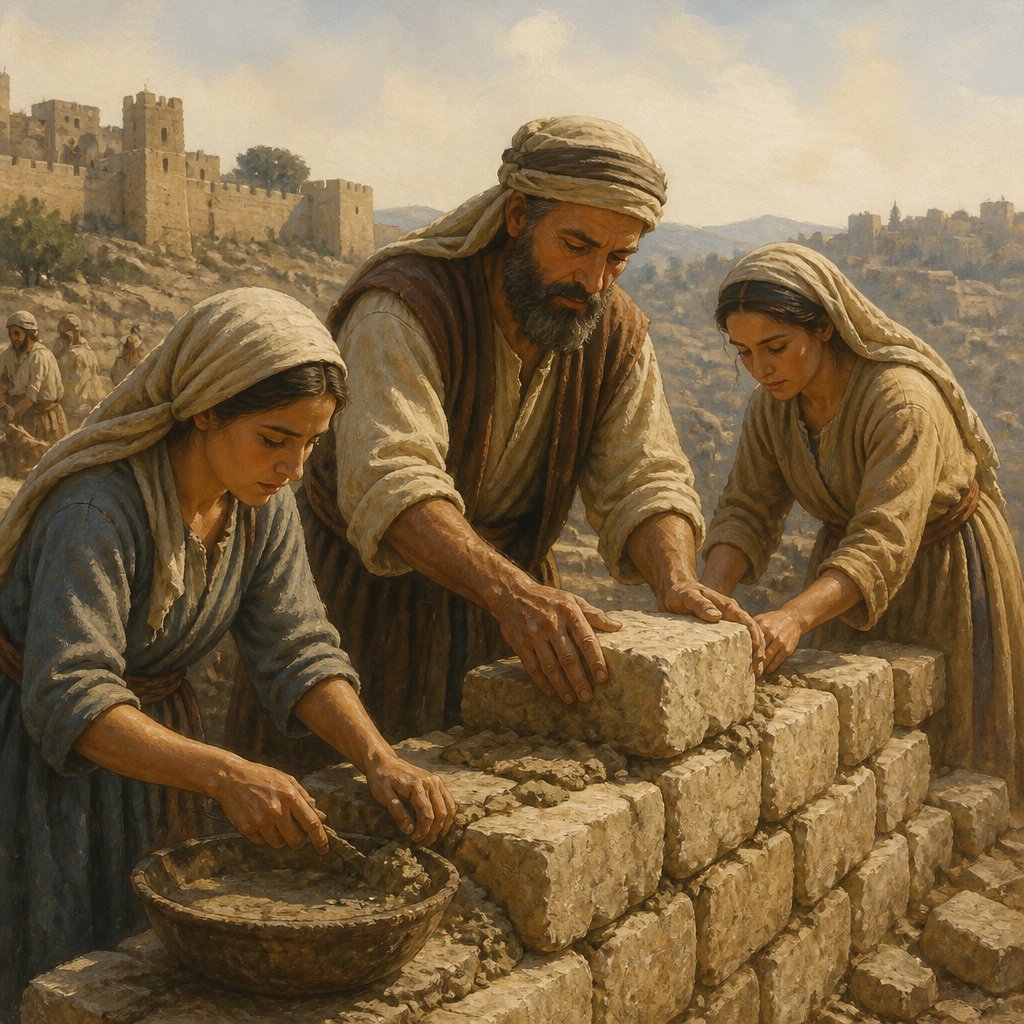
In the book of Nehemiah, we witness an incredible narrative of restoration, leadership, and unity among the people of God. Chapter 3 introduces us to a detailed account of the repairs to the walls of Jerusalem, which had lain in ruins for decades. Among the laborers is a noteworthy figure named Shallum, highlighted in Nehemiah 3:12 in the King James Version: "And next unto him repaired Shallum the son of Halohesh, the ruler of the half part of Jerusalem, he and his daughters." This brief verse holds profound significance that is rich for meditation and application in our lives today.
Shallum, the son of Halohesh, was not just any worker; he was a ruler—a leader over a portion of Jerusalem. This detail is crucial because it reflects the principle of servant leadership. Shallum did not consider himself above the task of repairing the wall, even with his authority. In fact, he took the initiative to involve not only himself but also his daughters in this important mission. This act is a poignant reminder that leadership includes service and sacrifice; true leaders roll up their sleeves and work alongside their people, showing that no task is beneath them.
Moreover, Shallum’s inclusion of his daughters in the rebuilding project is revolutionary for its time. In a patriarchal society, this action signifies an acknowledgment of the value of women in the community and their capacity to contribute meaningfully. By working together, Shallum and his daughters exemplify the importance of family, collaboration, and the passing on of legacy. They illustrate that the work of rebuilding is not solely a masculine endeavor but a shared responsibility that involves everyone. In the Kingdom of God, there are no hierarchies when it comes to our capability to contribute; our value is found in our dedication to God’s purposes.
The act of repairing the wall is symbolic of broader themes in our lives. Each of us, like Shallum, is called to repair and restore the places in our lives that have been damaged—be it our relationships, our spirits, or our communities. Life can sometimes resemble the walls of Jerusalem; we feel broken, vulnerable, and exposed. But through the example of Shallum, we learn that rebuilding is possible when we participate actively and faithfully. Shallum’s willingness to engage with the task at hand serves as a challenge to our complacency. Are we content to stand by, watching while things fall apart, or are we ready to take up the tools necessary for restoration and wholeness?
Additionally, Shallum’s dedication to rebuilding the wall teaches us about the spiritual walls in our lives. Just like the physical repair of Jerusalem’s walls served to protect and restore the identity of the people of God, so too must we attend to our own spiritual formation. Each stone laid in that wall represents a commitment not only to God but to the community. Thus, our actions in the body of Christ—supporting one another, volunteering in service, praying for each other—are pivotal to the health of the Church.
Shallum, through his example, invites us into the grand narrative of God’s restoration plan. He demonstrates that our efforts, no matter how small or large, contribute to the larger vision of God's Kingdom. Whether we are leading or serving, we are all part of the rebuilding process. As we step out to repair our own walls and the walls of our community, we find a rich sense of purpose that echoes through generations.
In conclusion, Nehemiah 3:12 is more than just a historical account; it is a call to action that beckons to us today. Let us embrace the spirit of Shallum as we take ownership of our roles—be they great or small. Let us rebuild the walls of our lives and communities with diligence, unity, and purpose, and may we find joy in working alongside those we love, fostering a spirit of restoration that echoes into eternity.
Want to reflect more on Nehemiah 3:12?
Continue your spiritual journey with Bible Chat — an AI-powered tool for exploring God's Word through conversation. Ask questions, discover connections, and deepen your understanding.
Get Our Apps


Nehemiah 3:12 Artwork

Nehemiah 3:12 - "And next unto him repaired Shallum the son of Halohesh, the ruler of the half part of Jerusalem, he and his daughters."
"And next unto him repaired Shallum the son of Halohesh, the ruler of the half part of Jerusalem, he and his daughters." - Nehemiah 3:12

Nehemiah 12:3 - "Shechaniah, Rehum, Meremoth,"

"Shechaniah, Rehum, Meremoth," - Nehemiah 12:3

Nehemiah 12:26 - "These were in the days of Joiakim the son of Jeshua, the son of Jozadak, and in the days of Nehemiah the governor, and of Ezra the priest, the scribe."

Nehemiah 12:5 - "Miamin, Maadiah, Bilgah,"

Nehemiah 12:33 - "And Azariah, Ezra, and Meshullam,"

Nehemiah 12:4 - "Iddo, Ginnetho, Abijah,"

Nehemiah 12:2 - "Amariah, Malluch, Hattush,"

Nehemiah 10:12 - "Zaccur, Sherebiah, Shebaniah,"

Nehemiah 12:6 - "Shemaiah, and Joiarib, Jedaiah,"

Nehemiah 12:12 - "And in the days of Joiakim were priests, the chief of the fathers: of Seraiah, Meraiah; of Jeremiah, Hananiah;"

Nehemiah 12:13 - "Of Ezra, Meshullam; of Amariah, Jehohanan;"

Nehemiah 12:16 - "Of Iddo, Zechariah; of Ginnethon, Meshullam;"

Nehemiah 12:20 - "Of Sallai, Kallai; of Amok, Eber;"

Nehemiah 12:19 - "And of Joiarib, Mattenai; of Jedaiah, Uzzi;"

Nehemiah 12:34 - "Judah, and Benjamin, and Shemaiah, and Jeremiah,"

Nehemiah 12:15 - "Of Harim, Adna; of Meraioth, Helkai;"

Nehemiah 12:18 - "Of Bilgah, Shammua; of Shemaiah, Jehonathan;"

Nehemiah 12:21 - "Of Hilkiah, Hashabiah; of Jedaiah, Nethaneel."

Nehemiah 12:14 - "Of Melicu, Jonathan; of Shebaniah, Joseph;"

Nehemiah 12:17 - "Of Abijah, Zichri; of Miniamin, of Moadiah, Piltai;"

Nehemiah 12:11 - "And Joiada begat Jonathan, and Jonathan begat Jaddua."

Nehemiah 10:3 - "Pashur, Amariah, Malchijah,"

Nehemiah 7:12 - "The children of Elam, a thousand two hundred fifty and four."

Nehemiah 12:32 - "And after them went Hoshaiah, and half of the princes of Judah,"

"Miamin, Maadiah, Bilgah," - Nehemiah 12:5

"Shemaiah, and Joiarib, Jedaiah," - Nehemiah 12:6

"Iddo, Ginnetho, Abijah," - Nehemiah 12:4

"Zaccur, Sherebiah, Shebaniah," - Nehemiah 10:12