Building Together: The Power of Community in Restoration
"And next unto them repaired Jedaiah the son of Harumaph, even over against his house. And next unto him repaired Hattush the son of Hashabniah." - Nehemiah 3:10
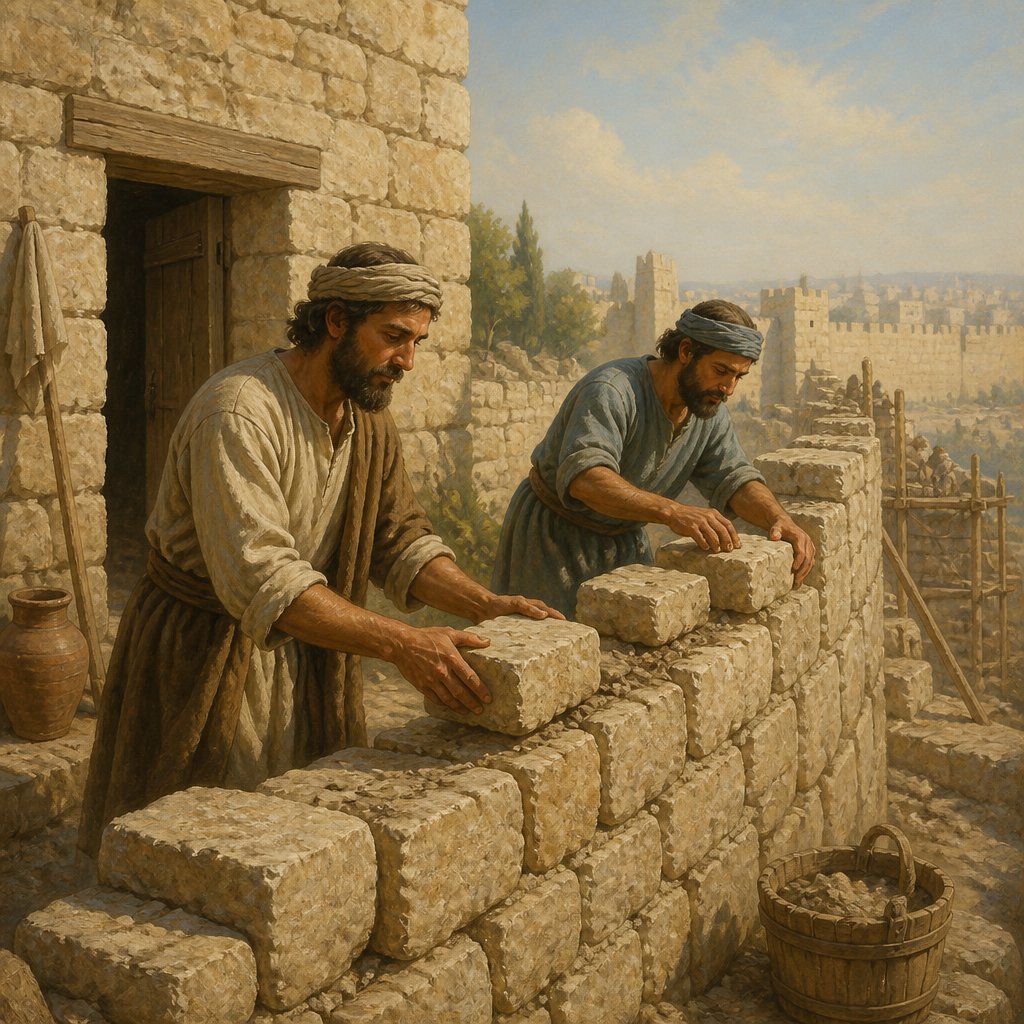
Nehemiah 3:10 states, "And next unto them repaired Jedaiah the son of Harumaph, even over against his house. And next unto him repaired Hattush the son of Hashabniah." At first glance, this verse may appear to recount a simple act of construction, but it embodies a profound truth about the power of community and individual contribution in the work of God.
As we delve into the context of Nehemiah's undertaking, we find a narrative rich with lessons on leadership and collective responsibility. Nehemiah, once a cupbearer to the king of Persia, was deeply moved by the plight of his ancestral city, Jerusalem. Upon learning of the city's broken walls and the disgrace that accompanied its desolation, he felt a divine call to action. This was not merely about rebuilding a physical structure; it was about restoring dignity, hope, and identity to the people of God.
In chapter 3, we see the meticulous listing of names and roles as each individual participates in the herculean task of repairing the walls. This verse highlights the crucial role of Jedaiah and Hattush, who repair sections directly in front of their homes. This portrayal is significant for several reasons. Firstly, it underscores the idea of personal investment in community restoration. Jedaiah and Hattush were not just workers; they were neighbors, motivated to restore the integrity of their immediate environment.
One could liken their efforts to our own lives. Are we contributing to the restoration of our communities, or have we become passive observers? In the tapestry of God's kingdom, each thread plays a vital role. Just as Jedaiah repaired the wall facing his house with dedication, we are called to invest in our own backyards—our families, neighborhoods, and churches. This call to action resonates loudly, particularly in a world often marked by division and isolation.
Moreover, the process of rebuilding in Nehemiah's time was remarkably collaborative. Each person had a defined role, and the work was segmented but interconnected. This illustrates an essential principle of community; while we all have unique gifts and responsibilities, we must work together toward a common purpose. In 1 Corinthians 12:12, Paul emphasizes that the body of Christ is one, yet it is made up of many parts. The analogy is not by coincidence. The health and effectiveness of the church depend on every member contributing their part where God has placed them.
Unlike many contemporary structures that rely on high-level leadership to spur action, Nehemiah’s approach was grassroots. He empowered ordinary people to make extraordinary changes. When we think about community restoration, we may often consider volunteer work, charitable giving, or organized outreach. However, it's equally crucial to examine the daily interactions we have within our families and closer communities. How we treat our relatives, neighbors, and coworkers can significantly affect the overall health of our community.
Furthermore, Jedaiah’s and Hattush’s repairs symbolize the importance of repairing the physical and spiritual foundations of our lives. Just as walls protect cities, boundaries safeguard our hearts. Erecting structures that defend against negativity, criticism, and despair allows us to create safe spaces for growth and healing.
As we work to rebuild our communities in our various capacities—whether through serving, volunteering, or simply being present—let us remember that every act counts. The endeavor may seem small at times, but like Jedaiah and Hattush, our collective, committed action has lasting effects. Together, we can restore what the enemy has sought to destroy, piece by piece, neighbor by neighbor, and wall by wall.
In conclusion, let us be inspired by the selfless acts of Jedaiah and Hattush. May we not only seek to repair the walls in our lives but also encourage the spirit of collaboration and ownership among one another. Just as they stood shoulder to shoulder, let us unite in purpose, reminding ourselves that we are part of something larger than ourselves. In restoring our immediate surroundings, we honor God’s desire for us to love and serve one another.
Want to reflect more on Nehemiah 3:10?
Continue your spiritual journey with Bible Chat — an AI-powered tool for exploring God's Word through conversation. Ask questions, discover connections, and deepen your understanding.
Get Our Apps


Nehemiah 3:10 Artwork

Nehemiah 3:10 - "And next unto them repaired Jedaiah the son of Harumaph, even over against his house. And next unto him repaired Hattush the son of Hashabniah."
"And next unto them repaired Jedaiah the son of Harumaph, even over against his house. And next unto him repaired Hattush the son of Hashabniah." - Nehemiah 3:10

Nehemiah 10:3 - "Pashur, Amariah, Malchijah,"

"Pashur, Amariah, Malchijah," - Nehemiah 10:3

Nehemiah 10:1 - "Now those that sealed were, Nehemiah, the Tirshatha, the son of Hachaliah, and Zidkijah,"

Nehemiah 10:10 - "And their brethren, Shebaniah, Hodijah, Kelita, Pelaiah, Hanan,"

Nehemiah 8:10

Nehemiah 8:10

Nehemiah 8:10

Nehemiah 10:24 - "Hallohesh, Pileha, Shobek,"

Nehemiah 10:22 - "Pelatiah, Hanan, Anaiah,"

Nehemiah 10:5 - "Harim, Meremoth, Obadiah,"

Nehemiah 10:23 - "Hoshea, Hananiah, Hashub,"

Nehemiah 10:21 - "Meshezabeel, Zadok, Jaddua,"

Nehemiah 10:7 - "Meshullam, Abijah, Mijamin,"

Nehemiah 10:11 - "Micha, Rehob, Hashabiah,"

Nehemiah 10:27 - "Malluch, Harim, Baanah."

Nehemiah 10:25 - "Rehum, Hashabnah, Maaseiah,"

Nehemiah 10:19 - "Hariph, Anathoth, Nebai,"

Nehemiah 10:6 - "Daniel, Ginnethon, Baruch,"

Nehemiah 10:26 - "And Ahijah, Hanan, Anan,"

Nehemiah 10:16 - "Adonijah, Bigvai, Adin,"

Nehemiah 10:18 - "Hodijah, Hashum, Bezai,"

Nehemiah 10:20 - "Magpiash, Meshullam, Hezir,"

Nehemiah 10:17 - "Ater, Hizkijah, Azzur,"

Nehemiah 10:4 - "Hattush, Shebaniah, Malluch,"

Nehemiah 10:2 - "Seraiah, Azariah, Jeremiah,"

Nehemiah 10:12 - "Zaccur, Sherebiah, Shebaniah,"

Nehemiah 10:15 - "Bunni, Azgad, Bebai,"

Nehemiah 10:13 - "Hodijah, Bani, Beninu."