Building Gates and Sanctifying Hearts
"Then Eliashib the high priest rose up with his brethren the priests, and they builded the sheep gate; they sanctified it, and set up the doors of it; even unto the tower of Meah they sanctified it, unto the tower of Hananeel." - Nehemiah 3:1
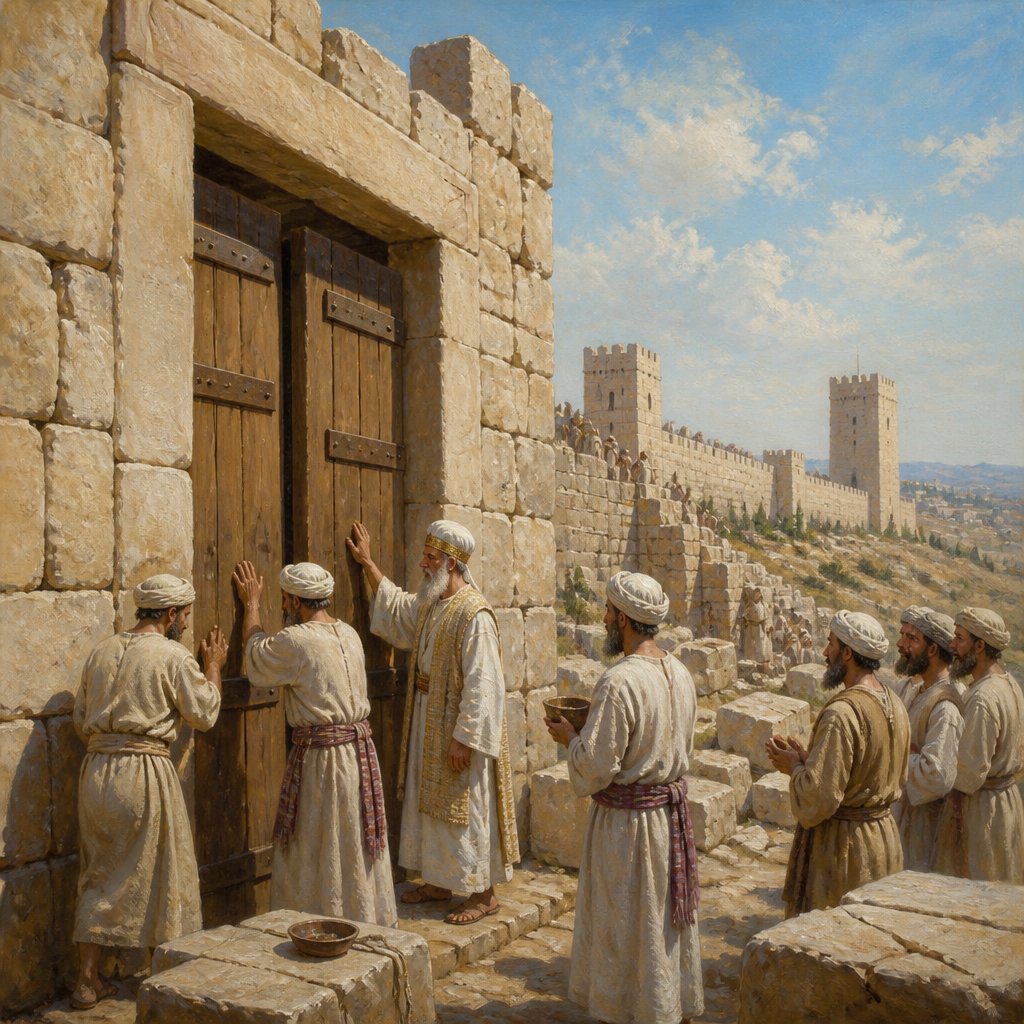
Nehemiah 3:1 (KJV) reads: "Then Eliashib the high priest rose up with his brethren the priests, and they builded the sheep gate; they sanctified it, and set up the doors of it; even unto the tower of Meah they sanctified it, unto the tower of Hananeel."
In these few lines, we are transported to a significant moment in the history of Israel, a pivotal time when the people, after years of captivity and desolation, sought to rebuild and restore what had been lost – both in their physical city and their spiritual lives. Eliashib, the high priest, is introduced not just as a leader of the clergy, but as a catalyst for renewal and restoration. His name means "God will restore," and indeed, God is using him to fulfill that very promise in the community of Jerusalem.
The mention of the *sheep gate* is deeply symbolic. In Ancient Israel, this gate was primarily used for bringing sheep into the city, especially those meant for sacrifices at the temple. By beginning the reconstruction with the sheep gate, Eliashib and the priests reflected an essential truth: the restoration of the city was intricately tied to the restoration of their worship and relationship with God. This gate was a reminder of the sacrificial system that connected the people with their God, a foreshadowing of the ultimate sacrifice that Christ would later embody.
As we ponder this scripture, it compels us to examine the gates of our lives. Just as the sheep gate was the entry point for sheep to be sacrificed, we must ask ourselves what entrances we are building in our own lives for the sacred. Are we making room for worship, prayer, and the presence of God? Are we sanctifying the spaces in our hearts and homes where His Spirit can dwell? Sanctification is a conscious act of setting apart – a declaration that what we create and establish is holy and meant for God's glory.
The act of building the sheep gate was not merely a physical endeavor; it symbolized a communal awakening. The people rallied together, priests and laypeople, to undertake this task. In our context, we often find solitude in our faith journeys; however, Nehemiah 3:1 exemplifies the strength found in community. The body of Christ is called to work hand-in-hand, each member playing a vital role in the construction and preservation of the kingdom of God on earth. Consequently, we must ask ourselves: Who are we building with? Who are the 'brethren' in our lives that join us in laying down the spiritual foundations and setting up divine doors? Are we fostering relationships that inspire holiness and encourage each other to rise up in faith?
As the priests sanctified the sheep gate, they not only constructed it but also dedicated it to God. This purposeful act of sanctification reminds us of our own call to dedicate our work, our careers, our relationships, and our time to Him. It leads us to reflect on whether we have made commitments solely to worldly aims or if we have set our foundations in sacred ground. Everything we do should be a reflection of our relationship with God, and this passage challenges us to rethink how we approach the bricks-and-mortar aspects of our lives.
Moreover, the mention of the towers of Meah and Hananeel extends the boundaries of their labor. Towers often symbolized strength and protection. It urges us to consider how our lives stand firm in Christ amidst external pressures and adversities. Are we erecting towers that symbolize our faith standing strong against trials and tribulations? Each tower we build through faith acts as a testament to God’s glory and faithfulness.
In closing, Nehemiah 3:1 beckons us to rise up like Eliashib and actively participate in the work of God. Let it challenge us to build our lives, our churches, and our communities on the foundation of faith, commitment, and sanctification. May we open the gates of our hearts for His presence and dedicate every aspect of our lives to bring honor to His name, for in the act of rebuilding, we too experience personal renewal and a deeper relationship with our Savior.
Want to reflect more on Nehemiah 3:1?
Continue your spiritual journey with Bible Chat — an AI-powered tool for exploring God's Word through conversation. Ask questions, discover connections, and deepen your understanding.
Get Our Apps


Nehemiah 3:1 Artwork

Nehemiah 3:1 - "Then Eliashib the high priest rose up with his brethren the priests, and they builded the sheep gate; they sanctified it, and set up the doors of it; even unto the tower of Meah they sanctified it, unto the tower of Hananeel."
"Then Eliashib the high priest rose up with his brethren the priests, and they builded the sheep gate; they sanctified it, and set up the doors of it; even unto the tower of Meah they sanctified it, unto the tower of Hananeel." - Nehemiah 3:1

Nehemiah 1:3 - "And they said unto me, The remnant that are left of the captivity there in the province are in great affliction and reproach: the wall of Jerusalem also is broken down, and the gates thereof are burned with fire."

Nehemiah 12:3 - "Shechaniah, Rehum, Meremoth,"

Nehemiah 10:3 - "Pashur, Amariah, Malchijah,"

Nehemiah 1:1 - "The words of Nehemiah the son of Hachaliah. And it came to pass in the month Chisleu, in the twentieth year, as I was in Shushan the palace,"

Nehemiah 10:1 - "Now those that sealed were, Nehemiah, the Tirshatha, the son of Hachaliah, and Zidkijah,"

Nehemiah 3:22 - "And after him repaired the priests, the men of the plain."

Nehemiah 3:16 - "After him repaired Nehemiah the son of Azbuk, the ruler of the half part of Beth-zur, unto the place over against the sepulchres of David, and to the pool that was made, and unto the house of the mighty."

"Pashur, Amariah, Malchijah," - Nehemiah 10:3

"Shechaniah, Rehum, Meremoth," - Nehemiah 12:3

Nehemiah 11:1-19

Nehemiah 3:32 - "And between the going up of the corner unto the sheep gate repaired the goldsmiths and the merchants."

Nehemiah 3:5 - "And next unto them the Tekoites repaired; but their nobles put not their necks to the work of their Lord."

Nehemiah 11:13

Nehemiah 8:10

Nehemiah 3:3 - "But the fish gate did the sons of Hassenaah build, who also laid the beams thereof, and set up the doors thereof, the locks thereof, and the bars thereof."

Nehemiah 3:9 - "And next unto them repaired Rephaiah the son of Hur, the ruler of the half part of Jerusalem."

Nehemiah 3:18 - "After him repaired their brethren, Bavai the son of Henadad, the ruler of the half part of Keilah."

Nehemiah 3:11 - "Malchijah the son of Harim, and Hashub the son of Pahath-moab, repaired the other piece, and the tower of the furnaces."

Nehemiah 3:2 - "And next unto him builded the men of Jericho. And next to them builded Zaccur the son of Imri."

Nehemiah 3:28 - "From above the horse gate repaired the priests, every one over against his house."

Nehemiah 11:11-14

Nehemiah 13:3 - "Now it came to pass, when they had heard the law, that they separated from Israel all the mixed multitude."

"The words of Nehemiah the son of Hachaliah. And it came to pass in the month Chisleu, in the twentieth year, as I was in Shushan the palace," - Nehemiah 1:1

"And after him repaired the priests, the men of the plain." - Nehemiah 3:22

"Now those that sealed were, Nehemiah, the Tirshatha, the son of Hachaliah, and Zidkijah," - Nehemiah 10:1

Nehemiah 3:12 - "And next unto him repaired Shallum the son of Halohesh, the ruler of the half part of Jerusalem, he and his daughters."

Nehemiah book overview with element mentioned

Nehemiah 3:26 - "Moreover the Nethinims dwelt in Ophel, unto the place over against the water gate toward the east, and the tower that lieth out."