The Sound of Mourning: A Call to Deeper Understanding
"Therefore I will wail and howl, I will go stripped and naked: I will make a wailing like the dragons, and mourning as the owls." - Micah 1:8
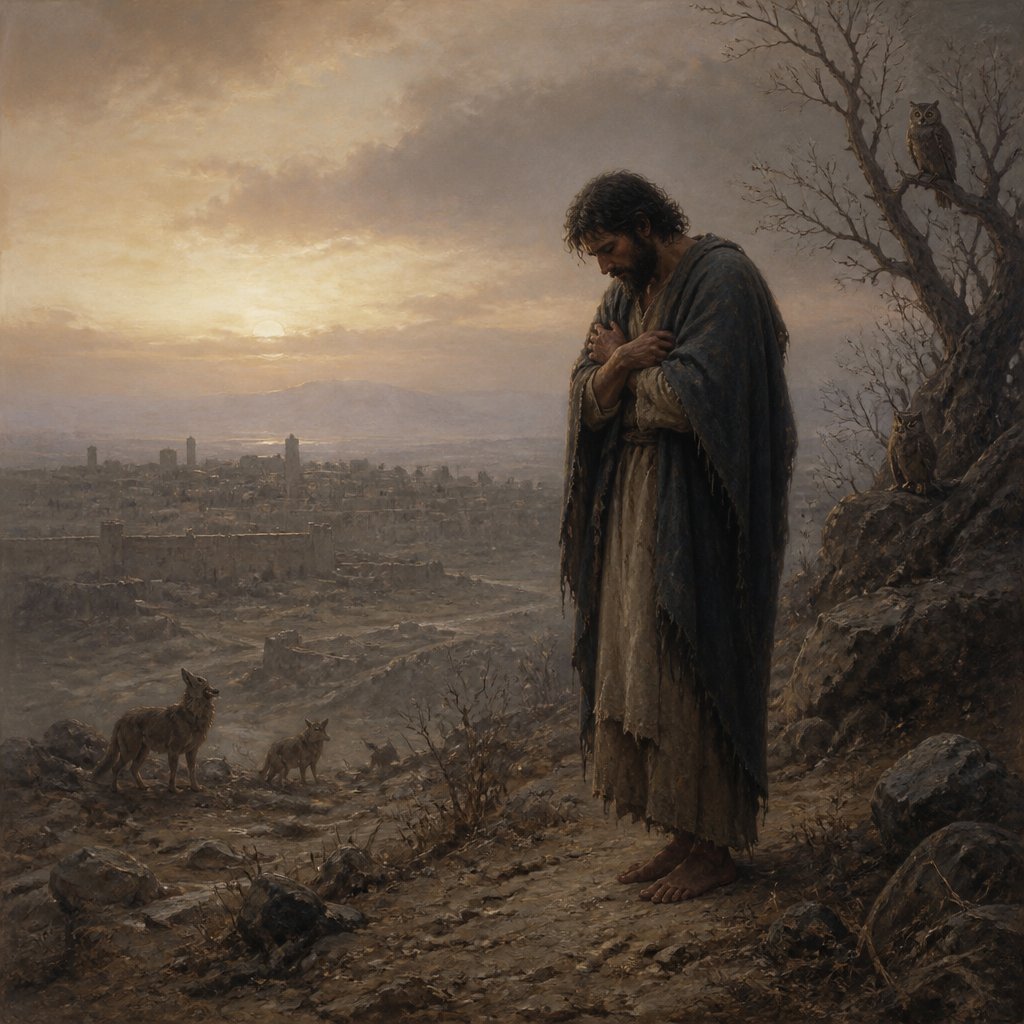
In Micah 1:8, we read a poignant and visceral expression of grief from the prophet Micah: "Therefore I will wail and howl, I will go stripped and naked: I will make a wailing like the dragons, and mourning as the owls." This verse captures the deep emotional turmoil and the severe consequences of sin and injustice within God’s chosen people. As we delve into the implications of Micah’s words, we come to recognize the state of our own hearts and the world around us—calling us not just to observe but to respond with mourning and action.
Micah proclaims that he will "wail and howl," an indication of his utter distress. In times of sorrow, expressing grief is essential. It is the heart's natural response to pain, confusion, and loss. Often, however, in the hustle and bustle of modern life, we tend to suppress such feelings, fearing the vulnerability that comes with open lament. Micah, on the other hand, models the biblical approach of allowing ourselves to feel deeply. He embodies a grieving heart, engaging fully with his emotions as he prepares to stand before God and the people. There is no shame in expressing grief; it is a crucial step in the process of healing, repentance, and restoration.
Furthermore, the act of going "stripped and naked" symbolizes a shedding of worldly comforts. In this moment of mourning, Micah removes any pretense of stability or security that may distract from the weight of the sorrow he bears. Nakedness in Scripture often represents vulnerability and exposure. When we lay aside our defenses—possessions, achievements, and even our reputations—we unveil our true selves before God, grounded in humility and authenticity. This raw openness is necessary for God to work in our lives; we cannot experience transformation while clinging to false identities or worldly distractions.
Micah’s comparison of his wailing to that of dragons and owls underscores the sense of urgency and despair of his crying out. In the biblical context, dragons symbolize chaos and desolation, while owls are nocturnal creatures traditionally tied to loneliness and mourning. In these images, Micah illustrates the depths of his anguish and the profound state of the people’s sin. He laments not only for his own soul but also for the collective state of the nation, highlighting a communal sense of guilt and the need for divine mercy.
As we reflect on Micah’s lament, we are faced with the challenge of how we respond to the injustices in our world today. Are we comfortably numb, or do we feel the weight of sorrow for the suffering around us? In a society driven by success and distraction, we must not forget the call to grieve for our communities, our nation, and our world. Jesus Himself wept over Jerusalem (Luke 19:41-44), showing us that deep sorrow for sin and suffering is vital in the heart of a true follower.
Micah’s wailing is a prophetic denunciation aimed at awakening his people from their spiritual complacency. God’s call often includes moments of deep reflection and lamentation, leading to repentance and renewal. As we partake in this journey of mourning, let us also carry the promise of hope—the assurance that through our lamenting, God hears us and is drawn closer to us. He invites us to experience His healing and restoration, transforming our sorrow into joy, and our mourning into a testimony of His grace.
In conclusion, let us not shy away from the difficult emotions highlighted in Micah 1:8. Grieving for sin, both personal and collective, leads to a deeper understanding of God’s heart and the compassionate call He extends to us. May we learn to wail and howl—not out of despair, but as an expression of our longing for redemption and healing in a world that desperately needs it.
Want to reflect more on Micah 1:8?
Continue your spiritual journey with Bible Chat — an AI-powered tool for exploring God's Word through conversation. Ask questions, discover connections, and deepen your understanding.
Get Our Apps


Micah 1:8 Artwork

Micah 1:8 - "Therefore I will wail and howl, I will go stripped and naked: I will make a wailing like the dragons, and mourning as the owls."
"Therefore I will wail and howl, I will go stripped and naked: I will make a wailing like the dragons, and mourning as the owls." - Micah 1:8

1 Chronicles 8:35 - "And the sons of Micah were, Pithon, and Melech, and Tarea, and Ahaz."

1 Chronicles 8:34 - "And the son of Jonathan was Merib-baal; and Merib-baal begat Micah."

Micah 6:8

"And the sons of Micah were, Pithon, and Melech, and Tarea, and Ahaz." - 1 Chronicles 8:35

"And the son of Jonathan was Merib-baal; and Merib-baal begat Micah." - 1 Chronicles 8:34

Micah 1:1 - "The word of the LORD that came to Micah the Morasthite in the days of Jotham, Ahaz, and Hezekiah, kings of Judah, which he saw concerning Samaria and Jerusalem."

Micah 5:2-5

Judges 17:1 - "And there was a man of mount Ephraim, whose name was Micah."

Micah 3:8 - "¶ But truly I am full of power by the spirit of the LORD, and of judgment, and of might, to declare unto Jacob his transgression, and to Israel his sin."

1 Chronicles 9:41 - "And the sons of Micah were, Pithon, and Melech, and Tahrea, and Ahaz."

1 Chronicles 9:40 - "And the son of Jonathan was Merib-baal: and Merib-baal begat Micah."

Micah 4:8 - "¶ And thou, O tower of the flock, the strong hold of the daughter of Zion, unto thee shall it come, even the first dominion; the kingdom shall come to the daughter of Jerusalem."

Micah 2:8 - "Even of late my people is risen up as an enemy: ye pull off the robe with the garment from them that pass by securely as men averse from war."

"The word of the LORD that came to Micah the Morasthite in the days of Jotham, Ahaz, and Hezekiah, kings of Judah, which he saw concerning Samaria and Jerusalem." - Micah 1:1

1 Chronicles 5:5 - "Micah his son, Reaia his son, Baal his son,"

Micah 7:8 - "¶ Rejoice not against me, O mine enemy: when I fall, I shall arise; when I sit in darkness, the LORD shall be a light unto me."

Micah 6:8 - "He hath shewed thee, O man, what is good; and what doth the LORD require of thee, but to do justly, and to love mercy, and to walk humbly with thy God?"

1 Chronicles 9:15 - "And Bakbakkar, Heresh, and Galal, and Mattaniah the son of Micah, the son of Zichri, the son of Asaph;"

Micah 1:10 - "¶ Declare ye it not at Gath, weep ye not at all: in the house of Aphrah roll thyself in the dust."

Judges 17:8 - "And the man departed out of the city from Beth-lehem-judah to sojourn where he could find a place: and he came to mount Ephraim to the house of Micah, as he journeyed."

Micah 1:14 - "Therefore shalt thou give presents to Moresheth-gath: the houses of Achzib shall be a lie to the kings of Israel."

Micah 1:12 - "For the inhabitant of Maroth waited carefully for good: but evil came down from the LORD unto the gate of Jerusalem."

Micah 1:9 - "For her wound is incurable; for it is come unto Judah; he is come unto the gate of my people, even to Jerusalem."

Micah 1:3 - "For, behold, the LORD cometh forth out of his place, and will come down, and tread upon the high places of the earth."

"And there was a man of mount Ephraim, whose name was Micah." - Judges 17:1

Micah 2:1 - "Woe to them that devise iniquity, and work evil upon their beds! when the morning is light, they practise it, because it is in the power of their hand."

Micah 1:5 - "For the transgression of Jacob is all this, and for the sins of the house of Israel. What is the transgression of Jacob? is it not Samaria? and what are the high places of Judah? are they not Jerusalem?"

Micah 3:1 - "And I said, Hear, I pray you, O heads of Jacob, and ye princes of the house of Israel; Is it not for you to know judgment?"