The Weight of Transgression: A Call to Holiness
"For the transgression of Jacob is all this, and for the sins of the house of Israel. What is the transgression of Jacob? is it not Samaria? and what are the high places of Judah? are they not Jerusalem?" - Micah 1:5
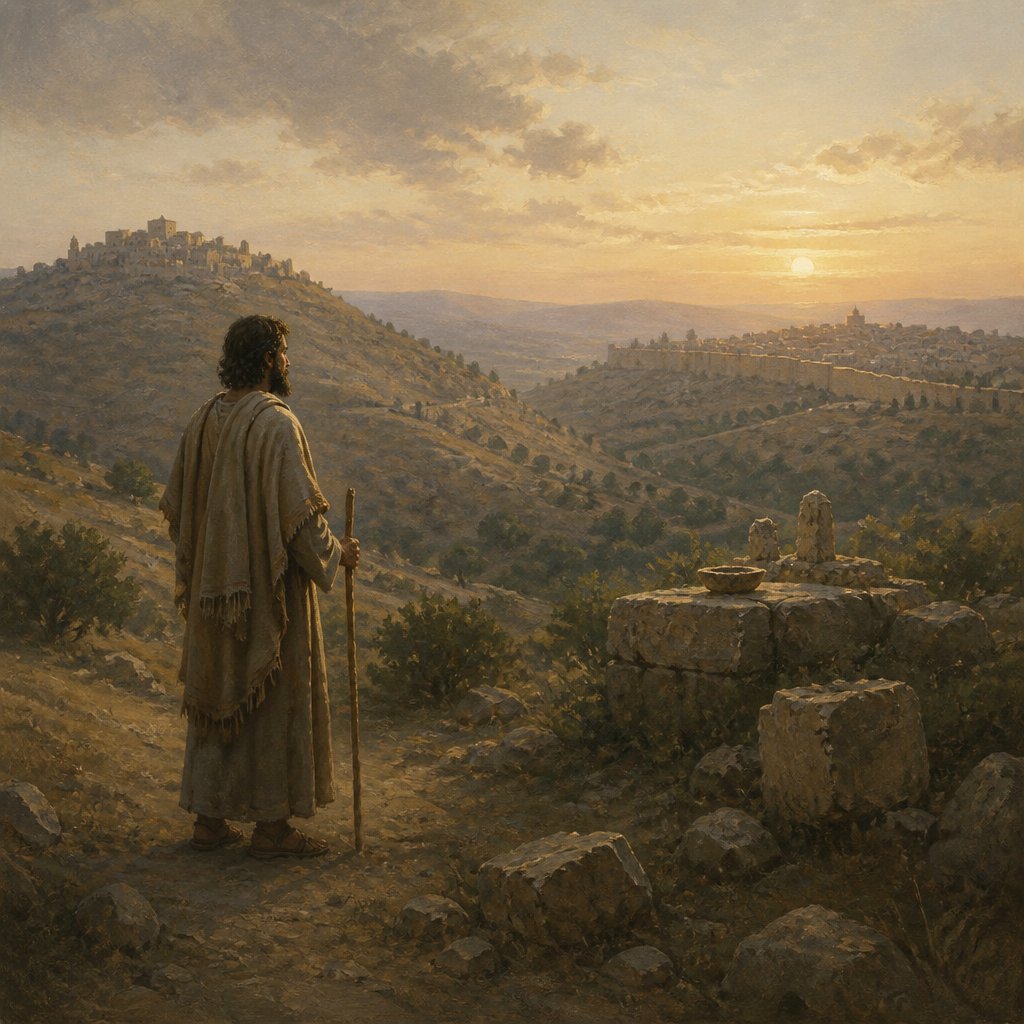
In Micah 1:5, the profound lament of the prophet Micah echoes the spiritual and moral decay present in Israel and Judah: "For the transgression of Jacob is all this, and for the sins of the house of Israel. What is the transgression of Jacob? is it not Samaria? and what are the high places of Judah? are they not Jerusalem?" This verse serves as both a declaration of judgment and a call to introspection, urging readers to reflect on their own walk with God and the consequences of disobedience.
Micah, speaking to the heart of Israel, draws attention to the specific sins that have become a part of the national identity of both Samaria and Jerusalem. Samaria, as the capital of the northern kingdom, represents widespread idolatry and injustice, while Jerusalem, the seat of the southern kingdom, epitomizes betrayal of God's covenant amidst the very places intended for worship. It is in these cities that the true nature of transgression is revealed: a departure from the worship of Yahweh and an embrace of worldly ideals.
When Micah mentions "the transgression of Jacob," he is not merely pointing to individual acts of sin but to a collective failure of a people who were chosen by God to reflect His holiness to the world. The sins of the house of Israel, encompassing both moral decay and spiritual compromise, are cyclical, breeding both complacency and a false sense of security. It begs the question – what do we, too, allow to become commonplace in our lives that dilutes our witness to the holiness of God?
In the context of today’s society, we must ask ourselves: What sins do we harbor in our personal and communal lives? Are we guilty of idolatry through our attachment to material possessions, status, or our own ambitions? In a world where distractions come in myriad forms—social media, entertainment, and the relentless pursuit of success—it can be easy to inadvertently prioritize these over our relationship with God, much like the inhabitants of Samaria and Jerusalem.
The notion of high places in Judah represents the altars of worship set up in disobedience to God’s commands. They symbolize a hybrid faith; a blending of the true worship of Yahweh with pagan practices. The stark reality is that today’s "high places" may manifest as cultural pressures that dilate our faith, diluting our devotion into something unrecognizable—an echo of the extravagant grace of God subverted into a comfortable, self-serving religion. This invites us to reconsider what we honor in our lives. Are there practices or beliefs that, while seemingly benign, lead us away from the absolute standard of holiness that God calls us towards?
As we reflect on Micah 1:5, let us take this moment to acknowledge that transgression beckons a response. God does not merely aim to deliver His judgment upon Israel; rather, His desire is repentance—turning back to Him. The challenge for believers today lies in understanding that every sin carries weight. Each act that pulls us away from God’s truth distances us from the life-giving relationship He longs for us to have.
In light of this, let us cast aside complacency and seek a renewed understanding of what it means to be holy as He is holy. Let us return to the foundational truths of Scripture, regularly engaging with God’s word to discern where we may have inadvertently erected our own high places.
Ultimately, Micah’s call is one of hope entwined with accountability. Yes, there is a weight to transgression, yet, in recognizing our errors and returning to God, we find grace anew. In doing so, we can reclaim the testimony of Christ’s redemptive power in our lives and shine brightly amidst a world in desperate need of His love and truth. Let us pray for strength to identify and dismantle our high places, yielding ourselves fully to the purity that He desires.
Want to reflect more on Micah 1:5?
Continue your spiritual journey with Bible Chat — an AI-powered tool for exploring God's Word through conversation. Ask questions, discover connections, and deepen your understanding.
Get Our Apps


Micah 1:5 Artwork

Micah 1:5 - "For the transgression of Jacob is all this, and for the sins of the house of Israel. What is the transgression of Jacob? is it not Samaria? and what are the high places of Judah? are they not Jerusalem?"
"For the transgression of Jacob is all this, and for the sins of the house of Israel. What is the transgression of Jacob? is it not Samaria? and what are the high places of Judah? are they not Jerusalem?" - Micah 1:5

Micah 5:2-5

1 Chronicles 5:5 - "Micah his son, Reaia his son, Baal his son,"

"Micah his son, Reaia his son, Baal his son," - 1 Chronicles 5:5

Micah 5:1 - "Now gather thyself in troops, O daughter of troops: he hath laid siege against us: they shall smite the judge of Israel with a rod upon the cheek."

Micah 1:1 - "The word of the LORD that came to Micah the Morasthite in the days of Jotham, Ahaz, and Hezekiah, kings of Judah, which he saw concerning Samaria and Jerusalem."

Micah 5:15 - "And I will execute vengeance in anger and fury upon the heathen, such as they have not heard."

Micah 2:5 - "Therefore thou shalt have none that shall cast a cord by lot in the congregation of the LORD."

Micah 5:11 - "And I will cut off the cities of thy land, and throw down all thy strong holds:"

Micah 5:12 - "And I will cut off witchcrafts out of thine hand; and thou shalt have no more soothsayers:"

Micah 5:14 - "And I will pluck up thy groves out of the midst of thee: so will I destroy thy cities."

Micah 5:9 - "Thine hand shall be lifted up upon thine adversaries, and all thine enemies shall be cut off."

Judges 17:1 - "And there was a man of mount Ephraim, whose name was Micah."

Micah 4:5 - "For all people will walk every one in the name of his god, and we will walk in the name of the LORD our God for ever and ever."

Micah 7:5 - "¶ Trust ye not in a friend, put ye not confidence in a guide: keep the doors of thy mouth from her that lieth in thy bosom."

Judges 17:5 - "And the man Micah had an house of gods, and made an ephod, and teraphim, and consecrated one of his sons, who became his priest."

Micah 5:5 - "And this man shall be the peace, when the Assyrian shall come into our land: and when he shall tread in our palaces, then shall we raise against him seven shepherds, and eight principal men."

1 Chronicles 8:35 - "And the sons of Micah were, Pithon, and Melech, and Tarea, and Ahaz."

Micah 5:7 - "And the remnant of Jacob shall be in the midst of many people as a dew from the LORD, as the showers upon the grass, that tarrieth not for man, nor waiteth for the sons of men."

1 Chronicles 9:41 - "And the sons of Micah were, Pithon, and Melech, and Tahrea, and Ahaz."

Micah 5:10 - "And it shall come to pass in that day, saith the LORD, that I will cut off thy horses out of the midst of thee, and I will destroy thy chariots:"

1 Chronicles 9:40 - "And the son of Jonathan was Merib-baal: and Merib-baal begat Micah."

"The word of the LORD that came to Micah the Morasthite in the days of Jotham, Ahaz, and Hezekiah, kings of Judah, which he saw concerning Samaria and Jerusalem." - Micah 1:1

1 Chronicles 8:34 - "And the son of Jonathan was Merib-baal; and Merib-baal begat Micah."

Micah 5:4 - "¶ And he shall stand and feed in the strength of the LORD, in the majesty of the name of the LORD his God; and they shall abide: for now shall he be great unto the ends of the earth."

Micah 5:13 - "Thy graven images also will I cut off, and thy standing images out of the midst of thee; and thou shalt no more worship the work of thine hands."

Micah 5:3 - "Therefore will he give them up, until the time that she which travaileth hath brought forth: then the remnant of his brethren shall return unto the children of Israel."

1 Chronicles 9:15 - "And Bakbakkar, Heresh, and Galal, and Mattaniah the son of Micah, the son of Zichri, the son of Asaph;"

"And I will execute vengeance in anger and fury upon the heathen, such as they have not heard." - Micah 5:15