The Call to Compassion: Living the Gospel in Action
"Naked, and ye clothed me: I was sick, and ye visited me: I was in prison, and ye came unto me." - Matthew 25:36
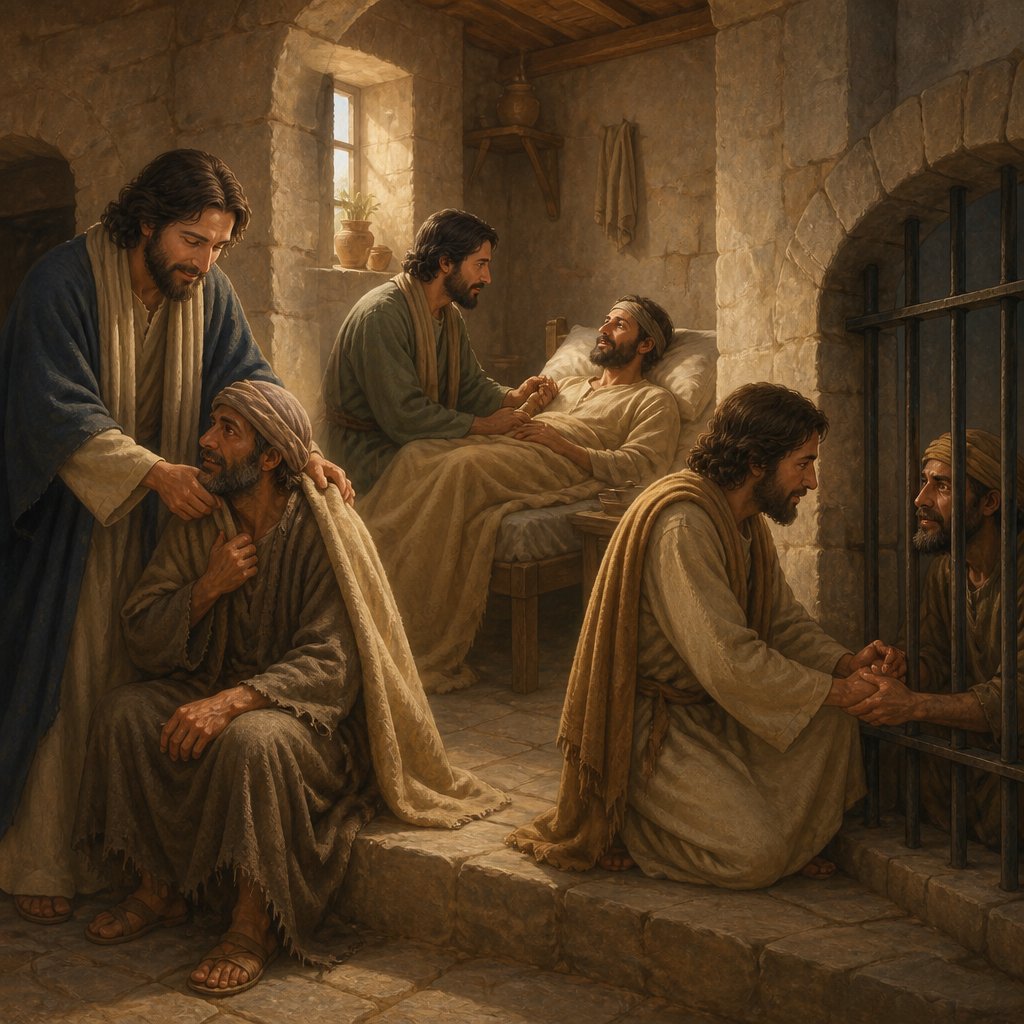
In Matthew 25:36, Jesus states, "Naked, and ye clothed me: I was sick, and ye visited me: I was in prison, and ye came unto me." This powerful proclamation encapsulates the essence of compassion that our Lord exemplifies and calls us to live out in our daily lives. In this verse, we are reminded of our duty to care for the most vulnerable among us, showcasing the heart of Christianity through acts of love and service.
To understand the depth of this scripture, we must consider the context in which Jesus speaks. This passage is part of the parable of the sheep and the goats, where Jesus illustrates the final judgment. He separates the righteous from the unrighteous based on their actions towards those in need. The righteous are commended for their service to the least of these, implying that our relationship with Christ is demonstrated through our treatment of others. The call to compassion is not merely a suggestion; it is a divine expectation.
The phrase "Naked, and ye clothed me" highlights the plight of those who are without basic necessities. In a world where materialism can often overshadow the needs of the marginalized, this part of the verse challenges us to reflect on our priorities. Clothing is a fundamental human need, and to clothe the naked is not simply about providing warmth; it is about granting dignity. Each piece of clothing we offer carries with it a message of worth and care, reminding the recipient that they are seen and valued.
Next, Jesus states, "I was sick, and ye visited me." Here, we are reminded of the importance of presence in times of suffering. Those who are sick often face not only physical ailments but also emotional isolation. Our visitation symbolizes support and empathy; it is a small yet profound act of compassion that brings hope and humanity into the dark spaces of illness. Visiting the sick is not simply about inquiring about their health; it embodies the love of Christ. It was Jesus who healed the sick and comforted the afflicted, and He invites us to do the same.
The final part of the verse states, "I was in prison, and ye came unto me." This powerful statement invites us into the complexity of justice and mercy. To visit those in prison is to confront the often uncomfortable realities of crime, punishment, and rehabilitation. It challenges us to question our perspectives on justice and forgiveness. Christ does not condone sin, but He calls us to reach out with love even to those deemed unworthy by society. Our visits can lead to transformation—not only for those incarcerated but also for ourselves, as we are often challenged to see the humanity in places that society shuns.
Living out Matthew 25:36 is not merely an act of charity; it is the embodiment of the gospel. When we clothe the naked, visit the sick, and attend to those in prison, we align ourselves with the mission of Christ. It calls us to dismantle our preconceived notions of worthiness and challenge societal norms that dictate who deserves our help. Each action becomes a thread in the fabric of the kingdom of God, where grace and mercy abound.
As we reflect on this passage, we must ask ourselves: How can we better serve those in our communities who are suffering? Are we aware of the needs around us? Compassion is a choice, one that requires our active participation. Our faith is a living faith, demonstrated through our tangible actions. Let us strive to be conduits of Christ's love, shining His light in every corner of the world, knowing full well that when we serve the least of these, we serve Christ Himself.
In conclusion, let us take to heart the words of our Savior and seek opportunities to embody His love through our actions. May our eyes be opened to the needs around us, our hearts be softened with compassion, and our feet be quick to respond in service. For it is in giving that we receive, and in serving that we find our true purpose.
Want to reflect more on Matthew 25:36?
Continue your spiritual journey with Bible Chat — an AI-powered tool for exploring God's Word through conversation. Ask questions, discover connections, and deepen your understanding.
Get Our Apps


Matthew 25:36 Artwork

Matthew 25:36 - "Naked, and ye clothed me: I was sick, and ye visited me: I was in prison, and ye came unto me."
"Naked, and ye clothed me: I was sick, and ye visited me: I was in prison, and ye came unto me." - Matthew 25:36

Matthew 12:36-37

matthew 12:36-37

Matthew 25:25

Matthew 12:36-37

Matthew 27:36 - "And sitting down they watched him there;"

Matthew 22:36 - "Master, which is the great commandment in the law?"

Genesis 36:25 - "And the children of Anah were these; Dishon, and Aholibamah the daughter of Anah."

Matthew 25: 14-25

Matthew 10:36 - "And a man's foes shall be they of his own household."

Job 36:25 - "Every man may see it; man may behold it afar off."

Matthew 24:36 - "¶ But of that day and hour knoweth no man, no, not the angels of heaven, but my Father only."

Exodus 36:25 - "And for the other side of the tabernacle, which is toward the north corner, he made twenty boards,"

Exodus 25:36 - "Their knops and their branches shall be of the same: all it shall be one beaten work of pure gold."

Matthew 26:25

Matthew 16:25

Matthew 25:21

Matthew 25:23

matthew 25:31

Matthew 25:21

Jeremiah 25:36 - "A voice of the cry of the shepherds, and an howling of the principal of the flock, shall be heard: for the LORD hath spoiled their pasture."

"And sitting down they watched him there;" - Matthew 27:36

Matthew 25:23

Matthew 21:25

Leviticus 25:36 - "Take thou no usury of him, or increase: but fear thy God; that thy brother may live with thee."

Matthew 23:36 - "Verily I say unto you, All these things shall come upon this generation."

Matthew 25:25 - "And I was afraid, and went and hid thy talent in the earth: lo, there thou hast that is thine."

"Master, which is the great commandment in the law?" - Matthew 22:36

Matthew 21:36 - "Again, he sent other servants more than the first: and they did unto them likewise."