The Healing of the Soul and Body
"Whether is it easier to say to the sick of the palsy, Thy sins be forgiven thee; or to say, Arise, and take up thy bed, and walk?" - Mark 2:9
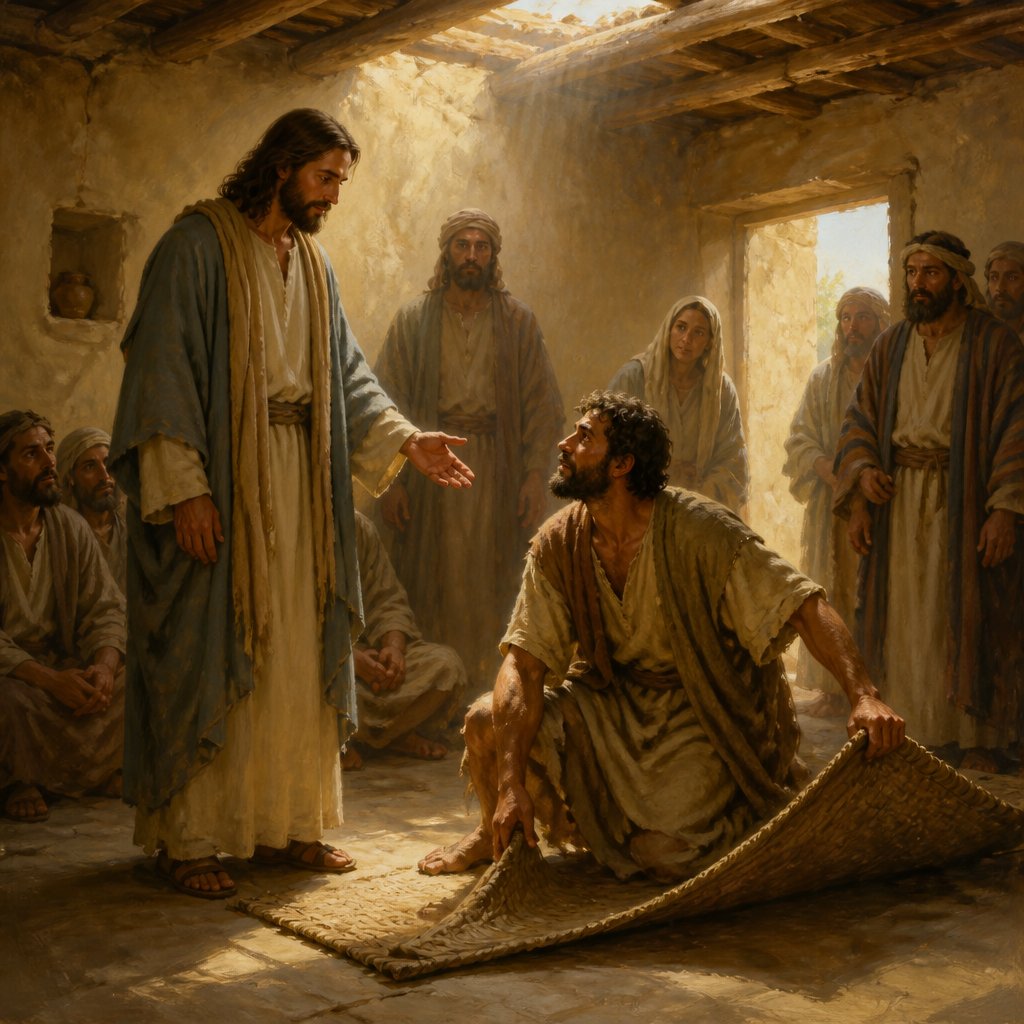
In the Gospel of Mark, we encounter the remarkable account of Jesus healing the paralytic man. In Mark 2:9, Jesus poses a thought-provoking question: "Whether is it easier to say to the sick of the palsy, Thy sins be forgiven thee; or to say, Arise, and take up thy bed, and walk?" This verse invites us to reflect on the interplay between sin, physical ailments, and the deeper longing for restoration.
To fully appreciate the gravity of Jesus' question, we must first set the scene. In Mark 2, Jesus is in Capernaum, teaching in a house so crowded that no one could enter through the door. A group of four men, desperate to bring their paralytic friend to Jesus, demonstrates unbelievable faith. They tear open the roof and lower the man down on his bed. Their actions exemplify the realization that Jesus is the answer to their friend’s deepest needs—not just physical healing, but spiritual restoration.
Jesus first addresses the man's spiritual condition, declaring, "Thy sins be forgiven thee." This statement is powerful because it acknowledges that sin can often lead to physical and emotional suffering. The spiritual bondage that sin inflicts can manifest in many forms, and for this man, it became paralysis. Jesus was not merely a healer of physical conditions; He was also the ultimate healer of the soul. This aspect is profoundly significant since it shows us that the Creator prioritizes our eternal wellbeing above our temporary existence.
The religious leaders present are taken aback by this declaration. They silently accuse Jesus of blasphemy, questioning who has the authority to forgive sins but God alone. Jesus, knowing their thoughts, poses his second question, highlighting a deeper truth:
"Which is easier?" In a sense, both commands hold immense weight.
To pronounce forgiveness demands divine authority and an understanding of the human heart's intricate workings; to heal the sick requires not a lesser power but a visible manifestation of that authority. Both acts—forgiving sins and healing—are intrinsically connected and quintessential to Christ's ministry.
The ability to heal the body illustrates the foretaste of what it means to be restored spiritually. Jesus, through His miracles, not only displayed His power but also advanced a deeper Kingdom truth—that our spiritual and physical conditions are intertwined.
In our lives, we often face situations where we feel paralyzed—by sin, guilt, or even the pressures of life. It’s a grim state, reminiscent of the paralysis of the man in the story.
However, the essence of Jesus’ question offers us profound comfort. When He speaks of forgiveness, He challenges us to consider our understanding of ease: is it ‘easier’ for us to accept forgiveness or to believe in physical healing? If we were to internalize this message, we would recognize that God’s grace is available to us regardless of our failures or situational distress.
Forgiveness is the root of our freedom; it allows us to stand up from our paralyzed state, to rise above our despair and take up our burden—proclaiming the gospel of hope. When we allow Jesus to speak the words of forgiveness into our hearts, we are set free from the chains of sin that immobilize us. Like the paralytic, we can arise, take up our bed, and walk in the light of His love and redemption.
As we meditate on this verse, let us search our hearts for what truly holds us captive. Let us remember that the easy part is not simply forgiving ourselves but embracing the radical freedom that comes from embracing Christ’s forgiveness. He calls us not only to heal but also to share in His mission—transforming lives, bringing hope to the hopeless, and proclaiming the good news to a world desperately in need of healing.
Want to reflect more on Mark 2:9?
Continue your spiritual journey with Bible Chat — an AI-powered tool for exploring God's Word through conversation. Ask questions, discover connections, and deepen your understanding.
Get Our Apps


Mark 2:9 Artwork

Mark 2:9

Mark 2:9

Mark 2:9 - "Whether is it easier to say to the sick of the palsy, Thy sins be forgiven thee; or to say, Arise, and take up thy bed, and walk?"
"Whether is it easier to say to the sick of the palsy, Thy sins be forgiven thee; or to say, Arise, and take up thy bed, and walk?" - Mark 2:9

Mark 9:2 Show only 4 people Show a mountain area According to Mark 9:2

Mark 9:2 Show only 4 people and one of them is Jesus Show a mountain area According to Mark 9:2

Mark 9:2 Do not show Jesus' face Show only 4 people including Jesus Show a mountain area therefore, show only 4 people in a mountain area and for one of them don't show the face. Mark 9:2

Mark 9:2 - "¶ And after six days Jesus taketh with him Peter, and James, and John, and leadeth them up into an high mountain apart by themselves: and he was transfigured before them."

Mark 9:38

Mark 9:36-37

Mark 9:48 - "Where their worm dieth not, and the fire is not quenched."

Mark 6:9 - "But be shod with sandals; and not put on two coats."

Mark 9:40 - "For he that is not against us is on our part."

Mark 9:46 - "Where their worm dieth not, and the fire is not quenched."

Mark 9:44 - "Where their worm dieth not, and the fire is not quenched."

Mark 9:32 - "But they understood not that saying, and were afraid to ask him."

Mark 2:2

african american mary magdalene, mark 16: 9

Mark 9:16 - "And he asked the scribes, What question ye with them?"

Mark 9:6 - "For he wist not what to say; for they were sore afraid."

Mark 9:4 - "And there appeared unto them Elias with Moses: and they were talking with Jesus."

Mark 9:27 - "But Jesus took him by the hand, and lifted him up; and he arose."

Mark 2

Mark 2

Mark 9:49 - "For every one shall be salted with fire, and every sacrifice shall be salted with salt."

Mark 9:34 - "But they held their peace: for by the way they had disputed among themselves, who should be the greatest."

Mark 8:9 - "And they that had eaten were about four thousand: and he sent them away."

Mark 10:9 - "What therefore God hath joined together, let not man put asunder."

Mark 9:11 - "¶ And they asked him, saying, Why say the scribes that Elias must first come?"

Mark 15:9 - "But Pilate answered them, saying, Will ye that I release unto you the King of the Jews?"