The Faithful Witness of Anna: A Life Dedicated to Prayer and Hope
"And there was one Anna, a prophetess, the daughter of Phanuel, of the tribe of Aser: she was of a great age, and had lived with an husband seven years from her virginity; And she was a widow of about fourscore and four years, which departed not from the temple, but served God with fastings and prayers night and day. And she coming in that instant gave thanks likewise unto the Lord, and spake of him to all them that looked for redemption in Jerusalem." - Luke 2:36-38
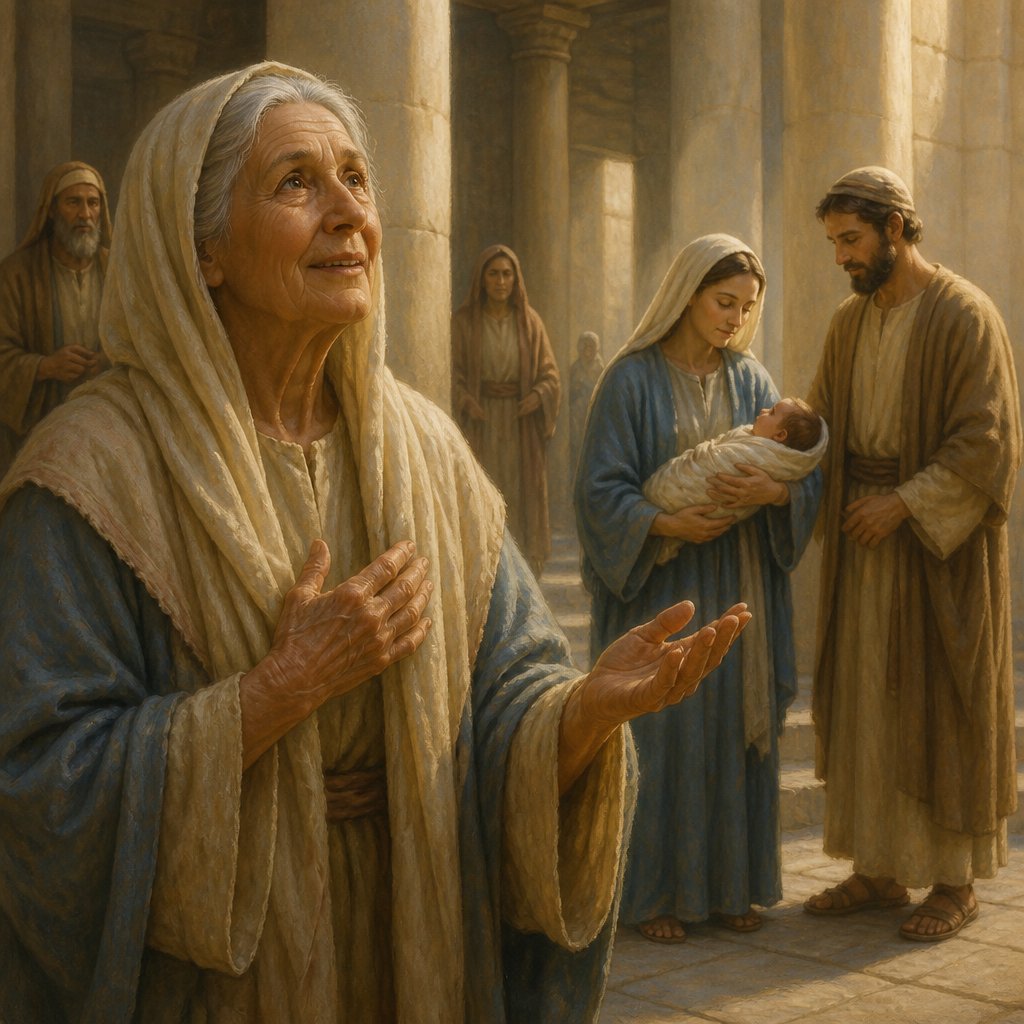
In the Gospel of Luke, amidst the wondrous events surrounding the birth of Christ, we encounter a remarkable woman named Anna—a figure who embodies unwavering faith and devotion. Luke 2:36-38 captures her unique story, revealing profound truths about God's timing, our role in His redemption plan, and the power of unwavering faith.
"And there was one Anna, a prophetess, the daughter of Phanuel, of the tribe of Aser: she was of a great age, and had lived with an husband seven years from her virginity; And she was a widow of about fourscore and four years, which departed not from the temple, but served God with fastings and prayers night and day. And she coming in that instant gave thanks likewise unto the Lord, and spake of him to all them that looked for redemption in Jerusalem" (Luke 2:36-38, KJV).
Anna is introduced to us as a prophetess, which already places her in high spiritual regard. In a culture where women were often sidelined, Anna stands out not only because she holds the title of prophetess, but also because of her lineage—she is of the tribe of Aser. This tribe was known for its abundance and blessedness, and Anna embodies this legacy not through wealth or status, but through her profound commitment to God.
The account of Anna’s life reveals her personal history marked by significant loss. After being married for seven years, she became a widow, and for the next eighty-four years, she committed herself wholly to the service of God. Imagine the depths of grief she must have experienced, yet in the wake of her personal tragedy, she chose a path of fasting and prayer. This persistence in prayer is a core aspect of her character and faith. It prompts us to reflect: how often do we find ourselves disheartened by circumstances that lead us to withdraw from God, rather than seeking Him even more fervently?
Anna’s life challenges our modern understanding of widowhood. While our society might see it as a time of loneliness or despair, Anna illustrates that it can also be a period of intense spiritual growth and devotion. She exemplifies how we can turn our grief into grace by investing our energy into serving God and praying fervently. Her refusal to depart from the temple indicates her deep desire to be close to God, to worship in community, and to await the fulfillment of God’s promise of redemption. Her commitment teaches us that in our waiting, God is working.
At the moment Anna arrives in the temple, she encounters the Holy Family—Mary, Joseph, and the infant Jesus. The text tells us she came "in that instant," highlighting the divine orchestration of events in our lives. God’s timing is perfect, and those who wait on Him are often rewarded in unimaginable ways. Anna’s immediate response upon seeing Jesus is one of worship and proclamation. She gives thanks unto the Lord, recognizing that this child is the answer to her prayers and the hope of redemption she and so many others had long awaited.
What does Anna's example mean for us today? It speaks volumes about the importance of being watchful and expectant. It encourages us to dedicate ourselves to prayer and service, particularly when facing our life’s challenges. Are we willing to serve God wholeheartedly, even when our circumstances feel overwhelming? Are we actively looking for moments where God is at work in our lives?
Let us emulate Anna in her faithfulness and her jubilant proclamation. Like Anna, may we be children of hope, whose lives reflect the beauty of anticipation in God’s promises. When we face loss or discouragement, let us draw nearer to the temple—figuratively speaking, into the presence of God, where we can find strength, purpose, and clarity. May we also be faithful witnesses, sharing the Good News of Christ's redemptive work with all who look for hope in a world of despair.
In conclusion, Anna was not just a faithful widow; she was a testament to the power of a life lived in prayer, a beacon calling others to recognize their redemption. As we reflect on her story, let us ask ourselves if we are ready to embrace our roles in His story, to await with expectation, and to share the joy of His coming with a world that desperately needs it.
Want to reflect more on Luke 2:36-38?
Continue your spiritual journey with Bible Chat — an AI-powered tool for exploring God's Word through conversation. Ask questions, discover connections, and deepen your understanding.
Get Our Apps


Luke 2:36-38 Artwork

Luke 2:36-38 - "And there was one Anna, a prophetess, the daughter of Phanuel, of the tribe of Asher: she was of a great age, and had lived with a husband seven years from her virginity; And she was a widow of about fourscore and four years, which departed not from the temple, but served God with fastings and prayers night and day. And she coming in that instant gave thanks likewise unto the Lord, and spoke of him to all them that looked for redemption in Jerusalem."
"And there was one Anna, a prophetess, the daughter of Phanuel, of the tribe of Asher: she was of a great age, and had lived with a husband seven years from her virginity; And she was a widow of about fourscore and four years, which departed not from the temple, but served God with fastings and prayers night and day. And she coming in that instant gave thanks likewise unto the Lord, and spoke of him to all them that looked for redemption in Jerusalem." - Luke 2:36-38

Job 38:36

Job 38:36

Job 38:36

Job 38:36

Luke 2:38 - "And she coming in that instant gave thanks likewise unto the Lord, and spake of him to all them that looked for redemption in Jerusalem."

Genesis 36:38 - "And Saul died, and Baal-hanan the son of Achbor reigned in his stead."

Elijah in the scene 1 Kings 18:36–38

Job 38:36 - "Who hath put wisdom in the inward parts? or who hath given understanding to the heart?"

Luke 2:36 - "And there was one Anna, a prophetess, the daughter of Phanuel, of the tribe of Aser: she was of a great age, and had lived with an husband seven years from her virginity;"

Luke 5:36

Luke 11.33-36

Exodus 36:38 - "And the five pillars of it with their hooks: and he overlaid their chapiters and their fillets with gold: but their five sockets were of brass."

Luke 5:36-38 - "He also told them a parable: “No one tears a piece from a new garment and sews it on an old garment; otherwise the new will be torn, and the piece from the new will not match the old. And no one puts new wine into old wineskins; otherwise the new wine will burst the skins and will be spilled, and the skins will be destroyed. But new wine must be put into fresh wineskins."

Luke 6:27-38

Luke 6: 27-38

Luke 7:36-50

Luke 7:36–50

Luke 19:36 - "And as he went, they spread their clothes in the way."

Luke 6:38 Give, and it will be given to you

Luke 5:38 - "But new wine must be put into new bottles; and both are preserved."

Luke 20:38 - "For he is not a God of the dead, but of the living: for all live unto him."

Luke 6:36 - "Be ye therefore merciful, as your Father also is merciful."

Luke 18:36 - "And hearing the multitude pass by, he asked what it meant."

Luke 21:38 - "And all the people came early in the morning to him in the temple, for to hear him."

Ezekiel 36:38 - "As the holy flock, as the flock of Jerusalem in her solemn feasts; so shall the waste cities be filled with flocks of men: and they shall know that I am the LORD."

Luke 20:27-38. All people of color.

Job 38:36 (KJV) Who hath put wisdom in the inward parts? or who hath given understanding to the heart?

Luke 18:38 - "And he cried, saying, Jesus, thou Son of David, have mercy on me."