No Fault Found: The Divine Innocence of Christ
"Then said Pilate to the chief priests and to the people, I find no fault in this man." - Luke 23:4
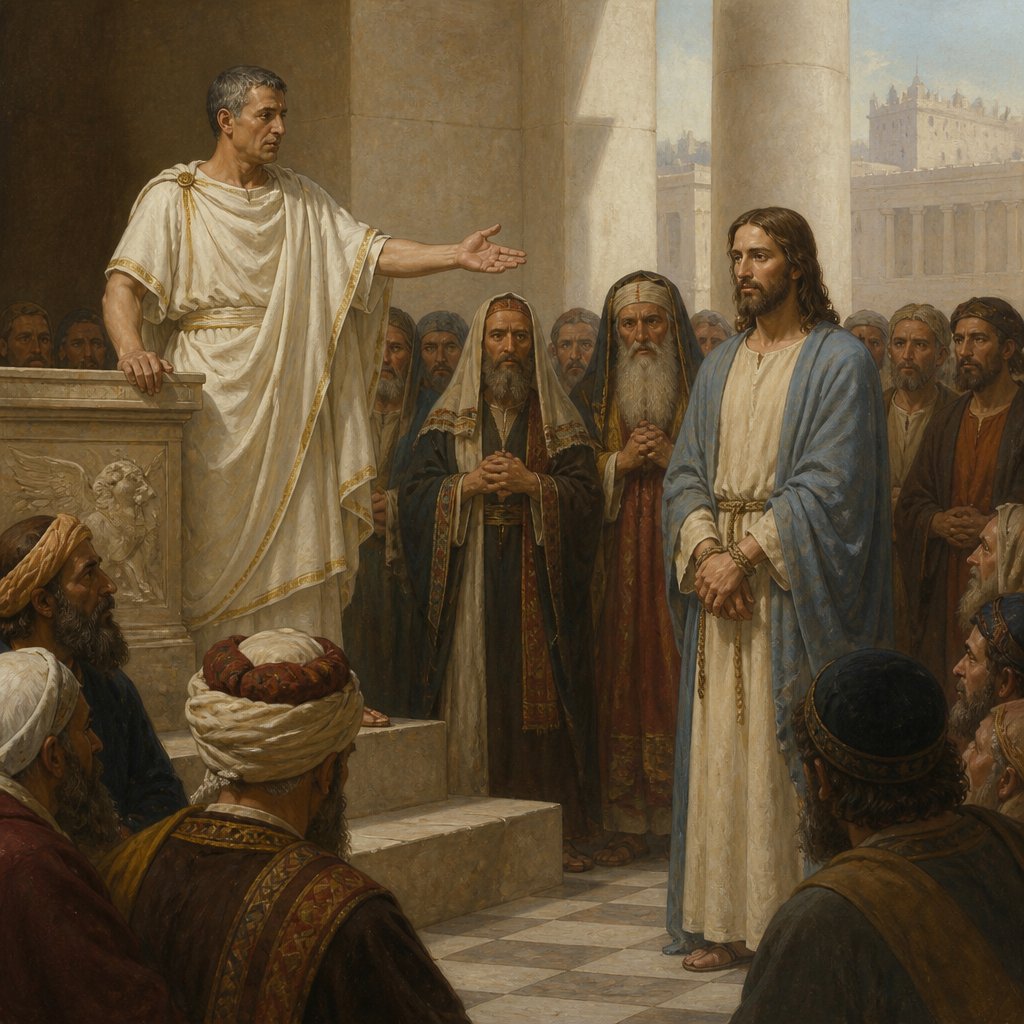
Luke 23:4 declares, "Then said Pilate to the chief priests and to the people, I find no fault in this man." This profound statement emerges during a moment of deep tension and impending injustice, as the Roman governor, Pontius Pilate, wrestles with the pressure placed upon him by the religious leaders and the populace who were clamoring for the condemnation of Jesus. This verse offers us not only a glimpse into the trial of Jesus but also invites us to reflect on the deeper implications of His inherent innocence and what it means for us as believers.
Pilate’s declaration serves as a pivotal moment in the narrative of the Passion. The context reveals that many accusations had been hurled against Christ, yet none were substantive enough for Pilate to declare Him guilty. This is significant because it highlights the profound truth that Jesus, fully God and fully man, lived a life unmarred by sin. He stood before Pilate not as a criminal, but as the embodiment of righteousness. In a world filled with moral ambiguity, we see in Christ the standard of true goodness and purity.
To grasp the depth of Pilate's admission, we must understand that he was not merely stating a legal assessment but also acknowledging a spiritual reality. The world often judges based on external factors—appearance, social standing, and perceived righteousness. Yet here stands Jesus, judged by the world and found innocent by the very authority set to condemn Him. In this encounter, we witness a clash between the truth of Jesus' character and the deception of human judgment. Pilate's statement, therefore, is not just an acquittal; it is a prophetic declaration that echoes the Psalmist's words: "The LORD looked down from heaven upon the children of men, to see if there were any that did understand, and seek God" (Psalm 14:2, KJV).
In our lives, we often find ourselves in situations where we face judgment, criticism, or misunderstanding. The world may label us by our past mistakes, but God sees beyond our failures. He knows our hearts and our struggles, and He invites us into a relationship where we stand, not in our own righteousness, but in the righteousness of Christ. Just as Pilate recognized the faultlessness of Jesus, we are called to recognize our own identity as redeemed children of God.
Furthermore, in Pilate's declaration, we see the prophetic nature of Christ's innocence. It fulfills the prophecies of old and sets the stage for Jesus’ ultimate sacrifice. As the Lamb without blemish, Jesus became the perfect sacrifice for our sins. He did not just die on a cross; He died because He bore the weight of our transgressions, and in doing so, He offers us a gracious invitation into a new covenant—a relationship where we can find true forgiveness and restoration.
When we contemplate Pilate's statement, we must ask ourselves: What does it mean that Jesus, who is without fault, chose to take our blame? This truth should lead us to a place of deep gratitude. The King of Glory, who was righteous in all His ways, willingly took upon Himself our sins to bring us back into fellowship with the Father. In moments of doubt or when we are overwhelmed by guilt, we can find comfort in knowing that we have a Savior who stands before the Father on our behalf.
In conclusion, Luke 23:4 reminds us that even in the darkest moments of injustice, God’s light shines through. Jesus remains our anchor, our defender, the one who knew no sin yet bore our sins that we might become the righteousness of God. Let us, therefore, lean into this truth, allowing it to transform how we view ourselves and others, always remembering that in Christ, there is no fault—a reality we can embrace each day.
Want to reflect more on Luke 23:4?
Continue your spiritual journey with Bible Chat — an AI-powered tool for exploring God's Word through conversation. Ask questions, discover connections, and deepen your understanding.
Get Our Apps


Luke 23:4 Artwork

Luke 23:4 - "Then said Pilate to the chief priests and to the people, I find no fault in this man."
"Then said Pilate to the chief priests and to the people, I find no fault in this man." - Luke 23:4

Luke 4:23 - "And he said unto them, Ye will surely say unto me this proverb, Physician, heal thyself: whatsoever we have heard done in Capernaum, do also here in thy country."

Luke 23:53

Luke 19:23

luke 11:23

Luke 19:23

luke 11:23

Luke 15:23

luke 11:23

luke 11:23

Luke 23:54 - "And that day was the preparation, and the sabbath drew on."

Luke 23:23 - "And they were instant with loud voices, requiring that he might be crucified. And the voices of them and of the chief priests prevailed."

Luke 23:24 - "And Pilate gave sentence that it should be as they required."

Luke 23:45 - "And the sun was darkened, and the veil of the temple was rent in the midst."

Luke 7:23 - "And blessed is he, whosoever shall not be offended in me."

Luke 23:21 - "But they cried, saying, Crucify him, crucify him."

Luke 23:16 - "I will therefore chastise him, and release him."

Luke 23:37 - "And saying, If thou be the king of the Jews, save thyself."

Luke 23:10 - "And the chief priests and scribes stood and vehemently accused him."

Proverbs 4:23

Luke 23:52 - "This man went unto Pilate, and begged the body of Jesus."

Luke 11:23 - "He that is not with me is against me: and he that gathereth not with me scattereth."

Luke 23:1 - "And the whole multitude of them arose, and led him unto Pilate."

Luke 23:20 - "Pilate therefore, willing to release Jesus, spake again to them."

Proverbs 4:23

Proverbs 4:23

Proverbs 4:23

Proverbs 4:23

Psalm 23:4