Sacrifices of Peace: Meeting God on Sacred Ground
"Also a bullock and a ram for peace offerings, to sacrifice before the LORD; and a meat offering mingled with oil: for to day the LORD will appear unto you." - Leviticus 9:4
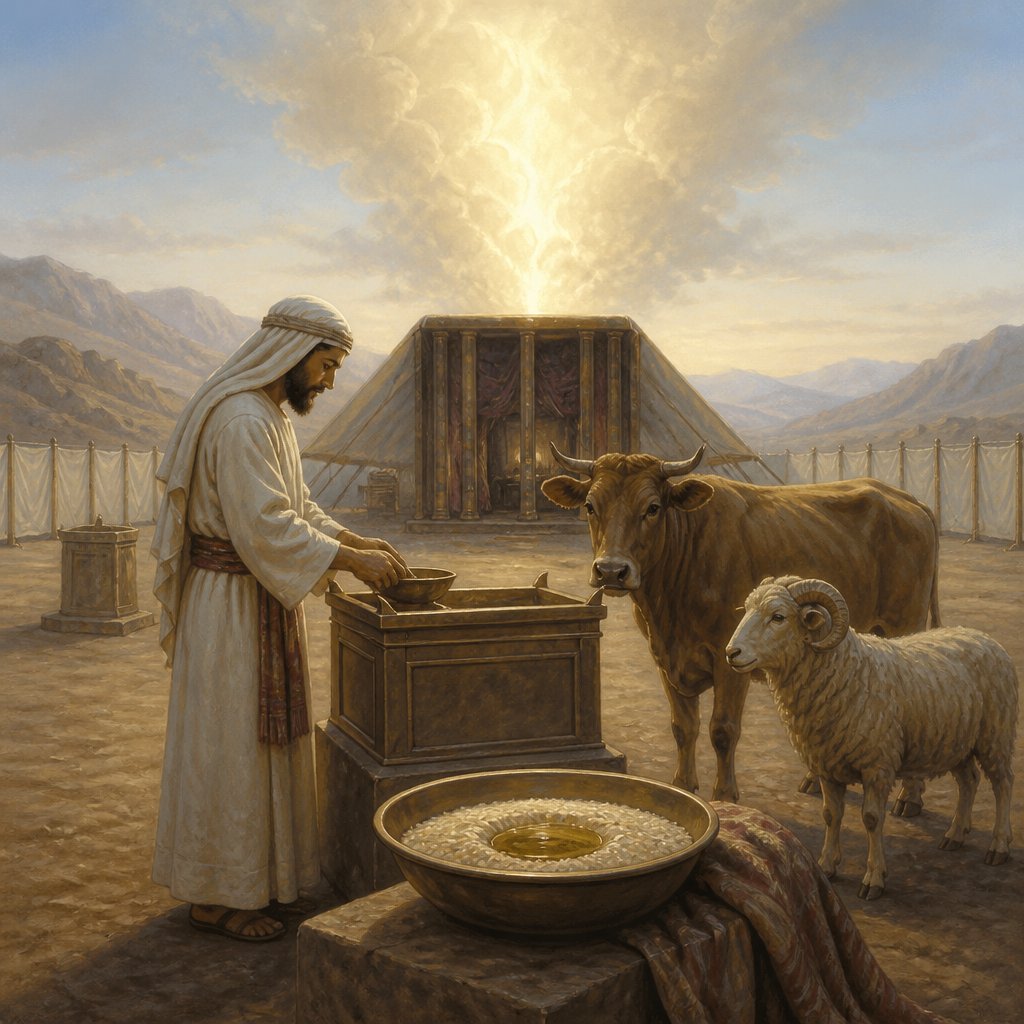
In Leviticus 9:4, we encounter a powerful moment in the Old Testament that resonates deeply with themes of sacrifice, peace, and divine presence. The King James Version (KJV) recounts: "Also a bullock and a ram for peace offerings, to sacrifice before the LORD; and a meat offering mingled with oil: for to day the LORD will appear unto you." This pivotal verse unfolds layers of meaning that can deepen our understanding of our relationship with God and the sacred nature of worship.
To appreciate the significance of this verse, we must first understand the context in which it was given. The book of Leviticus is often viewed as a manual for holiness and worship within the community of Israel. It lays out the laws and rituals that are to set the people apart from other nations, emphasizing the importance of purity, sanctity, and the right approach to God. Chapter 9 marks a climactic moment where Aaron, as the newly appointed high priest, is instructed on how to make the offerings that would enable God's presence among His people. It was not only a moment of ritual but also a profound encounter with the living God.
The offerings mentioned—a bullock and a ram for peace offerings, along with a meat offering mingled with oil—speak to the rich tradition of sacrificial worship in ancient Israel. Peace offerings were unique in that they were voluntary, symbolizing gratitude, fellowship, or celebration. Such offerings were not only meant to appease God but also to celebrate the peace and relationship that God extended to His people. In offering a bullock and ram, the Israelites acknowledged their need for atonement and the restoration of their relationship with God. As they prepared these sacrifices, they were not only following prescriptive actions; they were cultivating an attitude of humility, reverence, and thanksgiving.
Moreover, the mention of the meat offering mingled with oil highlights the richness of the offering. Oil in biblical times was considered a symbol of abundance, joy, and the Holy Spirit. It was often used to anoint and consecrate; thus, when combined with the meat offering, it represented an offering dedicated to God with joy and devotion. This intricate detail encourages us to reflect on the quality of our offering to God—whether it is our time, talents, or resources—we are invited to offer not only what is left over but the best of what we have, mixed with the oil of our devotion and love.
The concluding phrase, "for to day the LORD will appear unto you," encapsulates the ultimate purpose behind the sacrifices. It signifies an imminent encounter with the Holy One—the very reason for which the offerings are made. This invitation to experience God's presence is one of the most profound aspects of worship. The God we serve is not distant or disengaged; He longs to draw near to His people. This verse encourages us that every act of worship, every humble offering, has the potential to bring us closer to God's presence.
As we meditate on Leviticus 9:4, we are invited to ask ourselves: What are the sacrifices we are bringing before God in our lives? Are they peace offerings that celebrate our relationship with Him? Are we mingling our offerings with the oil of joy and the spirit of commitment? God invites us to meet Him in our sacred spaces, reminding us that our act of worship is a pathway to experience His presence.
In a world that often prioritizes busyness over communion, let us take the time to pause, reflect, and truly seek the face of God as we offer our hearts, lives, and resources to Him. Each offering can be a catalyst for divine encounter—a testimony of peace established by our faith. When we come before God in sincerity and faith, He will indeed appear unto us, fulfilling His promise of presence in our lives.
Want to reflect more on Leviticus 9:4?
Continue your spiritual journey with Bible Chat — an AI-powered tool for exploring God's Word through conversation. Ask questions, discover connections, and deepen your understanding.
Get Our Apps


Leviticus 9:4 Artwork

Leviticus 9:4 - "Also a bullock and a ram for peace offerings, to sacrifice before the LORD; and a meat offering mingled with oil: for to day the LORD will appear unto you."
"Also a bullock and a ram for peace offerings, to sacrifice before the LORD; and a meat offering mingled with oil: for to day the LORD will appear unto you." - Leviticus 9:4

Leviticus 4:9 - "And the two kidneys, and the fat that is upon them, which is by the flanks, and the caul above the liver, with the kidneys, it shall he take away,"
Leviticus 23:9 - "¶ And the LORD spake unto Moses, saying,"

Leviticus 26: 4-6
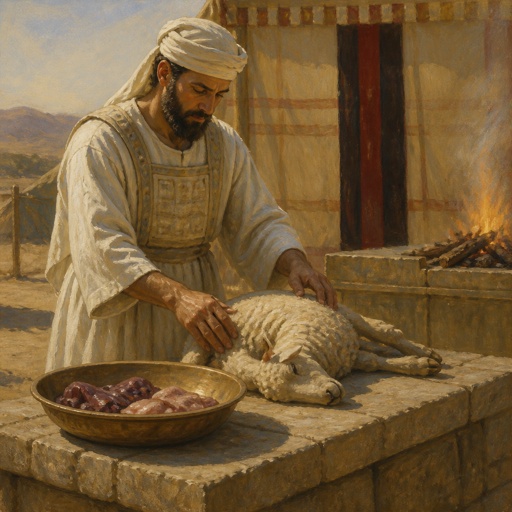
"And the two kidneys, and the fat that is upon them, which is by the flanks, and the caul above the liver, with the kidneys, it shall he take away," - Leviticus 4:9
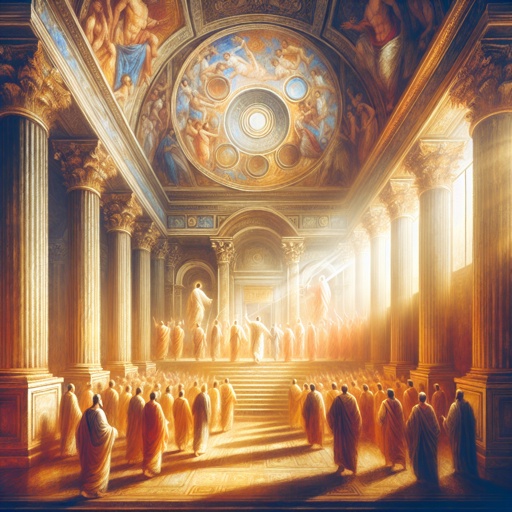
Leviticus 26: 4-6

Leviticus 26: 4-6

Leviticus 9:16 - "And he brought the burnt offering, and offered it according to the manner."

Leviticus 9:11 - "And the flesh and the hide he burnt with fire without the camp."

Leviticus 4:1 - "And the LORD spake unto Moses, saying,"

Leviticus 27:4 - "And if it be a female, then thy estimation shall be thirty shekels."

Leviticus 13:9 - "¶ When the plague of leprosy is in a man, then he shall be brought unto the priest;"

Leviticus 9:20 - "And they put the fat upon the breasts, and he burnt the fat upon the altar:"

Leviticus 9:9 - "And the sons of Aaron brought the blood unto him: and he dipped his finger in the blood, and put it upon the horns of the altar, and poured out the blood at the bottom of the altar:"

Leviticus 15:9 - "And what saddle soever he rideth upon that hath the issue shall be unclean."

Leviticus 9:14 - "And he did wash the inwards and the legs, and burnt them upon the burnt offering on the altar."

Leviticus 9:8 - "¶ Aaron therefore went unto the altar, and slew the calf of the sin offering, which was for himself."

Leviticus 9:1 - "And it came to pass on the eighth day, that Moses called Aaron and his sons, and the elders of Israel;"

Leviticus 4:16 - "And the priest that is anointed shall bring of the bullock's blood to the tabernacle of the congregation:"

Leviticus 9:19 - "And the fat of the bullock and of the ram, the rump, and that which covereth the inwards, and the kidneys, and the caul above the liver:"

Leviticus 9:21 - "And the breasts and the right shoulder Aaron waved for a wave offering before the LORD; as Moses commanded."

Leviticus 7:9 - "And all the meat offering that is baken in the oven, and all that is dressed in the fryingpan, and in the pan, shall be the priest's that offereth it."
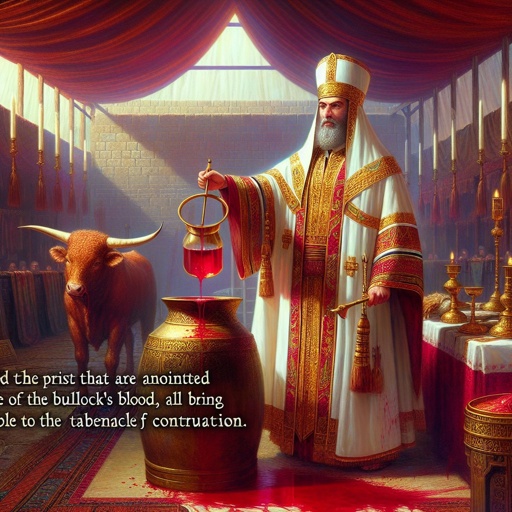
Leviticus 4:5 - "And the priest that is anointed shall take of the bullock's blood, and bring it to the tabernacle of the congregation:"

"¶ And the LORD spake unto Moses, saying," - Leviticus 23:9

Leviticus 16:9 - "And Aaron shall bring the goat upon which the LORD'S lot fell, and offer him for a sin offering."

Leviticus 24:4 - "He shall order the lamps upon the pure candlestick before the LORD continually."

Leviticus 23:4 - "¶ These are the feasts of the LORD, even holy convocations, which ye shall proclaim in their seasons."

Leviticus 9:13 - "And they presented the burnt offering unto him, with the pieces thereof, and the head: and he burnt them upon the altar."

Leviticus 9:5 - "¶ And they brought that which Moses commanded before the tabernacle of the congregation: and all the congregation drew near and stood before the LORD."