The Sacredness of Sacrifice: Understanding Leviticus 6:30
"And no sin offering, whereof any of the blood is brought into the tabernacle of the congregation to reconcile withal in the holy place, shall be eaten: it shall be burnt in the fire." - Leviticus 6:30

The book of Leviticus is often perceived as a dense collection of laws and rituals, a chapter in our spiritual understanding that many gloss over in favor of the more narrative-driven books of the Bible. However, in Leviticus 6:30, we find a principle that speaks profoundly about the sacredness of sacrifice: "And no sin offering, whereof any of the blood is brought into the tabernacle of the congregation to reconcile withal in the holy place, shall be eaten: it shall be burnt in the fire."
This verse encapsulates the essence of what it means to be in right standing with God—a theme that resonates throughout Scripture. The blood of the sin offering was not just a part of a ritual; it symbolized life, as stated in Leviticus 17:11: "For the life of the flesh is in the blood." Here, we see that the offering was not merely for the sake of ritual compliance but was an integral part of reconciling man to God. In the holy place, the blood offered was a potent symbol of sin being addressed, evil being confronted, and a life being surrendered.
The directive that the remains of the sin offering should not be consumed but rather burned in the fire calls us to contemplate the seriousness with which God addresses sin. We must recognize that sin cannot be casual; it cannot be treated lightly. The sin offering represents the gravity of sin and the absolute necessity of atonement. Eating the remains would dilute its significance and might even suggest that sin could be trivialized. In this act of burning, we see God emphasizing that our sin requires a complete and utter separation from Himself. Hence, it must be dealt with appropriately—through whole-hearted repentance and an understanding that sin has consequences that lead to death.
The burning of the offering also stands as a foreshadowing of the ultimate sacrifice to come. Christ, our sin offering, fulfilled what the Old Testament sacrifices pointed toward. Unlike the priests of Leviticus, who offered animals repeatedly, Jesus was the ultimate final sacrifice. He took upon Himself the sins of the world, and His shed blood—once and for all—brings reconciliation. Our understanding of sin and sacrifice shifts significantly when we comprehend that the bloody altar of the Old Testament finds its fulfillment in the cross of Christ.
This leads us to reflect on our own lives. What do we do with our sin? Do we attempt to consume or minimize it, perhaps by dismissing it as unimportant in the grand scheme of what it means to live? Or are we allowing God to burn away our iniquities? In our prayer life, in our holy pursuits, what do we invite into the tabernacle of our souls? Are we recognizing that sin disrupts our fellowship with the Holy and demanding a serious response from us?
As we meditate on Leviticus 6:30, we must take a moment to appreciably engage with the concept of sacrificial holiness. The cleaning and reconciling of our lives through sacrifice does not end at the cross; it continues as we offer ourselves back to God in worship and service. Paul reminds us in Romans 12:1, "I beseech you therefore, brethren, by the mercies of God, that ye present your bodies a living sacrifice, holy, acceptable unto God, which is your reasonable service."
In the light of such a great sacrifice, how do we respond? We can ignite our worship with the fiery passion of understanding that sacrifice is not a matter of tradition but a matter of profound relationship. Let's carry forward the lesson from Leviticus into our contemporary lives, recognizing our need for continual surrender and the burning away of our old selves so we may be reborn in Christ.
Want to reflect more on Leviticus 6:30?
Continue your spiritual journey with Bible Chat — an AI-powered tool for exploring God's Word through conversation. Ask questions, discover connections, and deepen your understanding.
Get Our Apps


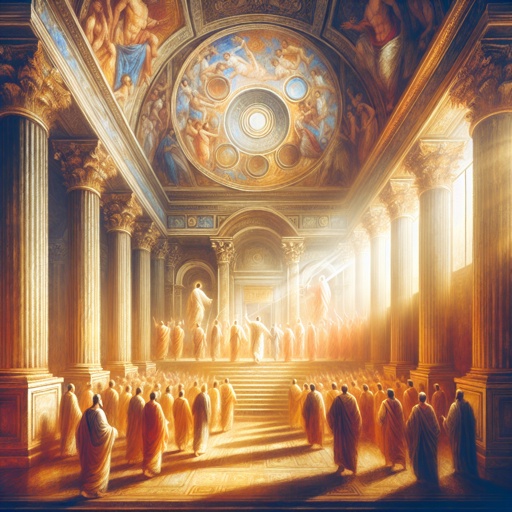
Leviticus 6:30 Artwork

Leviticus 6:30 - "And no sin offering, whereof any of the blood is brought into the tabernacle of the congregation to reconcile withal in the holy place, shall be eaten: it shall be burnt in the fire."

"And no sin offering, whereof any of the blood is brought into the tabernacle of the congregation to reconcile withal in the holy place, shall be eaten: it shall be burnt in the fire." - Leviticus 6:30

Leviticus 8:30

Leviticus 11:30 - "And the ferret, and the chameleon, and the lizard, and the snail, and the mole."

Leviticus 14:30 - "And he shall offer the one of the turtledoves, or of the young pigeons, such as he can get;"

Leviticus 19:30 - "¶ Ye shall keep my sabbaths, and reverence my sanctuary: I am the LORD."

Leviticus 27:30 - "And all the tithe of the land, whether of the seed of the land, or of the fruit of the tree, is the LORD'S: it is holy unto the LORD."

"And the ferret, and the chameleon, and the lizard, and the snail, and the mole." - Leviticus 11:30

Matthew 6:30

luke 6:30

Leviticus 22:30 - "On the same day it shall be eaten up; ye shall leave none of it until the morrow: I am the LORD."

Leviticus 26: 4-6

Leviticus 23:30 - "And whatsoever soul it be that doeth any work in that same day, the same soul will I destroy from among his people."
Leviticus 26: 4-6

Leviticus 26: 4-6

Leviticus 16:30 - "For on that day shall the priest make an atonement for you, to cleanse you, that ye may be clean from all your sins before the LORD."

Leviticus 6:24 - "¶ And the LORD spake unto Moses, saying,"

Leviticus 6:8 - "¶ And the LORD spake unto Moses, saying,"

Leviticus 6:19 - "¶ And the LORD spake unto Moses, saying,"

Leviticus 6:1 - "And the LORD spake unto Moses, saying,"

Job 30:6 - "To dwell in the clifts of the valleys, in caves of the earth, and in the rocks."

Leviticus 15:30 - "And the priest shall offer the one for a sin offering, and the other for a burnt offering; and the priest shall make an atonement for her before the LORD for the issue of her uncleanness."

Leviticus 25:30 - "And if it be not redeemed within the space of a full year, then the house that is in the walled city shall be established for ever to him that bought it throughout his generations: it shall not go out in the jubile."

Leviticus 1:6 - "And he shall flay the burnt offering, and cut it into his pieces."

Leviticus 4:30 - "And the priest shall take of the blood thereof with his finger, and put it upon the horns of the altar of burnt offering, and shall pour out all the blood thereof at the bottom of the altar."

Leviticus 26:30 - "And I will destroy your high places, and cut down your images, and cast your carcases upon the carcases of your idols, and my soul shall abhor you."

Leviticus 8:6 - "And Moses brought Aaron and his sons, and washed them with water."
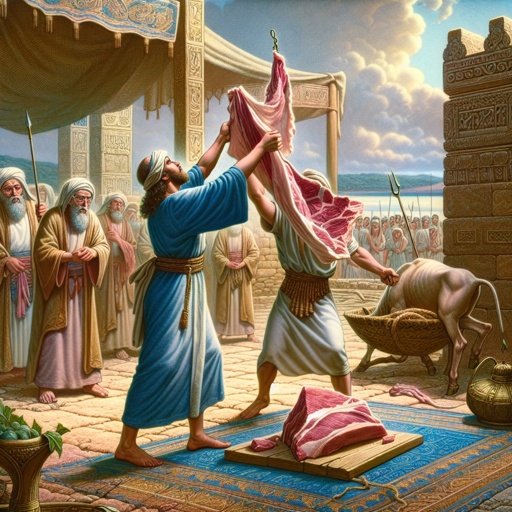
Leviticus 7:30 - "His own hands shall bring the offerings of the LORD made by fire, the fat with the breast, it shall he bring, that the breast may be waved for a wave offering before the LORD."

Leviticus 2:6 - "Thou shalt part it in pieces, and pour oil thereon: it is a meat offering."

1 Kings 6:30 - "And the floor of the house he overlaid with gold, within and without."