The Weight of Our Choices: A Reflection on Judges 9:27
"And they went out into the fields, and gathered their vineyards, and trode the grapes, and made merry, and went into the house of their god, and did eat and drink, and cursed Abimelech." - Judges 9:27
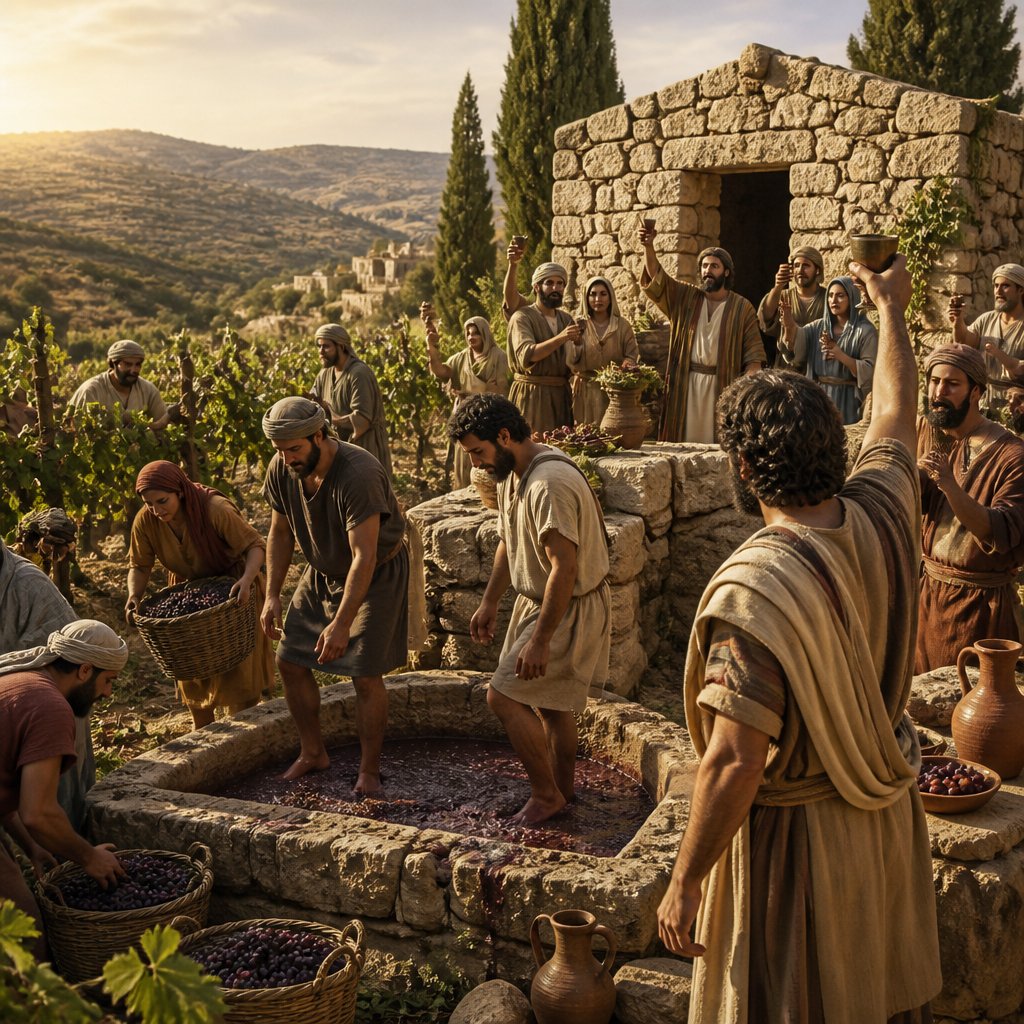
In Judges 9:27, we encounter a moment of betrayal and the weight of choices. The verse reads: "And they went out into the fields, and gathered their vineyards, and trode the grapes, and made merry, and went into the house of their god, and did eat and drink, and cursed Abimelech" (KJV). This passage invites us to reflect on the nature of celebration, the choices we make, and the consequences they bear.
At first glance, the scene depicted in Judges presents an image of festivity. The people have harvested their vineyards and are joyfully treading grapes, symbolizing both labor and the reward that comes from their efforts. They gather with a sense of community and abundance, indulging in food and drink. It is a moment filled with joy, yet it also becomes a pivotal point of rebellion and scorn against Abimelech, who had claimed rulership over them through treachery.
The act of making merry in the house of their god signifies a complex relationship between worship and rebellion. These people, despite participating in a feast that could be construed as religious celebration, find themselves cursing their leader. This duality raises a pressing question about our celebrations: what do we choose to glorify with our actions and gatherings? In celebrating our victories, do we also recognize our failures? In feasting and toasting to life, do we ever find ourselves cursing what weighs heavily on our hearts?
Abimelech was a figure born of morally ambiguous lineage, and his rise to power was marked by bloodshed and deceit. His ascent illustrates how leadership can be corrupted by betrayal, and how the fruits of such authority can lead to division rather than unity. The people’s decision to curse him while gathered in merriment reflects a profound inner conflict: they enjoyed the fruits of their labor but resented the one who claimed dominion over them. Herein lies a vital truth about leadership and influence — it should cultivate community and peace, yet it can also create division and strife.
Moreover, the act of cursing Abimelech in their place of worship draws attention to the irony of human nature. We often find ourselves caught between honoring our commitments and expressing our deep-seated frustrations. In moments of joy, we can still feel the grip of resentment. Our celebrations can be filled with shadows of discontent, strange then that creation often revels in duality. As we acknowledge the good in our lives, we must confront the obstacles and injustices that lead us to question those who lead us.
Life calls us to acknowledge that every act of worship, every gathering around a feast, should reflect both gratitude and truths we hold in our hearts. How do we seek to glorify God in our merriment when there are curses lingering beneath the surface? Our worship should not merely numb the pain or hide conflicts but should engage with and elevate the complexities of our existence.
In modern contexts, the parallels to this account are clear: as we gather with family and friends, we must be mindful of the narratives shared and the hearts present. Are we lifting up those in authority or cursing them? Are we choosing to celebrate communal moments with honesty before God?
While celebrating, let’s endeavor to respect our leaders, voice our concerns with grace, and promote healing dialogue—just as scripture guides us to resolve conflict amongst ourselves rather than allowing negativity to fester behind facade gatherings of joy. May our hearts be aligned with honesty as we eat and drink, ultimately fostering kindness, wisdom, and love in all that we do. May we remember that worshiping in the house of God should lead to lifting each other up rather than tearing each other down. In doing so, we will cultivate a community steeped not in division from our choices but in unity and growth.
Want to reflect more on Judges 9:27?
Continue your spiritual journey with Bible Chat — an AI-powered tool for exploring God's Word through conversation. Ask questions, discover connections, and deepen your understanding.
Get Our Apps


Judges 9:27 Artwork

Judges 9:27 - "And they went out into the fields, and gathered their vineyards, and trode the grapes, and made merry, and went into the house of their god, and did eat and drink, and cursed Abimelech."
"And they went out into the fields, and gathered their vineyards, and trode the grapes, and made merry, and went into the house of their god, and did eat and drink, and cursed Abimelech." - Judges 9:27

Judges 20:27 - "And the children of Israel enquired of the LORD, (for the ark of the covenant of God was there in those days,"

Judges 11:27 - "Wherefore I have not sinned against thee, but thou doest me wrong to war against me: the LORD the Judge be judge this day between the children of Israel and the children of Ammon."

Judges 9:8-15

1 Corinthians 9:25-27

1 Corinthians 9:25-27

1 Corinthians 9:25-27

1 Corinthians 9:25-27

Judges 9:50 - "¶ Then went Abimelech to Thebez, and encamped against Thebez, and took it."

Matthew 12:27 - "And if I by Beelzebub cast out devils, by whom do your children cast them out? therefore they shall be your judges."

Judges 9:22 - "¶ When Abimelech had reigned three years over Israel,"

Judges 15:9 - "¶ Then the Philistines went up, and pitched in Judah, and spread themselves in Lehi."

Judges 9:39 - "And Gaal went out before the men of Shechem, and fought with Abimelech."

Judges 21:9 - "For the people were numbered, and, behold, there were none of the inhabitants of Jabesh-gilead there."

Judges 9:10 - "And the trees said to the fig tree, Come thou, and reign over us."

Judges 9:42 - "And it came to pass on the morrow, that the people went out into the field; and they told Abimelech."

Judges 9:12 - "Then said the trees unto the vine, Come thou, and reign over us."

Judges 9:47 - "And it was told Abimelech, that all the men of the tower of Shechem were gathered together."

Psalms 98:9 - "Before the LORD; for he cometh to judge the earth: with righteousness shall he judge the world, and the people with equity."

Judges 9:9 - "But the olive tree said unto them, Should I leave my fatness, wherewith by me they honour God and man, and go to be promoted over the trees?"

Judges 9:32 - "Now therefore up by night, thou and the people that is with thee, and lie in wait in the field:"

Judges 9:14 - "Then said all the trees unto the bramble, Come thou, and reign over us."

Judges 3:27 - "And it came to pass, when he was come, that he blew a trumpet in the mountain of Ephraim, and the children of Israel went down with him from the mount, and he before them."

Judges 9:46 - "¶ And when all the men of the tower of Shechem heard that, they entered into an hold of the house of the god Berith."

Judges 9:21 - "And Jotham ran away, and fled, and went to Beer, and dwelt there, for fear of Abimelech his brother."

"And the children of Israel enquired of the LORD, (for the ark of the covenant of God was there in those days," - Judges 20:27

Judges 9:30 - "¶ And when Zebul the ruler of the city heard the words of Gaal the son of Ebed, his anger was kindled."

Job 9:24 - "The earth is given into the hand of the wicked: he covereth the faces of the judges thereof; if not, where, and who is he?"

Judges 1:9 - "¶ And afterward the children of Judah went down to fight against the Canaanites, that dwelt in the mountain, and in the south, and in the valley."