The Weight of Judgment and the Grace of Remembrance
"And the king of Ai he hanged on a tree until eventide: and as soon as the sun was down, Joshua commanded that they should take his carcase down from the tree, and cast it at the entering of the gate of the city, and raise thereon a great heap of stones, that remaineth unto this day." - Joshua 8:29
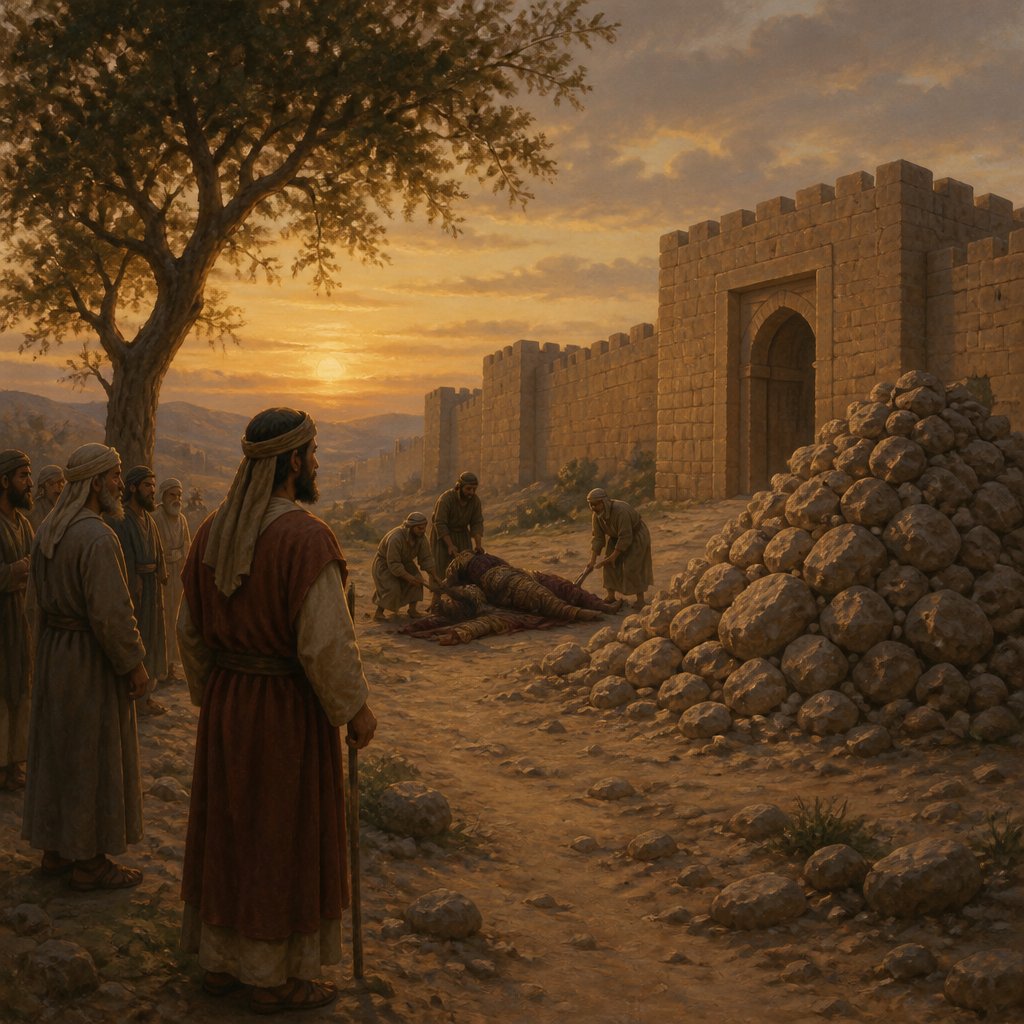
The story of Joshua and the people of Israel is one filled with triumphs and trials, obedience and deception, and the profound weight of divine justice. The verse Joshua 8:29 states: "And the king of Ai he hanged on a tree until eventide: and as soon as the sun was down, Joshua commanded that they should take his carcass down from the tree, and cast it at the entering of the gate of the city, and raise thereon a great heap of stones, that remaineth unto this day." This passage encapsulates a moment not just of victory but of solemnity, remembrance, and striking judgment that carries spiritual significance even today.
### The Context of the Passage
In the narrative surrounding Joshua’s conquest of Ai, we witness the liberation of God’s people, a task laden with delicacy and divine order. The Israelites had suffered a defeat at Ai due to the sin of Achan, but after repentance and renewed dedication to God’s commands, they subsequently defeated the city. Hanging the king of Ai symbolizes the complete and utter judgment of God upon sin and rebellion. It served as a visual testimony of the consequences of opposing God's will.
### A Solemn Reminder
Hanging a defeated enemy publicly was a common ancient practice reflecting total dominance and servitude. For the Israelites, the action was not merely punitive; it was a grave reminder of the fate that awaited those who choose to stand against God. Thus, the king of Ai’s carcass hung until evening, symbolizing the enduring reality of sin's consequences. It is a powerful statement that beckons us to reflect on our own lives and the weight of our choices—how often do we hang onto sins that, if not addressed, might lead to our downfall?
### A Command In Time
The directive from Joshua to take down the carcass at sunset is also rich in significance. In biblical culture, the setting sun often represents the end of a cycle, darkness, or death. The Israelites were commanded to remove the carcass before nightfall as a reflection of God’s principles of dignity and respect for life— even in the face of judgment. The king of Ai had met his end, yet the manner of handling his remains reminds us of the importance of mercy and respect for all, emphasizing that even in judgment, God's character calls for integrity.
### The Heap of Remembrance
When the carcass was placed at the city gates and a heap of stones was erected, the act served multiple purposes. It was a marker of remembrance—not only of the defeat of Ai and its king but a beacon and warning to future generations. The stones stood as a testament to God’s justice and a reminder of His faithfulness to His promises. Stones in Scripture often symbolize permanence; just as these stones would be a point of reflection for the Israelites, we too are called to remember the lessons of our faith journeys.
### Our Modern Application
As we meditate on this text, it invites us to examine our spiritual walk in the light of God’s holiness and justice. Are there areas in our lives where we struggle against God’s will? Are we allowing the weight of past sins to linger unaddressed? Just as Joshua ensured that the remains of the king were treated with dignity, we must grapple with how we treat our own sin and the remnants it leaves behind. Instead of allowing our sins to cast a long shadow over our lives, we are reminded to confront them, cast them aside, and erect our own proverbial heap of stones—a tribute to grace and redemption found in Christ.
In the New Testament, the ultimate act of judgment and grace converges at the cross, where the weight of all sin was carried and laid to rest. Therefore, let us not merely remember the stones of judgment, but let us also rejoice in the grace available to us through Jesus, who took our sins away and invites us into a relationship characterized by love and light. May we become living monuments of His grace, bearing witness to those around us of the redemptive power that conquers all sin.
Want to reflect more on Joshua 8:29?
Continue your spiritual journey with Bible Chat — an AI-powered tool for exploring God's Word through conversation. Ask questions, discover connections, and deepen your understanding.
Get Our Apps


Joshua 8:29 Artwork
Joshua 8:29 - "And the king of Ai he hanged on a tree until eventide: and as soon as the sun was down, Joshua commanded that they should take his carcase down from the tree, and cast it at the entering of the gate of the city, and raise thereon a great heap of stones, that remaineth unto this day."
"And the king of Ai he hanged on a tree until eventide: and as soon as the sun was down, Joshua commanded that they should take his carcase down from the tree, and cast it at the entering of the gate of the city, and raise thereon a great heap of stones, that remaineth unto this day." - Joshua 8:29

Joshua 10:29 - "Then Joshua passed from Makkedah, and all Israel with him, unto Libnah, and fought against Libnah:"

Joshua 15:29 - "Baalah, and Iim, and Azem,"

Joshua 24:29 - "¶ And it came to pass after these things, that Joshua the son of Nun, the servant of the LORD, died, being an hundred and ten years old."

"Baalah, and Iim, and Azem," - Joshua 15:29

Joshua 8:23 - "And the king of Ai they took alive, and brought him to Joshua."

Joshua 21:29 - "Jarmuth with her suburbs, En-gannim with her suburbs; four cities."

Joshua 9:8 - "And they said unto Joshua, We are thy servants. And Joshua said unto them, Who are ye? and from whence come ye?"

Joshua 8:30 - "¶ Then Joshua built an altar unto the LORD God of Israel in mount Ebal,"

Joshua 8:28 - "And Joshua burnt Ai, and made it an heap for ever, even a desolation unto this day."

Joshua 8:15 - "And Joshua and all Israel made as if they were beaten before them, and fled by the way of the wilderness."

Joshua 1:8

Joshua 24: 29-31 An image including old Jushua

Joshua 8:9 - "¶ Joshua therefore sent them forth: and they went to lie in ambush, and abode between Beth-el and Ai, on the west side of Ai: but Joshua lodged that night among the people."

Joshua 13:29 - "¶ And Moses gave inheritance unto the half tribe of Manasseh: and this was the possession of the half tribe of the children of Manasseh by their families."

Joshua 8:3 - "¶ So Joshua arose, and all the people of war, to go up against Ai: and Joshua chose out thirty thousand mighty men of valour, and sent them away by night."

"Then Joshua passed from Makkedah, and all Israel with him, unto Libnah, and fought against Libnah:" - Joshua 10:29

Joshua 4:1-8

Joshua 4:1-8

Genesis 29-8

Romans 8:29

Joshua 8:10 - "And Joshua rose up early in the morning, and numbered the people, and went up, he and the elders of Israel, before the people to Ai."

Joshua 8:18 - "And the LORD said unto Joshua, Stretch out the spear that is in thy hand toward Ai; for I will give it into thine hand. And Joshua stretched out the spear that he had in his hand toward the city."

Joshua 19:29 - "And then the coast turneth to Ramah, and to the strong city Tyre; and the coast turneth to Hosah; and the outgoings thereof are at the sea from the coast to Achzib:"

"And the king of Ai they took alive, and brought him to Joshua." - Joshua 8:23

Joshua 8:27 - "Only the cattle and the spoil of that city Israel took for a prey unto themselves, according unto the word of the LORD which he commanded Joshua."

Joshua 8:21 - "And when Joshua and all Israel saw that the ambush had taken the city, and that the smoke of the city ascended, then they turned again, and slew the men of Ai."

Joshua 8:16 - "And all the people that were in Ai were called together to pursue after them: and they pursued after Joshua, and were drawn away from the city."

Joshua 8:26 - "For Joshua drew not his hand back, wherewith he stretched out the spear, until he had utterly destroyed all the inhabitants of Ai."