When God’s Waves Close Over Us: Learning to Pray from the Deep (Jonah 2:3)
"For thou hadst cast me into the deep, in the midst of the seas; and the floods compassed me about: all thy billows and thy waves passed over me." - Jonah 2:3
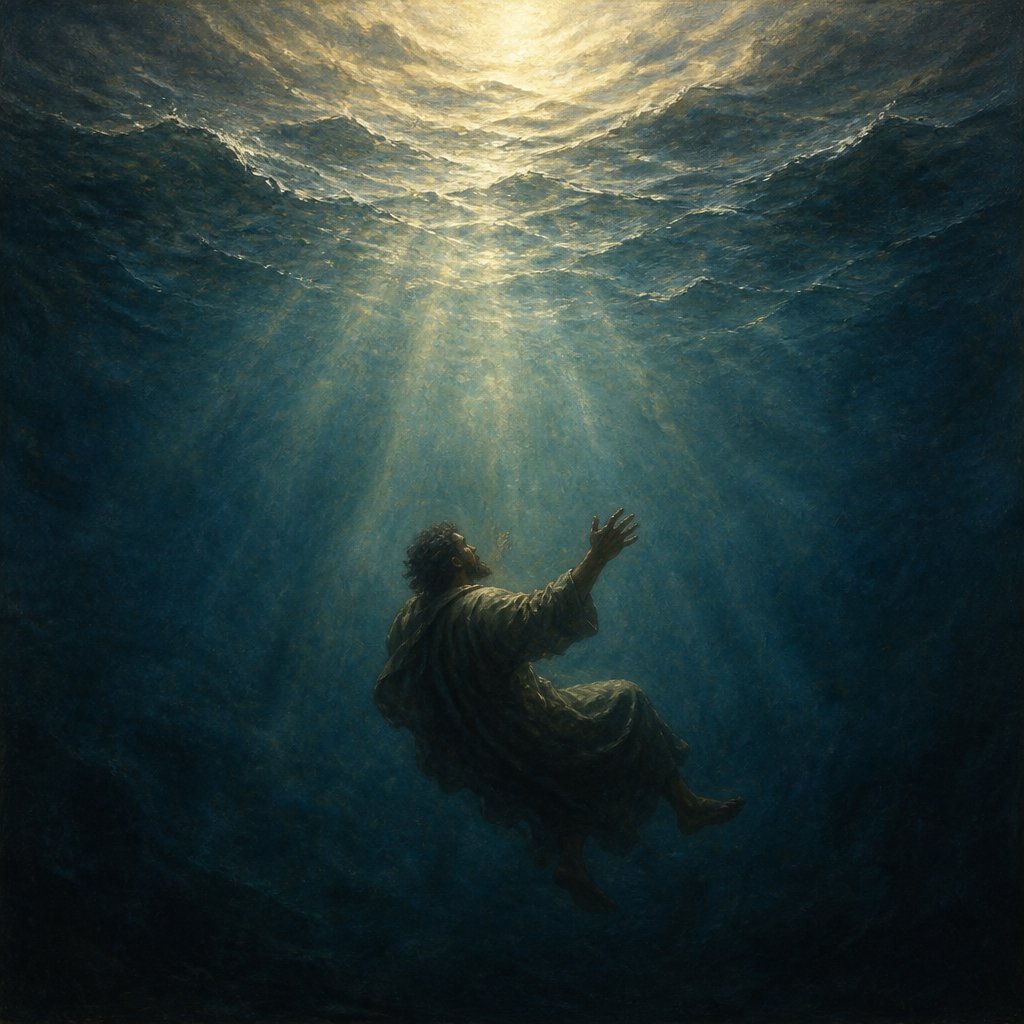
“For thou hadst cast me into the deep, in the midst of the seas; and the floods compassed me about: all thy billows and thy waves passed over me.” (Jonah 2:3, KJV)
Jonah’s prayer from the belly of the fish is not a polished speech offered from a comfortable distance. It is the cry of a man who has reached the end of himself. Jonah 2:3 gathers up the terrifying weight of his experience in a single verse: he is “cast…into the deep,” surrounded by waters that “compassed” him, overwhelmed by “billows” and “waves” that pass over him. The language is relentless. It describes a moment when escape is impossible and control is gone.
One of the most striking details is who Jonah says is responsible: “For thou hadst cast me into the deep.” Jonah does not merely blame the storm, the sailors, or bad luck. He addresses God directly. This is not irreverence—it is honesty shaped by faith. Jonah recognizes that he is not ultimately at the mercy of chaos. Even in discipline, even in consequences, even in terrifying providence, he is still dealing with the Lord. The same God who calls, commands, and pursues is the God who rules the waters.
Jonah’s words teach us that there is a difference between being overwhelmed and being abandoned. The verse sounds like abandonment—floods closing in, waves rolling over, no breath, no footing. Yet the very fact that Jonah is praying reveals something crucial: God has not cut him off. Jonah can still speak to the Lord, and the Lord can still hear. Sometimes the most painful seasons of life feel like drowning—not always because we have committed Jonah’s kind of stubborn disobedience, but because we live in a world where suffering is real. In those moments, Jonah 2:3 gives us language for prayer that is both raw and reverent: “the floods compassed me about.” It names the reality without denying the sovereignty of God.
Notice also Jonah’s repeated emphasis on what surrounds him: “in the midst of the seas… the floods compassed me about… all thy billows and thy waves passed over me.” He is boxed in from every side. This is what despair often feels like—problems in front of us, regrets behind us, fear above us, uncertainty beneath us. Yet Jonah’s phrasing contains an unexpected anchor: “thy billows” and “thy waves.” The waters are real, but they are not ultimate. They belong to God.
That truth does not minimize pain. It does something better: it puts pain into a relationship with the Lord. If the waves are “thy” waves, then the storm has boundaries, purpose, and an endpoint—even when we cannot see any of them. God’s sovereignty is not a cold doctrine; it is the only firm ground when everything else is liquid.
Jonah’s descent into the deep is also a picture of what God does to rescue us from ourselves. Jonah ran, but the Lord pursued—not to destroy him, but to restore him. Sometimes God’s mercy comes in severe forms. The deep is not where Jonah wanted to be, but it is where Jonah finally turns back to God. The floods become the place of awakening. This is one of the paradoxes of grace: the very situation that exposes our helplessness can also become the doorway into prayer, surrender, and renewed obedience.
If you feel as though “all thy billows and thy waves passed over me,” let Jonah’s verse guide your next step. Instead of rehearsing only what surrounds you, bring it to the Lord who surrounds you. Speak honestly: name the deep, the floods, the waves. Confess where you have run, if you have run. Ask for mercy, for clarity, for deliverance. And trust that the God who rules the seas is not threatened by your storm.
Jonah 2:3 reminds us that there is no depth so deep that God cannot meet us there. When the waves pass over, we may think it is the end—yet in God’s hands, it can become the beginning of repentance, the beginning of hearing again, the beginning of walking forward in His will.
Prayer: Lord, when I am in the deep and the floods compass me about, help me to remember that even the waves are in Thy hand. Teach me to pray honestly, to repent quickly, and to trust Thee fully. Amen.
Want to reflect more on Jonah 2:3?
Continue your spiritual journey with Bible Chat — an AI-powered tool for exploring God's Word through conversation. Ask questions, discover connections, and deepen your understanding.
Get Our Apps


Jonah 2:3 Artwork

Jonah 2:3 - "For thou hadst cast me into the deep, in the midst of the seas; and the floods compassed me about: all thy billows and thy waves passed over me."

"For thou hadst cast me into the deep, in the midst of the seas; and the floods compassed me about: all thy billows and thy waves passed over me." - Jonah 2:3
"For thou hadst cast me into the deep, in the midst of the seas; and the floods compassed me about: all thy billows and thy waves passed over me." - Jonah 2:3

Jonah 3:2 - "Arise, go unto Nineveh, that great city, and preach unto it the preaching that I bid thee."

Jonah 3:1 - "And the word of the LORD came unto Jonah the second time, saying,"

Jonah 3:3 - "So Jonah arose, and went unto Nineveh, according to the word of the LORD. Now Nineveh was an exceeding great city of three days' journey."

Jonah 2:2-9 Jonah praying in the belly of the fish.

Jonah 3:4 - "And Jonah began to enter into the city a day's journey, and he cried, and said, Yet forty days, and Nineveh shall be overthrown."

Jonah walking through the ancient city of Nineveh, preaching to the Assyrians. Jonah 3:4

Jonah 2:1 - "Then Jonah prayed unto the LORD his God out of the fish's belly,"

Jonah 2:10 - "¶ And the LORD spake unto the fish, and it vomited out Jonah upon the dry land."

Jonah 2:2

"And the word of the LORD came unto Jonah the second time, saying," - Jonah 3:1

Jonah 2:2-6 Jonah sinking down in the deep blue water, with the whale about to swallow him.

Jonah 2:2-8 Jonah praying in the belly if the fish - myst be realistic, no skeletons, weird teeth, etc.

Jonah 2:8

jonah 2:10 abstract

"Then Jonah prayed unto the LORD his God out of the fish's belly," - Jonah 2:1

"So Jonah arose, and went unto Nineveh, according to the word of the LORD. Now Nineveh was an exceeding great city of three days' journey." - Jonah 3:3

Jonah 2:4 Ship fit for the period in which Jonah lived. In daytime, great tempest, big waves, strong winds

"Arise, go unto Nineveh, that great city, and preach unto it the preaching that I bid thee." - Jonah 3:2

"¶ And the LORD spake unto the fish, and it vomited out Jonah upon the dry land." - Jonah 2:10

Jonah 1:3 - "But Jonah rose up to flee unto Tarshish from the presence of the LORD, and went down to Joppa; and he found a ship going to Tarshish: so he paid the fare thereof, and went down into it, to go with them unto Tarshish from the presence of the LORD."

Jonah 2:8 - "They that observe lying vanities forsake their own mercy."

"And Jonah began to enter into the city a day's journey, and he cried, and said, Yet forty days, and Nineveh shall be overthrown." - Jonah 3:4

Jonah 3:9 - "Who can tell if God will turn and repent, and turn away from his fierce anger, that we perish not?"

Jonah 3:5 - "¶ So the people of Nineveh believed God, and proclaimed a fast, and put on sackcloth, from the greatest of them even to the least of them."

Jonah 4:3 - "Therefore now, O LORD, take, I beseech thee, my life from me; for it is better for me to die than to live."

Jonah 1:2 - "Arise, go to Nineveh, that great city, and cry against it; for their wickedness is come up before me."

Jonah 2:9 - "But I will sacrifice unto thee with the voice of thanksgiving; I will pay that that I have vowed. Salvation is of the LORD."