Grace Unveiled: A Closer Look at Judgment and Mercy
"So when they continued asking him, he lifted up himself, and said unto them, He that is without sin among you, let him first cast a stone at her." - John 8:7
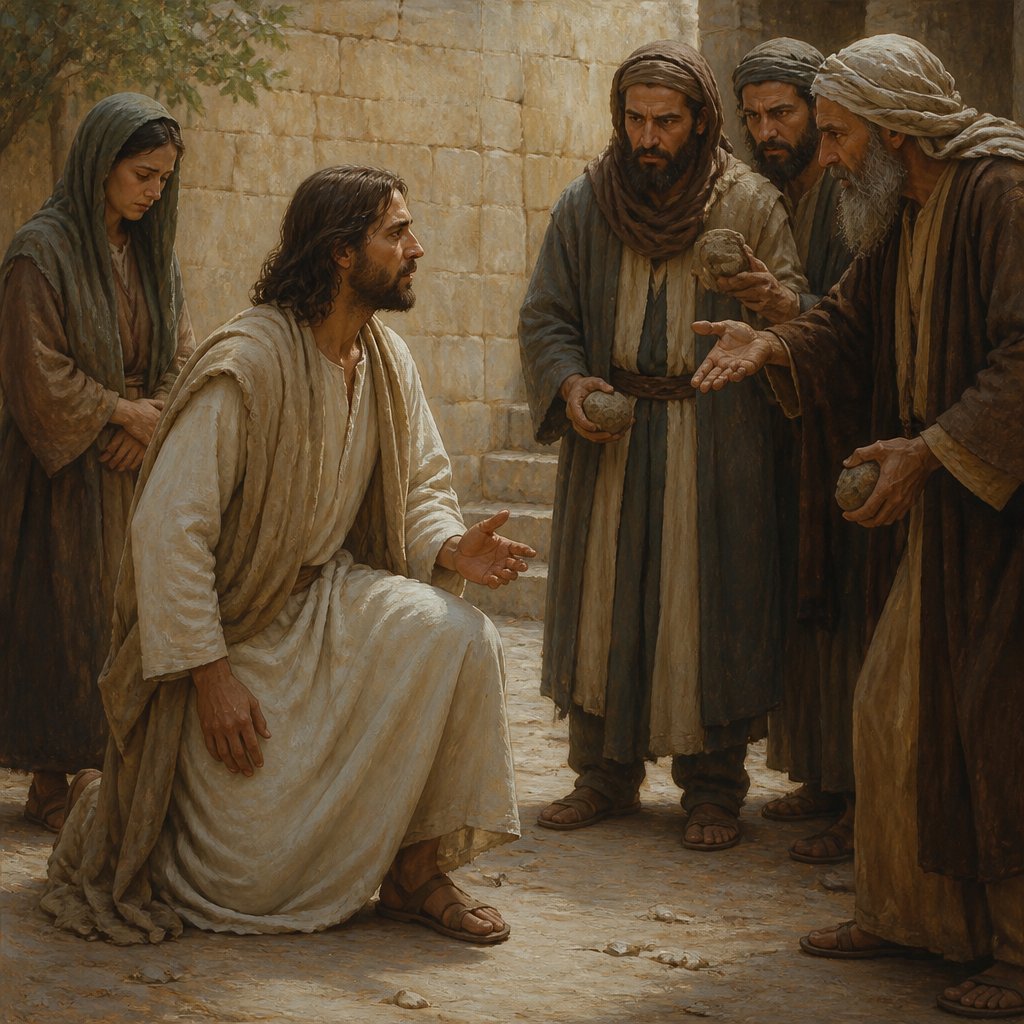
In the arena of spiritual growth and understanding, few moments are as profound as that captured in John 8:7. The scene unfolds with a woman, caught in the act of adultery, brought before Jesus by a group of Pharisees eager to trap Him in a dilemma of law versus compassion. They rallied around her, stones in hand, ready to carry out the law of Moses which called for such a sinner to face death by stoning. But as they pressed for a verdict, Jesus, in His boundless wisdom, lifts Himself up and drops a truth bomb that keeps echoing through the ages: "He that is without sin among you, let him first cast a stone at her."
This powerful declaration is a call to self-examination rather than condemnation. In it, we find an invitation to recognize our humanity and the weight of our own faults. The Pharisees, steeped in religious education, thought they understood righteousness. They believed that the law was the ultimate form of justice and held themselves as paragons of virtue. Yet, as they faced the compassionate Savior, Jesus called them to step back and examine their hearts. His words are a reminder that we are all flawed and need grace; we are all in desperate need of mercy.
As Christians, it’s so easy to adopt the position of the Pharisees; to stand in judgment of others while being blissfully unaware of our own imperfection. We can point fingers at those who have fallen short, while hiding behind the veil of our 'righteousness'. Jesus’ response challenges us to evaluate our own lives. How often do we hold onto our stones of judgment instead of extending hands of love? When was the last time we could empathize with someone's struggle rather than being quick to criticize?
The implications of Jesus’ statement resonate on multiple levels. On a personal level, it reminds us that no sin is greater than the grace of God. The woman caught in adultery is an embodiment of the very struggle we face; she represents every person who has ever stumbled and fallen, faced the accusations of others, and sought forgiveness. The relief of having those stones laid down—those judgments released—fills us with hope. We are reminded that sin does not have the final say in our lives; through Christ, we find redemption and a path towards righteousness.
On a wider scale, the implications challenge the church to create a culture of grace and restoration. How do we as a community respond to those who sin? Do we throw stones, or do we welcome them, offering them the hope of reconciliation? Our mission is reflective of Christ's actions: to extend mercy rather than judgement. When we emulate Christ, we create safe spaces for transformation instead of environments steeped in fear.
Moreover, consider the significance of ‘casting the first stone’. In an age of social media and public discourse, where opinions fly rapidly, we must ponder: what gives us the right to condemn? If we truly understand the depth of God’s grace for us, we would find ourselves hesitant to pass judgment. Instead of raising a stone, let us raise questions of love and support.
Finally, as we meditate on John 8:7, let us remember that Jesus stands among us, not to condemn, but to elevate the conversation around sin, grace, and redemption. He calls us to accountability but, even more, to mercy. In our daily lives, let us take the words of Christ to heart. Instead of seeking to cast stones, seek to give love. Instead of isolating the sinner, embrace the opportunity to guide them towards the magnificent grace that transforms lives.
The beauty of the Gospel is not merely in the absence of sin but in the presence of grace that calls us into new life. Let our hearts reflect that grace, leading us not to cast stones but to span bridges of mercy.
Want to reflect more on John 8:7?
Continue your spiritual journey with Bible Chat — an AI-powered tool for exploring God's Word through conversation. Ask questions, discover connections, and deepen your understanding.
Get Our Apps


John 8:7 Artwork

John 8:7 - "So when they continued asking him, he lifted up himself, and said unto them, He that is without sin among you, let him first cast a stone at her."
"So when they continued asking him, he lifted up himself, and said unto them, He that is without sin among you, let him first cast a stone at her." - John 8:7

John 7:8 - "Go ye up unto this feast: I go not up yet unto this feast; for my time is not yet full come."

"Beloved, let us love one another, for love is from God, and whoever loves has been born of God and knows God. Anyone who does not love does not know God, because God is love." - 1 John 4:7-8

John 8

John 8:44

John 8:44

John 8:44
John 7:38

John 15:7

John 7:38

John 8:8 - "And again he stooped down, and wrote on the ground."

1 John 4:7-8 - "Beloved, let us love one another, for love is from God, and whoever loves has been born of God and knows God. Anyone who does not love does not know God, because God is love."

John 15:7-8 - "If ye abide in me, and my words abide in you, ye shall ask what ye will, and it shall be done unto you. Herein is my Father glorified, that ye bear much fruit; so shall ye be my disciples."

John 15:7

John 7:38

John 7:38

John 7:17-18

John 7:37-39

John 7:17-18

John 7:37-39

John 8:12

John 7:17-18

John 7:17-18

John 8:12

John 8:12

John 8:12

John 7:38

John 7:38

John 7:38