Grace Amidst Judgment: The Story of the Woman Caught in Adultery
"But Jesus went unto the mount of Olives. And early in the morning he came again into the temple, and all the people came unto him; and he sat down, and taught them. And the scribes and Pharisees brought unto him a woman taken in adultery; and when they had set her in the midst, They say unto him, Master, this woman was taken in adultery, in the very act. Now Moses in the law commanded us, that such should be stoned: but what sayest thou? This they said, tempting him, that they might have to accuse him. But Jesus stooped down, and with his finger wrote on the ground, as though he heard them not. So when they continued asking him, he lifted up himself, and said unto them, He that is without sin among you, let him first cast a stone at her. And again he stooped down, and wrote on the ground. And they which heard it, being convicted by their own conscience, went out one by one, beginning at the eldest, even unto the last: and Jesus was left alone, and the woman standing in the midst. When Jesus had lifted up himself, and saw none but the woman, he said unto her, Woman, where are those thine accusers? hath no man condemned thee? She said, No man, Lord. And Jesus said unto her, Neither do I condemn thee: go, and sin no more." - John 8:1-11
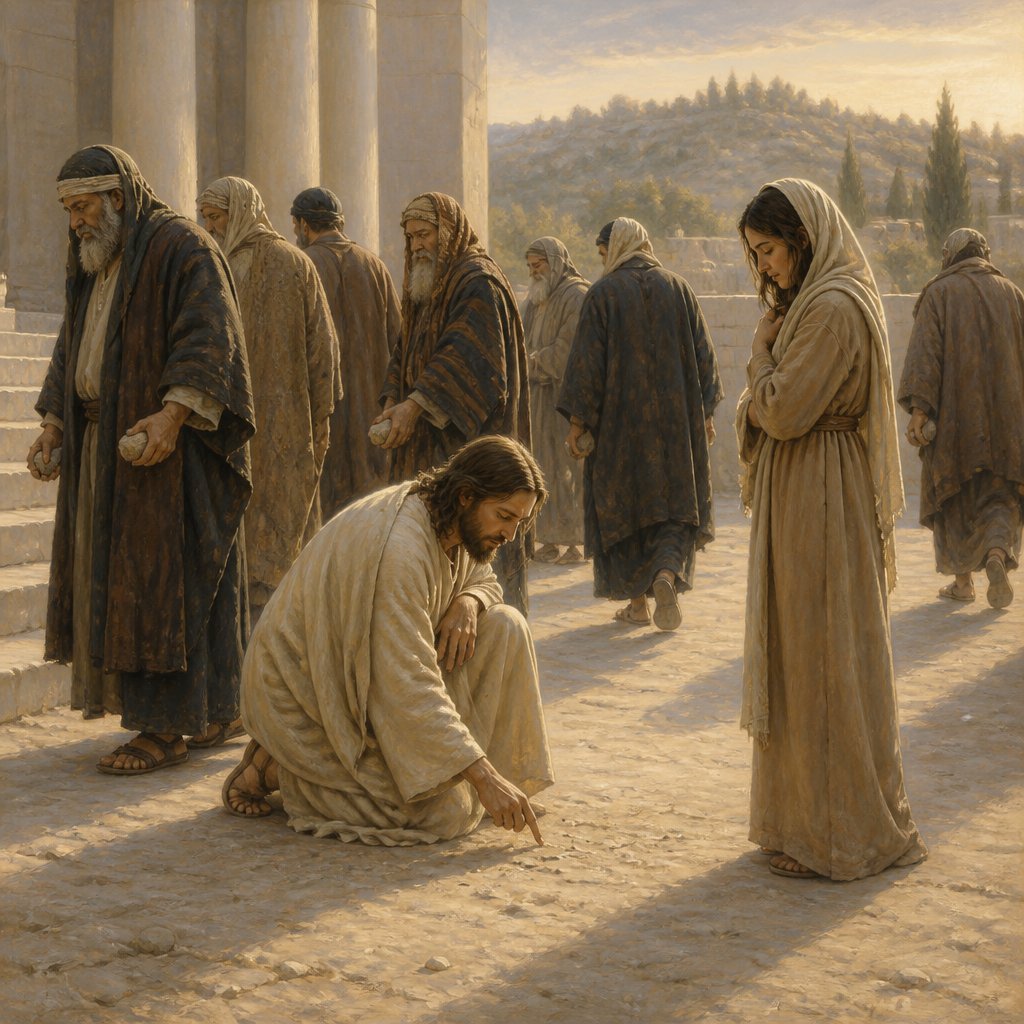
The account of the woman caught in adultery in John 8:1-11 serves as a profound narrative that encapsulates the essence of Christ’s mission: to bring grace, forgiveness, and a path to redemption. It tells us not just about Jesus' response to sin, but also reveals the heart of God toward humanity’s failings, underscoring the transformative power of divine mercy.
The scene opens with Jesus teaching in the temple early in the morning, drawing a crowd eager to hear His wisdom. Suddenly, the quiet is shattered by a group of religious leaders—the scribes and Pharisees—who bring forth a woman accused of adultery, dragging with her the weight of sin and shame. They present her before Jesus, invoking the Law of Moses, which commanded that such a woman should be stoned. Their intention is malicious, aimed at trapping Jesus in a dilemma. If He advocates for the stoning, He would be seen as lacking mercy; if He says to let her go, they would accuse Him of breaking the Law.
Jesus' response is striking and profound. Instead of engaging directly with their question, He stoops down and begins writing on the ground. This moment of silence is loaded with meaning; perhaps He is allowing the accusers' emotions to settle, or reflecting on the depth of their hypocrisy. As they continue to press Him for an answer, He stands and proclaims, "He that is without sin among you, let him first cast a stone at her."
This powerful statement is a mirror held up to the hearts of the accusers. Each man is forced to confront his own sinfulness. In doing so, Jesus challenges the rigid legalism of the Pharisees, illustrating that no one is without sin and that judgment should be left to God alone. Here, He reframes the scenario around grace rather than condemnation. One by one, beginning with the eldest, they leave, struck by their own conscience. What remains is a profound moment between Jesus and the woman who was condemned by society.
“Woman, where are those thine accusers? hath no man condemned thee?” He asks gently. Her response is one of disbelief and relief: “No man, Lord.” Jesus then declares, “Neither do I condemn thee: go, and sin no more.” Here lies the crux of the message—Jesus does not ignore the reality of her sin, but He extends grace to her. He acknowledges her guilt but simultaneously offers her a new beginning.
This narrative serves as a revelation of the heart of our Savior. He is not a judge waiting to cast stones but rather a Redeemer ready to forgive and empower. His words, "go, and sin no more," reflect the expectation of a transformed life following an encounter with grace. The forgiveness Jesus offers is not simply a dismissal of wrongdoing; it comes with a charge to live differently—encouraging us to abandon the old ways and embrace a new life.
In our contemporary context, we often find ourselves in similar positions—either as the woman trapped in our sins or as the self-righteous accuser. How easy it is to point fingers at others while neglecting our need for grace! Just as Jesus prompted the accusers to examine their own hearts, we too are called to a self-examination free from hypocrisy and judgment. Are we humble enough to acknowledge our flaws? Are we willing to approach others—not with stones in our hands, but with compassion and a desire to see them restored?
As we ponder this story, let us embrace the grace given to us through Christ and extend it to others. We are called to be conduits of His love, recognizing that we too were once lost but have now been found. The encounter between Jesus and the woman is a reminder of the breathtaking nature of grace—not as a license to continue in sin, but as an empowering call to live a life that reflects His holiness.
In a world full of judgment, let us be the voice of grace. Let us remember that as Jesus stood between condemnation and the broken, so must we stand for others, proclaiming forgiveness and the transformative power of repentance. May our lives be a testament to the mercy we have received, echoing the words of Christ as we educate others on the necessity of both grace and repentance.
Want to reflect more on John 8:1-11?
Continue your spiritual journey with Bible Chat — an AI-powered tool for exploring God's Word through conversation. Ask questions, discover connections, and deepen your understanding.
Get Our Apps


John 8:1-11 Artwork

John 8:1-11 - "But Jesus went to the Mount of Olives. Early in the morning he came again to the temple. All the people came to him, and he sat down and taught them. The scribes and the Pharisees brought a woman who had been caught in adultery, and placing her in the midst they said to him, “Teacher, this woman has been caught in the act of adultery. Now in the Law Moses commanded us to stone such women. So what do you say?” This they said to test him, that they might have some charge to bring against him. Jesus bent down and wrote with his finger on the ground. And as they continued to ask him, he stood up and said to them, “Let him who is without sin among you be the first to throw a stone at her.” And once more he bent down and wrote on the ground. But when they heard it, they went away one by one, beginning with the older ones, and Jesus was left alone with the woman standing before him. Jesus stood up and said to her, “Woman, where are they? Has no one condemned you?” She said, “No one, Lord.” And Jesus said, “Neither do I condemn you; go, and from now on sin no more.”"
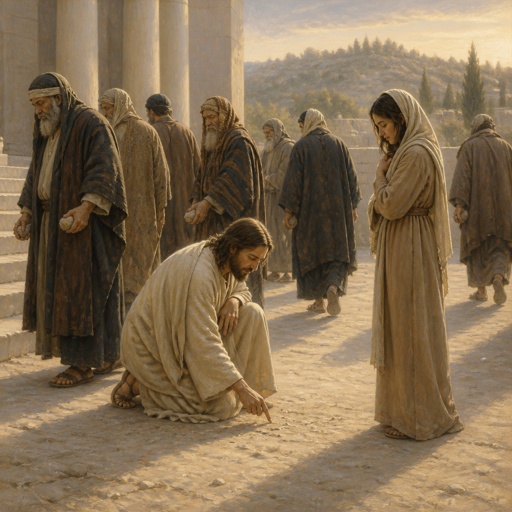
"But Jesus went to the Mount of Olives. Early in the morning he came again to the temple. All the people came to him, and he sat down and taught them. The scribes and the Pharisees brought a woman who had been caught in adultery, and placing her in the midst they said to him, “Teacher, this woman has been caught in the act of adultery. Now in the Law Moses commanded us to stone such women. So what do you say?” This they said to test him, that they might have some charge to bring against him. Jesus bent down and wrote with his finger on the ground. And as they continued to ask him, he stood up and said to them, “Let him who is without sin among you be the first to throw a stone at her.” And once more he bent down and wrote on the ground. But when they heard it, they went away one by one, beginning with the older ones, and Jesus was left alone with the woman standing before him. Jesus stood up and said to her, “Woman, where are they? Has no one condemned you?” She said, “No one, Lord.” And Jesus said, “Neither do I condemn you; go, and from now on sin no more.”" - John 8:1-11

John 8:1 - "Jesus went unto the mount of Olives."

"Jesus went unto the mount of Olives." - John 8:1

John 8:4-11

John 15:1-8

John 3:3-8

John 11:8 - "His disciples say unto him, Master, the Jews of late sought to stone thee; and goest thou thither again?"

John 1:8 - "He was not that Light, but was sent to bear witness of that Light."

John 8:11 - "She said, No man, Lord. And Jesus said unto her, Neither do I condemn thee: go, and sin no more."

Romans 8:11

1 John 1:8 - "If we say that we have no sin, we deceive ourselves, and the truth is not in us."

1 John 4:8 - "He that loveth not knoweth not God; for God is love."

Acts 1:1-11

Romans 8:1

John 1:11 - "He came unto his own, and his own received him not."

Acts 1:1-11

Psalm 80:8-11

3 John 1:8 - "We therefore ought to receive such, that we might be fellowhelpers to the truth."

2 John 1:11 - "For he that biddeth him God speed is partaker of his evil deeds."

1 Corinthians 11:8 - "For the man is not of the woman; but the woman of the man."

1 John 3:11 - "For this is the message that ye heard from the beginning, that we should love one another."

1 Chronicles 8:11 - "And of Hushim he begat Abitub, and Elpaal."

1 John 5:11 - "And this is the record, that God hath given to us eternal life, and this life is in his Son."

1 Corinthians 15:8-11

1 John 5:8 - "And there are three that bear witness in earth, the Spirit, and the water, and the blood: and these three agree in one."

1 John 4:11 - "Beloved, if God so loved us, we ought also to love one another."

John 11:1 - "Now a certain man was sick, named Lazarus, of Bethany, the town of Mary and her sister Martha."

"He was not that Light, but was sent to bear witness of that Light." - John 1:8

Revelation 1:11