The King's Rejection: A Devotional Reflection on John 19:15
"But they cried out, Away with him, away with him, crucify him. Pilate saith unto them, Shall I crucify your King? The chief priests answered, We have no king but Caesar." - John 19:15
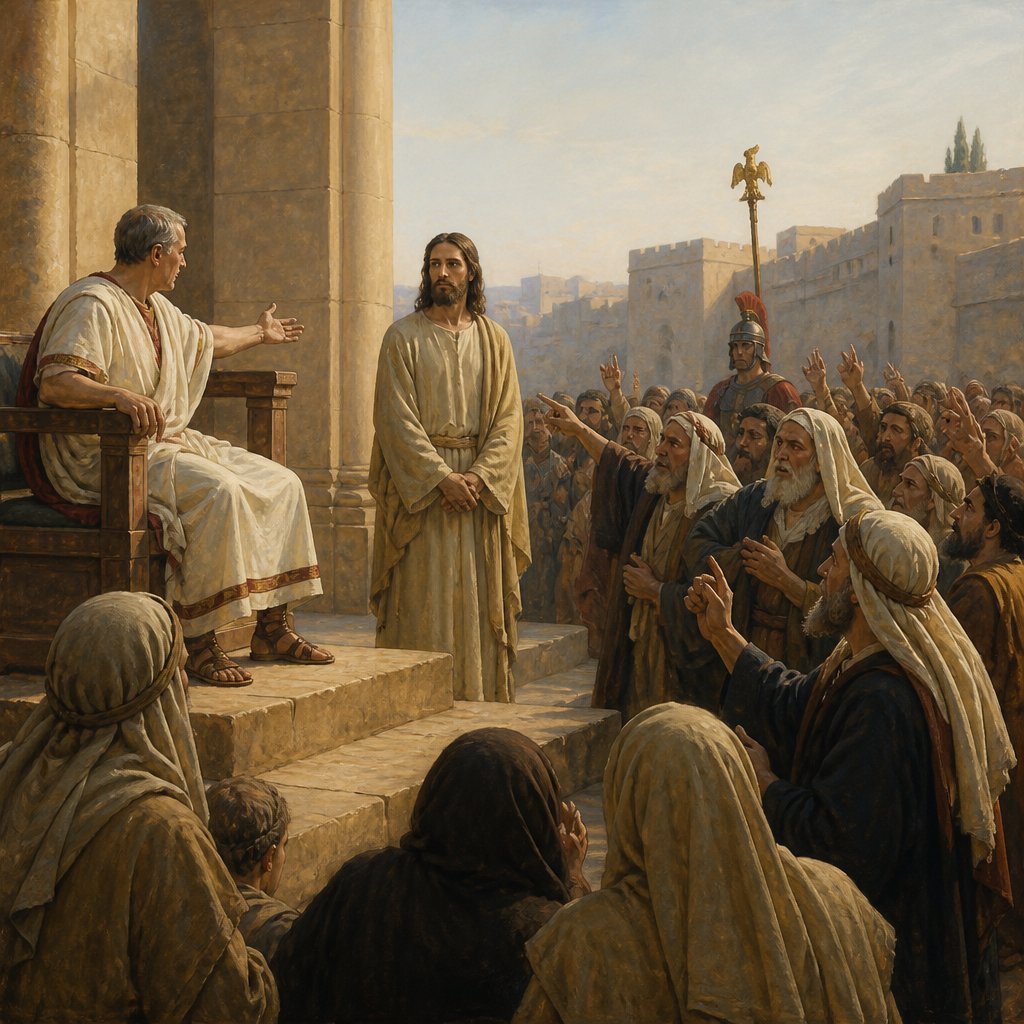
As we reflect on the moment captured in John 19:15, we find ourselves traversing not just an event in history but the complex landscape of human emotion, political pressure, and spiritual significance. The verse states, "But they cried out, Away with him, away with him, crucify him. Pilate saith unto them, Shall I crucify your King? The chief priests answered, We have no king but Caesar." In this confrontation, we witness a profound rejection that echoes through the ages and confronts us with our own allegiances.
At this point in the Gospel narrative, Jesus stands before Pilate, the Roman governor who represents the political power of the time. The scene is heavy with tension. Pilate, recognizing the innocence of Jesus, is puzzled by the extent of the crowd's fury. Despite his authority, he finds himself overwhelmed by the people's cries for blood. "Away with him," they shout, rejecting their Messiah. As we meditate on this betrayal, we must ask ourselves: what causes us to turn away from what is right and good, especially when it presents itself in ways we least expect?
The phrase "We have no king but Caesar" is astonishing in its implications. The Jewish people, who have waited centuries for the promised Messiah, the anointed King who would deliver them, now openly declare their allegiance to a foreign ruler. This moment reflects not only a political statement but a deeper spiritual dissonance. They place their trust in the immediate and tangible, in the power of Rome, rather than in the divine authority of Jesus—a King who offered not just deliverance from oppression but the restoration of their very souls.
In a world that often places power and success above all else, we find ourselves at times aligning with earthly authorities—whether they be in politics, culture, or even our daily lives—that offer a sense of security or convenience. We must engage in honest introspection to see if we too have, at moments, rejected Christ for the allure of worldly kings or contemporary idols.
In light of this rejection, the question Pilate poses is piercing: "Shall I crucify your King?" It serves as an invitation to consider who truly reigns in our hearts today. Are we willing to proclaim Jesus as our King, or do we allow societal pressures to dictate our faithfulness? The response from the chief priests reveals their inner conflict; it mirrors a choice that we continually face. They chose what was politically expedient over what was spiritually central, a choice that bore devastating consequences.
This moment reminds us that Christ's Kingdom is not of this world. It doesn't bend to political ideologies, social pressures, or human norms. When we choose to reject Christ today, we evade the beautiful and transformative power of His reign in our lives. Consider this: if the response of the Jewish leaders was born from fear of the Roman Empire, what fears do we harbor today that may cause us to sideline our commitment to Christ? What pressures entice us to prioritize temporary affections over our eternal allegiance?
As we contemplate this verse, let us not be so quick to condemn the crowd who cried for crucifixion. Instead, let us search our hearts and lay bare the conditions of our own spiritual allegiance. Are we advocating for Jesus, standing firm in our faith amid challenges? Or do we find ourselves, perhaps reluctantly, saying, "We have no king but ___" (fill in the blank with anything that takes precedence over Christ)?
Let this devotional stir within us a desire for deeper communion with our true King, Jesus. As we navigate the realities of our world, may we seek to proclaim Him fervently, aligning our hearts with His eternal Kingdom. In these reflections, we find both a warning and a gentle reminder of Jesus' unwavering authority in our lives, urging us to choose Him above all else.
Want to reflect more on John 19:15?
Continue your spiritual journey with Bible Chat — an AI-powered tool for exploring God's Word through conversation. Ask questions, discover connections, and deepen your understanding.
Get Our Apps


John 19:15 Artwork

John 19:15 - "But they cried out, Away with him, away with him, crucify him. Pilate saith unto them, Shall I crucify your King? The chief priests answered, We have no king but Caesar."
"But they cried out, Away with him, away with him, crucify him. Pilate saith unto them, Shall I crucify your King? The chief priests answered, We have no king but Caesar." - John 19:15

John 21:15-19

John 15:19 - "If ye were of the world, the world would love his own: but because ye are not of the world, but I have chosen you out of the world, therefore the world hateth you."

John 15:18-19 - "If the world hates you, keep in mind that it hated me first. If you belonged to the world, it would love you as its own. As it is, you do not belong to the world, but I have chosen you out of the world. That is why the world hates you."

John 19:38

John 19:1

John 15:7

John 15:7

John 19:19 - "¶ And Pilate wrote a title, and put it on the cross. And the writing was, JESUS OF NAZARETH THE KING OF THE JEWS."

John 17.6-19

John 19:1-3

John 19:25-27

John 15:5

John 15:5

John 15 The Vine

John 1:19 - "¶ And this is the record of John, when the Jews sent priests and Levites from Jerusalem to ask him, Who art thou?"

John 19:25-27

John 19:26-27

Genesis 15:19

John 15:26 NLT

John 14:15-21

John 15:1-8

Genesis 19-15

John 10:19 - "¶ There was a division therefore again among the Jews for these sayings."

John 15:9-10

John 15:9-10

John 19:1 - "Then Pilate therefore took Jesus, and scourged him."

Genesis 15:19 - "The Kenites, and the Kenizzites, and the Kadmonites,"

John 19:25-27 with emphasis on Mary