Grief Beyond Borders: Embracing Mourning as a Journey
"And when the inhabitants of the land, the Canaanites, saw the mourning in the floor of Atad, they said, This is a grievous mourning to the Egyptians: wherefore the name of it was called Abel-mizraim, which is beyond Jordan." - Genesis 50:11
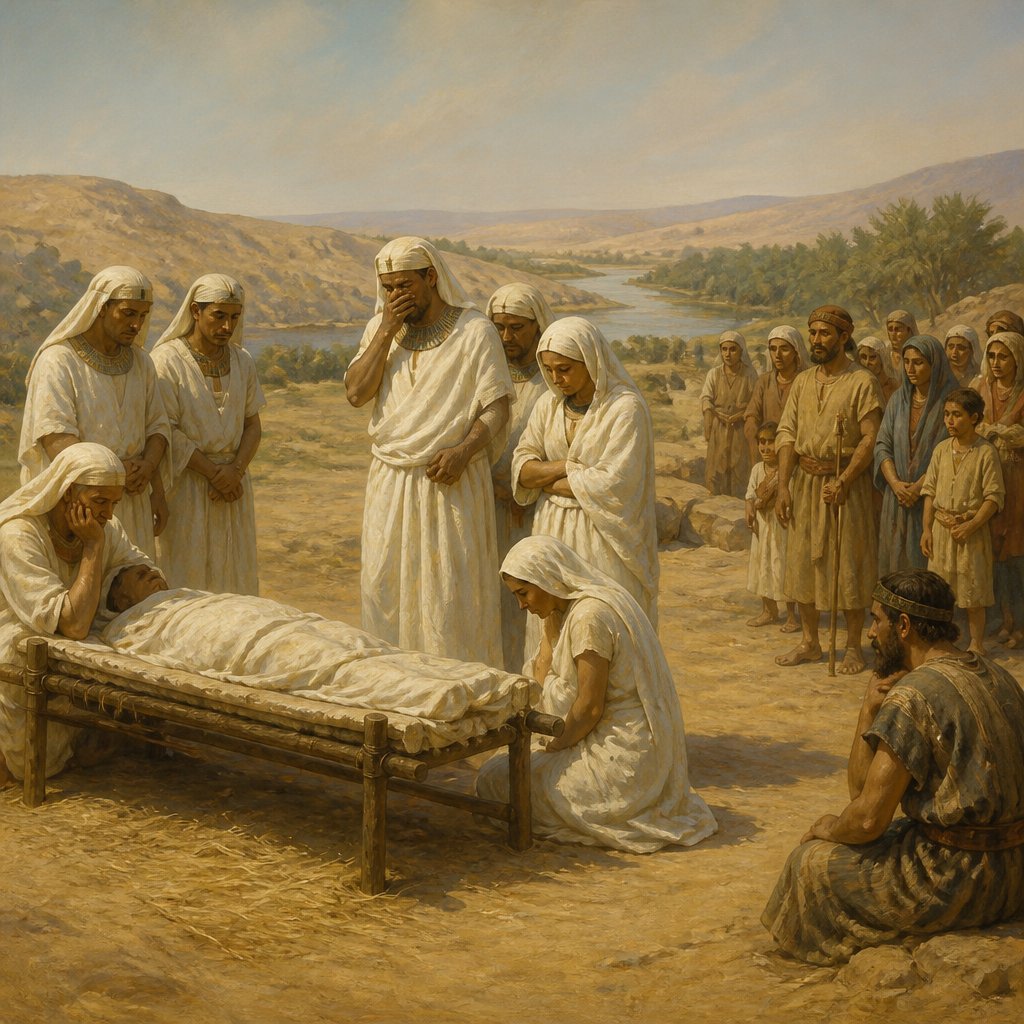
In the intricate tapestry of human experience, mourning holds a crucial and profound role. Genesis 50:11 sheds light on a moment from the life of Joseph, illustrating the powerful emotions tied to loss. The verse states, "And when the inhabitants of the land, the Canaanites, saw the mourning in the floor of Atad, they said, This is a grievous mourning to the Egyptians: wherefore the name of it was called Abel-mizraim, which is beyond Jordan."
This poignant scene unfolds in the context of their grief, revealing not only the heartache of a family grieving for Jacob, Joseph’s father, but also how this profound sorrow transcended cultural and geographic boundaries. The land of Atad became a sacred space of mourning, a place that the Canaanites recognized as deeply distressing—a collective grief that resonated across lines of ethnicity and culture.
In our own lives, we often encounter grief. Whether through the loss of loved ones, dreams, or relationships, mourning can feel isolating, yet it unites us as humans. In this verse, we see that loss does not merely belong to one group; mourning is universally felt. The Egyptians were experiencing a deep sorrow for Jacob, who was honored not only as their leader’s father but also as a wise man of faith. The Canaanites, observing this, recognized the gravity of the mourning, labeling it as a troubling event, leading to the naming of the place “Abel-mizraim,” a term reflecting the depth of grieving that took place.
Abel-mizraim means "the field of Murmuring of the Egyptians." This name not only encapsulates the overwhelming sorrow felt by Joseph and his brethren but also signifies how mourning shapes our identity and community. Mourning is not simply about sadness; it expresses our love and respect for those we have lost. It is an acknowledgment of shared experiences and the bonds we hold dear, emphasizing the profound connection between people, even amidst different cultural backgrounds.
As we reflect on this verse, we are invited to consider our own experiences with loss. How do we express our grief? Do we allow ourselves the necessary space to mourn, or do we rush through the process, thinking it a sign of weakness? Mourning is a sacred act, one that requires patience and understanding from ourselves and from those around us. Each person mourns differently, just as the Egyptians and Canaanites did, and our journeys through grief require compassion.
Furthermore, The location of this mourning, "beyond Jordan," holds significance as well. It symbolizes a crossing—both a geographical and an emotional transition. Grieving can indeed take us into new territories of our lives. Beyond the Jordan stood the Promised Land—a land of hope, a place where healing could ultimately begin. In the context of our losses, while we may find ourselves in valleys of sorrow, beyond those valleys lie hills of promise, restoration, and renewal.
The act of mourning allows us to process our emotions, foster healing, and embrace the journey ahead. The Egyptian mourning called upon the Canaanites, reminding us that we are part of a broader human experience. When we share in mourning collectively, we build bridges among diverse communities, fostering empathy and understanding across cultural divides.
Ultimately, Genesis 50:11 reminds us that grief, while painful, is also a transformative experience. As we draw closer to God in our mourning, seeking His comfort and strength, we become vessels of grace, not only for ourselves but for others as well. May we honor our losses and recognize them as intertwining threads in the fabric of our lives, leading us toward hope and healing—experiencing God’s grace and love even in our darkest moments.
Want to reflect more on Genesis 50:11?
Continue your spiritual journey with Bible Chat — an AI-powered tool for exploring God's Word through conversation. Ask questions, discover connections, and deepen your understanding.
Get Our Apps


Genesis 50:11 Artwork

Genesis 50:11 - "And when the inhabitants of the land, the Canaanites, saw the mourning in the floor of Atad, they said, This is a grievous mourning to the Egyptians: wherefore the name of it was called Abel-mizraim, which is beyond Jordan."
"And when the inhabitants of the land, the Canaanites, saw the mourning in the floor of Atad, they said, This is a grievous mourning to the Egyptians: wherefore the name of it was called Abel-mizraim, which is beyond Jordan." - Genesis 50:11

Genesis 24-50

Genesis 50:26

Genesis 50:25

Genesis 50:26

Genesis 50:25

Genesis 50:26

Genesis 50:25

Genesis 50:26

Genesis 50:12 - "And his sons did unto him according as he commanded them:"

Genesis 50:19 - "And Joseph said unto them, Fear not: for am I in the place of God?"

Create a coffin for Joseph Genesis 50:26

Genesis 50:1 - "And Joseph fell upon his father's face, and wept upon him, and kissed him."

Genesis 50:9 - "And there went up with him both chariots and horsemen: and it was a very great company."

Psalms 50:11 - "I know all the fowls of the mountains: and the wild beasts of the field are mine."

Genesis 50:22 - "¶ And Joseph dwelt in Egypt, he, and his father's house: and Joseph lived an hundred and ten years."

Genesis 50:2 - "And Joseph commanded his servants the physicians to embalm his father: and the physicians embalmed Israel."

Luke 11:50 - "That the blood of all the prophets, which was shed from the foundation of the world, may be required of this generation;"

Genesis 50:6 - "And Pharaoh said, Go up, and bury thy father, according as he made thee swear."

Genesis 50:16 - "And they sent a messenger unto Joseph, saying, Thy father did command before he died, saying,"

Genesis 50:18 - "And his brethren also went and fell down before his face; and they said, Behold, we be thy servants."

Genesis 50:26 - "So Joseph died, being an hundred and ten years old: and they embalmed him, and he was put in a coffin in Egypt."

Genesis 50:20 - "But as for you, ye thought evil against me; but God meant it unto good, to bring to pass, as it is this day, to save much people alive."

John 11:50 - "Nor consider that it is expedient for us, that one man should die for the people, and that the whole nation perish not."

Genesis 50:3 - "And forty days were fulfilled for him; for so are fulfilled the days of those which are embalmed: and the Egyptians mourned for him threescore and ten days."

Genesis 24:50 - "Then Laban and Bethuel answered and said, The thing proceedeth from the LORD: we cannot speak unto thee bad or good."

Genesis 50:25 - "And Joseph took an oath of the children of Israel, saying, God will surely visit you, and ye shall carry up my bones from hence."

Genesis 50:8 - "And all the house of Joseph, and his brethren, and his father's house: only their little ones, and their flocks, and their herds, they left in the land of Goshen."

Genesis 50:7 - "¶ And Joseph went up to bury his father: and with him went up all the servants of Pharaoh, the elders of his house, and all the elders of the land of Egypt,"