Between Two Sisters: A Call to Unity
"And Jacob sent and called Rachel and Leah to the field unto his flock," - Genesis 31:4
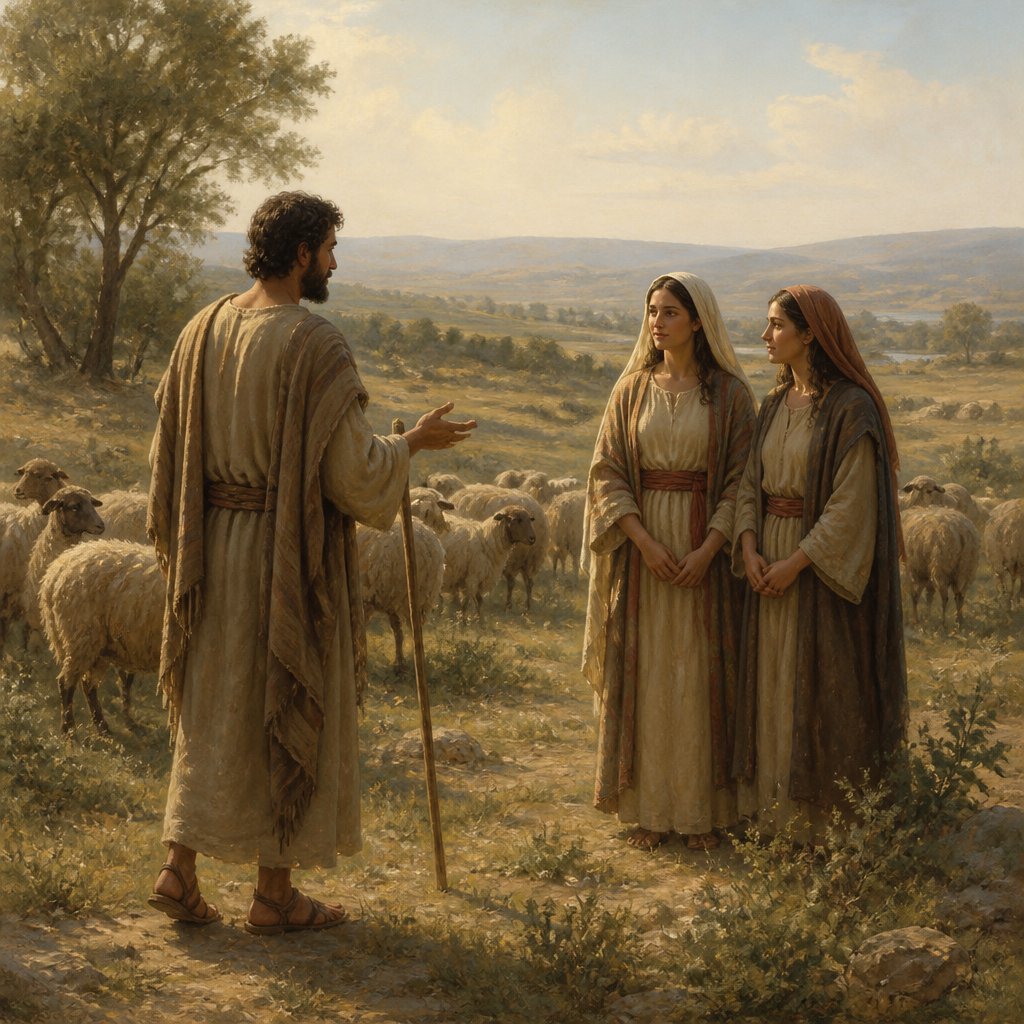
As we delve into Genesis 31:4, we find a moment that carries significant weight for Jacob, Rachel, and Leah. The King James Version (KJV) states, "And Jacob sent and called Rachel and Leah to the field unto his flock." This seemingly simple verse sets the stage for a profound dialogue among family members caught between complicated emotional ties, competition, and the pursuit of God’s leading.
Jacob finds himself in a tenuous position. After years of laboring under Laban’s watchful eye, he begins to sense that it is time to leave the land that, while prosperous, has brought him much strife. His heart, stirred by divine direction, compels him to seek clarity through a meeting with his wives. The act of calling Rachel and Leah to the field serves not merely as a family conversation but as a pivotal moment in the unfolding story of God’s covenant with Jacob’s family.
This scenario prompts us to reflect on the dynamics of family, particularly among siblings. Rachel and Leah, both daughters of Laban and married to Jacob, found themselves in an intricate web of rivalry and affection. Rachel, favored for her beauty and excessive desire to bear children, found herself in competition with Leah, who had been granted the blessing of motherhood. Yet, despite their differences, Jacob’s call to both women creates an opportunity for unity—an approach that resonates today.
In our modern context, we often find ourselves sitting in similar scenarios. Perhaps it’s within our own families, where rivalry and competition may overshadow healthy relationships. Or maybe it's within our communities, workplaces, or even in the local church, where divisions based on preference or past grievances can cause rifts. Jacob’s invitation to Rachel and Leah highlights the importance of coming together despite differences to find a common purpose.
Jacob’s calling of Rachel and Leah signifies an act of leadership rooted not in control, but in the desire for mutual understanding. He does not seek to dismiss their feelings or past grievances; instead, he creates a space for dialogue. In this act, we learn that true leadership involves the humility to acknowledge others’ experiences and the wisdom to gather those into decision-making processes.
As Jacob shares his vision with both of his wives, he demonstrates that God calls us not just to individual encounters, but to collective obedience to His purposes. In the same way, each of us is invited to bring our own unique struggles, perspectives, and gifts into God’s family. Much like Rachel and Leah, we stand at the crossroads where our voices matter; it is a reminder that God values our contributions, no matter our circumstances.
Moreover, Jacob’s action serves as a reminder of the patience and understanding needed to navigate complex relationships. It would be easy for him to favor Rachel’s feelings over Leah’s or vice versa. However, he remains steadfast in his role as a mediator, inviting both parties to contribute to the conversation about their future. This is a vital lesson in the Body of Christ, where division can easily cause us to miss God's blessings. Together, we can spur one another toward love and good deeds (Hebrews 10:24).
In conclusion, Genesis 31:4 teaches us that, like Jacob, we are called to extend invitations of unity amidst the noise of rivalry. It shows us that communication can dissolve tension and foster understanding. If Jacob could bring together two wives who lived in the shadows of their rivalry, how much more can we strive for unity within our families and the broader community of believers? Let us pray for the courage to call on those with whom we may feel discord, to seek reconciliation, and to remember that in God’s kingdom, no one stands alone.
Want to reflect more on Genesis 31:4?
Continue your spiritual journey with Bible Chat — an AI-powered tool for exploring God's Word through conversation. Ask questions, discover connections, and deepen your understanding.
Get Our Apps


Genesis 31:4 Artwork

Genesis 31:4 - "And Jacob sent and called Rachel and Leah to the field unto his flock,"
"And Jacob sent and called Rachel and Leah to the field unto his flock," - Genesis 31:4

Genesis 21-31

Genesis 18-31

Genesis 31:35

Genesis 19-31

Genesis 24-31

Genesis 31:22 - "And it was told Laban on the third day that Jacob was fled."

Genesis 31:45 - "And Jacob took a stone, and set it up for a pillar."

Genesis 31:47 - "And Laban called it Jegarsahadutha: but Jacob called it Galeed."

Genesis 31:31 - "And Jacob answered and said to Laban, Because I was afraid: for I said, Peradventure thou wouldest take by force thy daughters from me."

Genesis 34:31 - "And they said, Should he deal with our sister as with an harlot?"

Genesis 25:31 - "And Jacob said, Sell me this day thy birthright."

Genesis 31:2 - "And Jacob beheld the countenance of Laban, and, behold, it was not toward him as before."

Genesis 37:31 - "And they took Joseph's coat, and killed a kid of the goats, and dipped the coat in the blood;"

Genesis 42:31 - "And we said unto him, We are true men; we are no spies:"
Genesis 10:31 - "These are the sons of Shem, after their families, after their tongues, in their lands, after their nations."

Genesis 41:31 - "And the plenty shall not be known in the land by reason of that famine following; for it shall be very grievous."

Genesis 21:31 - "Wherefore he called that place Beer-sheba; because there they sware both of them."

Genesis 31:17 - "¶ Then Jacob rose up, and set his sons and his wives upon camels;"

Genesis 31:6 - "And ye know that with all my power I have served your father."

Genesis 31:9 - "Thus God hath taken away the cattle of your father, and given them to me."

Genesis 5:31 - "And all the days of Lamech were seven hundred seventy and seven years: and he died."

Genesis 31:20 - "And Jacob stole away unawares to Laban the Syrian, in that he told him not that he fled."

Genesis 36:31 - "¶ And these are the kings that reigned in the land of Edom, before there reigned any king over the children of Israel."

Genesis 43:31 - "And he washed his face, and went out, and refrained himself, and said, Set on bread."

Genesis 29:31 - "¶ And when the LORD saw that Leah was hated, he opened her womb: but Rachel was barren."

Galatians 4:31 - "So then, brethren, we are not children of the bondwoman, but of the free."

Genesis 31:48 - "And Laban said, This heap is a witness between me and thee this day. Therefore was the name of it called Galeed;"

Genesis 31:19 - "And Laban went to shear his sheep: and Rachel had stolen the images that were her father's."