The Hidden Cost of Our Choices: Reflections on Genesis 31:35
"And she said to her father, Let it not displease my lord that I cannot rise up before thee; for the custom of women is upon me. And he searched, but found not the images." - Genesis 31:35
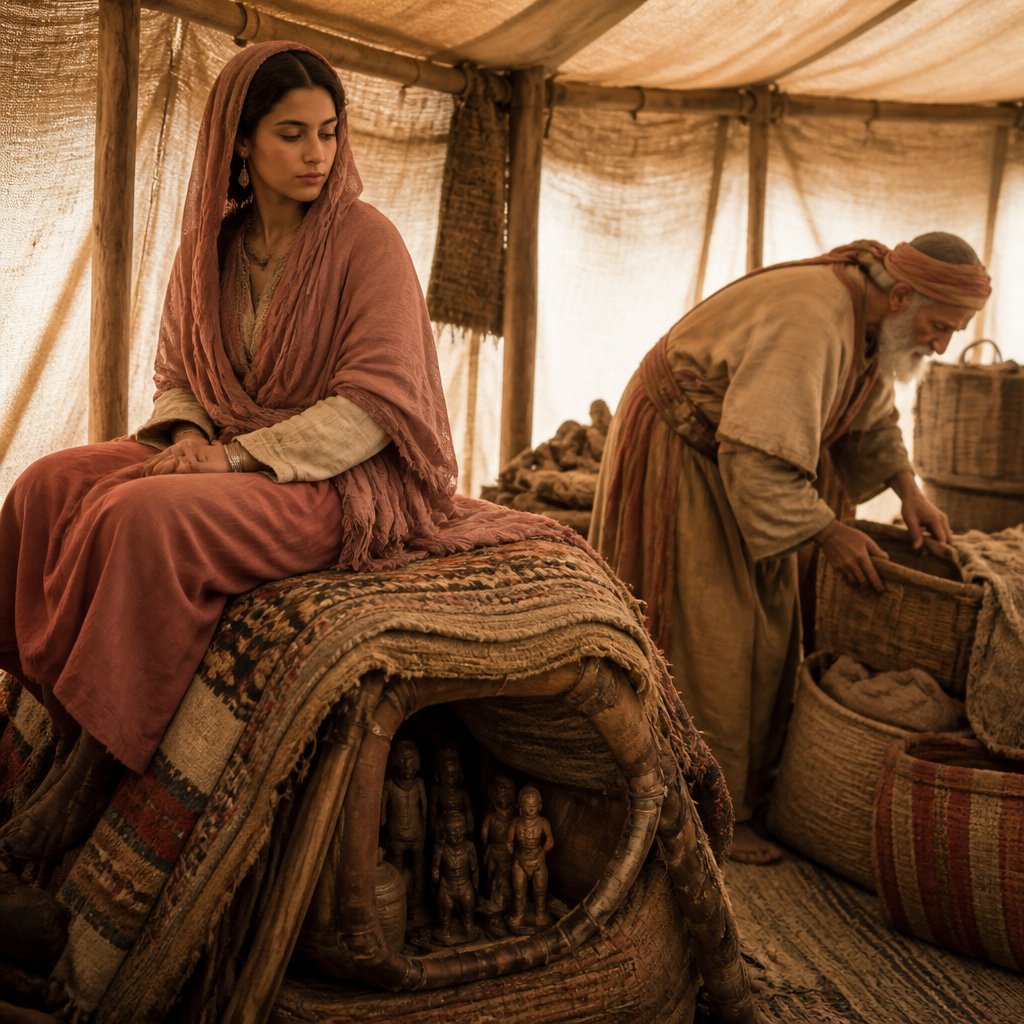
In the sacred narrative of Genesis, we find profound truths and lessons interwoven into the lives of its characters. Genesis 31:35 captures a poignant moment between Rachel and her father, Laban, during a tense confrontation over missing household idols. She speaks to him, saying, 'Let it not displease my lord that I cannot rise up before thee; for the custom of women is upon me. And he searched, but found not the images' (KJV). This verse raises significant themes: deception, the weight of cultural customs, and the hidden costs of our decisions.
Rachel's words reflect a complex interplay of identity and allegiance. On one hand, she demonstrates a desire to maintain peace with her father, knowing that Laban is displeased and suspicious about the missing idols. On the other hand, Rachel’s state—her womanhood and her monthly cycle—becomes a shield, a culturally accepted excuse that simultaneously allows her to conceal her own wrongdoing. Here, we see how Rachel is caught in a web of loyalty and betrayal. Her choice to steal her father's idols speaks to a deeper longing for control and possession in a life where she often felt displaced and less valued.
In examining Rachel's actions, we acknowledge the gravity of choices made in desperation. Having lived under her father’s rule, Rachel's theft was not merely an act of rebellion but a bid for strength and agency. How often do we find ourselves in similar positions, feeling compelled to make decisions that are not entirely honest to secure our place in the world?
The passage also reflects the cultural norms of the time, underlining how societal expectations can shape our actions. Rachel uses her womanhood as a defense, highlighting how women in her era were often constrained by cultural rules. For her, the ‘custom of women’ was not just a biological condition; it was a societal understanding that offered her a way to escape the scrutiny of Laban. How often do we, like Rachel, resort to what is expected or accepted by society, even when it might compromise our integrity? Let us ponder the times we have chosen to hide, conform, or lie under the weight of external expectations and pressures.
Laban's search for the idols reveals the futility of his efforts to exert control over Rachel and Jacob. He believes that possession of these images holds power, yet he finds nothing. In this moment, we are reminded that God’s providence prevails, and that ultimately, our attempts to seize control are oftentimes illusions. Rachel’s success in concealing the idols speaks to a deeper truth: sometimes we can be inhabitants of our own lies, and yet they cannot thwart God’s plan.
This scripture invites us to engage in self-reflection. What are we harboring that might resemble idols in our lives? Are there things we cling to out of fear or desire that distract us from the larger picture God has for us? Just as Rachel hid the idols, we too can hide things from God—be it pride, bitterness, anger, or materialism.
As we reflect on Rachel's plea, we recognize the duality of her existence: a search for identity amid familial conflict and a desperate grasping at control that ultimately leads to deception. In light of the Gospel, we are called to lay down our burdens at the feet of Christ. The answer to the hidden idols in our hearts is not found in subterfuge, but in surrendering to the One who knows us completely and loves us unconditionally.
In conclusion, Genesis 31:35 is not merely an account of a family dispute; it is an invitation for introspection. It teaches us about the consequences of our choices and the importance of authenticity in our relationships. Let us strive for honesty, knowing that although we may be tempted to hide behind our own ‘customs,’ true freedom and identity are found in Christ alone. As we walk in faith, may we shed the burdens of our hidden idols and embrace the transformative power of God’s love.
Want to reflect more on Genesis 31:35?
Continue your spiritual journey with Bible Chat — an AI-powered tool for exploring God's Word through conversation. Ask questions, discover connections, and deepen your understanding.
Get Our Apps


Genesis 31:35 Artwork

Genesis 31:35

Genesis 31:35 - "And she said to her father, Let it not displease my lord that I cannot rise up before thee; for the custom of women is upon me. And he searched, but found not the images."
"And she said to her father, Let it not displease my lord that I cannot rise up before thee; for the custom of women is upon me. And he searched, but found not the images." - Genesis 31:35

John 13:31-35

Genesis 19-35

Genesis 26:35

Genesis 24-35

genesis 26:1-35

Genesis 35:16-20

Genesis 29:16-35

Exodus 35:31 - "And he hath filled him with the spirit of God, in wisdom, in understanding, and in knowledge, and in all manner of workmanship;"

Genesis 35:24 - "The sons of Rachel; Joseph, and Benjamin:"

Genesis 21-31

Genesis 18-31

Genesis 19-31

Genesis 24-31

Genesis 35:25 - "And the sons of Bilhah, Rachel's handmaid; Dan, and Naphtali:"

Genesis 35:28 - "And the days of Isaac were an hundred and fourscore years."
Lucas 13, 31-35 Jezus op reis, Jeruzalem, Herodes

Genesis 26:35 - "Which were a grief of mind unto Isaac and to Rebekah."

Numbers 35:31 - "Moreover ye shall take no satisfaction for the life of a murderer, which is guilty of death: but he shall be surely put to death."

Genesis 35:19 - "And Rachel died, and was buried in the way to Ephrath, which is Beth-lehem."

Genesis 35:21 - "¶ And Israel journeyed, and spread his tent beyond the tower of Edar."

Job 31:35 - "Oh that one would hear me! behold, my desire is, that the Almighty would answer me, and that mine adversary had written a book."

"The sons of Rachel; Joseph, and Benjamin:" - Genesis 35:24

Genesis 35:15 - "And Jacob called the name of the place where God spake with him, Beth-el."

Genesis 35:23 - "The sons of Leah; Reuben, Jacob's firstborn, and Simeon, and Levi, and Judah, and Issachar, and Zebulun:"

Genesis 35:13 - "And God went up from him in the place where he talked with him."

Genesis 31:22 - "And it was told Laban on the third day that Jacob was fled."

Genesis 31:45 - "And Jacob took a stone, and set it up for a pillar."