The Weight of Legacy: A Reflection on Isaac's Last Blessing
"And it came to pass, that when Isaac was old, and his eyes were dim, so that he could not see, he called Esau his eldest son, and said unto him, My son: and he said unto him, Behold, here am I." - Genesis 27:1
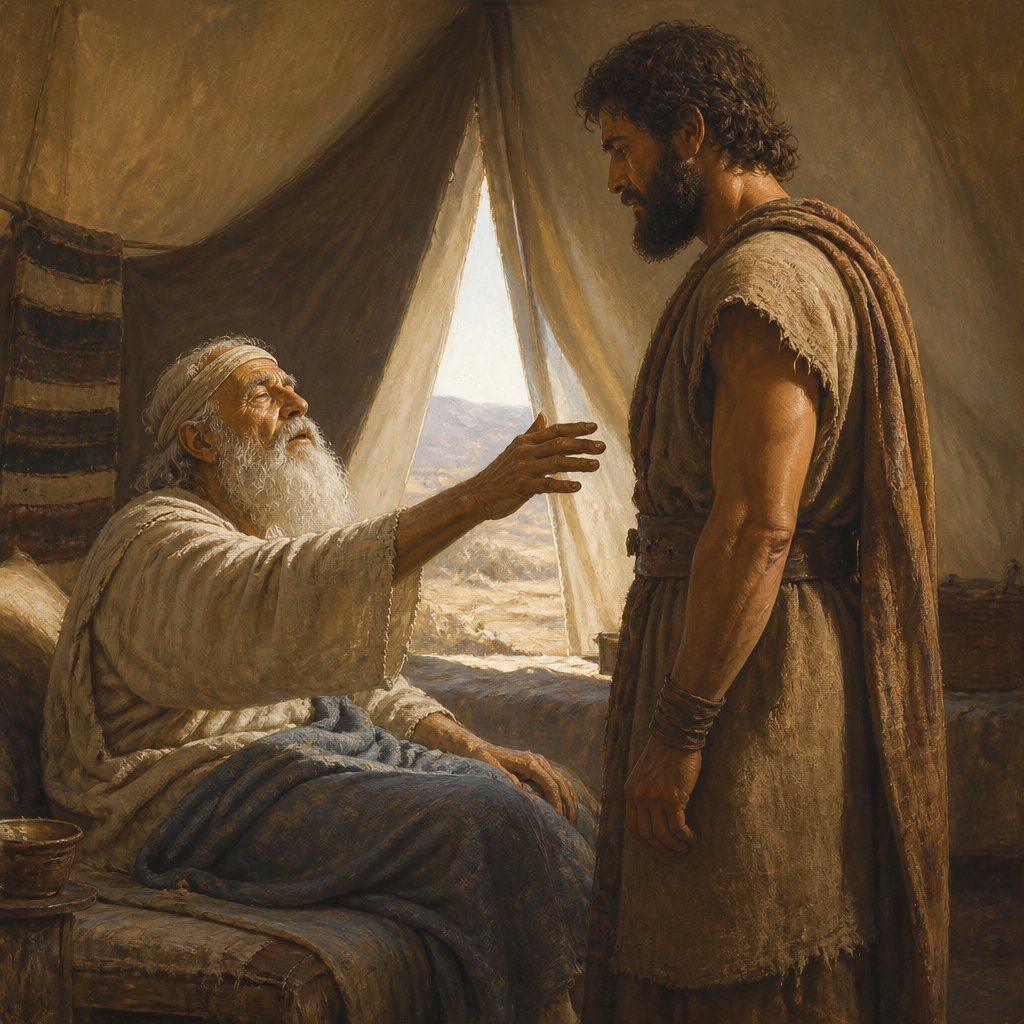
Genesis 27:1 (KJV) reads, "And it came to pass, that when Isaac was old, and his eyes were dim, so that he could not see, he called Esau his eldest son, and said unto him, My son: and he said unto him, Behold, here am I."
In this pivotal moment in biblical history, we witness an intimate glimpse into the life of Isaac, a patriarch of faith and the son of Abraham, as he reaches the twilight of his life. The setting is charged with emotion. Isaac, now advanced in years, is described as having dimmed vision, which serves as a metaphor for more than just the physical blindness that comes with age. It symbolizes the spiritual blindness and the clouding of judgment that often accompanies our later years or life events where we grapple with our legacy.
The act of calling upon Esau, his eldest son, indicates the weighty importance of the moment. Isaac's request is not a mere family gathering; it reflects a significant cultural and spiritual tradition where the blessing of the father carries a profound influence on the future of his lineage. Blessings in biblical times were more than a verbal affirmation; they were prophetic declarations shaping destinies and establishing futures. To be the recipient of a father’s blessing was to be endowed with responsibility, authority, and divine favor.
As we ponder this verse, we are confronted with the realities of aging and wisdom. Isaac’s dimmed eyesight can remind us of our own limitations. With time, the clarity of our visions may fade, leading us to rely more on faith and trust in God, rather than our understanding. Moreover, this moment of Isaac's life speaks volumes about the importance of relationships. He reaches out to his eldest son Esau, seeking connection and passing on a blessing that denotes acceptance and approval, which all children innately crave.
In a world filled with distractions and the relentless pace of modern living, it is easy to overlook the significance of such moments in our own lives. Perhaps we are in a season where we feel our vision is dimming, where the clarity of our purpose is shrouded by the busyness of our days. It is essential to slow down and consider whom we are calling to, both literally and metaphorically. Are we reaching out to those whom we might need to bless with our words and actions? Are we nurturing relationships that hold eternal value?
Furthermore, the moment of Isaac calling Esau demonstrates that legacy is often shaped by the way we engage with those around us. Isaac’s choice to bless Esau reveals his preferences and desires for his future. However, it also serves as a pivotal lesson in the sovereign nature of God. Despite Isaac’s intentions, God’s will for Jacob was to receive the birthright and the blessing, indicating that human decisions do not thwart divine plans.
In our lives, we often prepare to hand over our own legacies. These might take the shape of blessings we speak over our children, values we pass to others, or investments we make in our communities. How mindful are we of these legacies? Do we uphold the integrity of our intentions, or like Isaac, do we sometimes act out of personal preference rather than divine leading?
As you meditate on Genesis 27:1 today, reflect on your own relationships and consider: whom might you need to reach out to? What blessing might you be called to impart? And how can you ensure your legacy, much like Isaac's, is aligned with God’s purpose rather than mere human desire? May we strive to bless those around us with intention, clarity, and faith, understanding that every word we speak has the power to illuminate the path for others, even in the dimness of our own vision. Let us pray for eyes that see beyond the physical and hearts that embrace the call to bless in every season of our lives.
Want to reflect more on Genesis 27:1?
Continue your spiritual journey with Bible Chat — an AI-powered tool for exploring God's Word through conversation. Ask questions, discover connections, and deepen your understanding.
Get Our Apps


Genesis 27:1 Artwork

Genesis 27:1-3

Genesis 27:1 - "And it came to pass, that when Isaac was old, and his eyes were dim, so that he could not see, he called Esau his eldest son, and said unto him, My son: and he said unto him, Behold, here am I."
"And it came to pass, that when Isaac was old, and his eyes were dim, so that he could not see, he called Esau his eldest son, and said unto him, My son: and he said unto him, Behold, here am I." - Genesis 27:1

Genesis 1:27 - "So God created man in his own image, in the image of God created he him; male and female created he them."

Genesis 27:5

Genesis 27:32

Genesis 25-27

Genesis 17-27

Genesis 18-27

Genesis 24-27

Genesis 21-27

Genesis 19-27

Genesis 10:27 - "And Hadoram, and Uzal, and Diklah,"

Genesis 27:10 KJV

Genesis 27:18-19

The soul is the essence of life, that hidden, divine spark within every human being, created in the image and likeness of God (Genesis 1:27)

The soul is the essence of life, that hidden, divine spark within every human being, created in the image and likeness of God (Genesis 1:27)

The soul is the essence of life, that hidden, divine spark within every human being, created in the image and likeness of God (Genesis 1:27)

Genesis 36:27 - "The children of Ezer are these; Bilhan, and Zaavan, and Akan."

"And Hadoram, and Uzal, and Diklah," - Genesis 10:27

Genesis 38:27 - "¶ And it came to pass in the time of her travail, that, behold, twins were in her womb."

Genesis 27:44 - "And tarry with him a few days, until thy brother's fury turn away;"

Genesis 32:27 - "And he said unto him, What is thy name? And he said, Jacob."

Genesis 27:27 - "And he came near, and kissed him: and he smelled the smell of his raiment, and blessed him, and said, See, the smell of my son is as the smell of a field which the LORD hath blessed:"

Genesis 34:27 - "The sons of Jacob came upon the slain, and spoiled the city, because they had defiled their sister."

Genesis 27:35 - "And he said, Thy brother came with subtilty, and hath taken away thy blessing."

Genesis 5:27 - "And all the days of Methuselah were nine hundred sixty and nine years: and he died."

Genesis 19:27 - "¶ And Abraham gat up early in the morning to the place where he stood before the LORD:"

Genesis 27:28 - "Therefore God give thee of the dew of heaven, and the fatness of the earth, and plenty of corn and wine:"

Genesis 11:27 - "¶ Now these are the generations of Terah: Terah begat Abram, Nahor, and Haran; and Haran begat Lot."