The Heart of Mockery: A Lesson in Divine Promise and Human Conflict
"¶ And Sarah saw the son of Hagar the Egyptian, which she had born unto Abraham, mocking." - Genesis 21:9

Genesis 21:9 states, "And Sarah saw the son of Hagar the Egyptian, which she had born unto Abraham, mocking." This verse, simple yet profound, invites us into a world rife with the burdens of human relationships, contrasting promises of God, and the shadow of mockery that can arise within families.
To understand the tension in this moment, we must revisit the context. Sarah, the wife of Abraham, had long been barren and had endured years of waiting for the promised child. God had sealed His covenant with Abraham, proclaiming a multitude of descendants that would come through Sarah. However, in her impatience and despair, Sarah had offered Hagar, her Egyptian maid, to Abraham to bear a child. This decision, rooted in human understanding rather than faith, introduced complications that reverberated through their lives and culminated in the painful scene before us.
The Hebrew name Isaac, which Sarah eventually gives to her son, means "laughter," reflecting both the joy of God’s fulfilled promise and starkly juxtaposed by the mocking laughter of Hagar’s son, Ishmael. The irony is striking: while Isaac’s name represents a joyful promise fulfilled, the derision of Ishmael illustrates a deep-seated struggle—a reminder of the conflict born out of human decisions.
In acknowledging this mockery, it is essential to probe into Sarah’s heart. Here, we see her embody a deeply human response—a mixture of resentment, protectiveness, and fear. She had labored in hope for a miracle, and yet, the fruits of her earlier decision cast a shadow over the joy of her son. The mocking was not merely a playful insult; it symbolized a challenge to her identity, her motherhood, and the fulfillment of God’s promise.
Mockery often serves as a mirror reflecting our insecurities and doubts. How many times in our lives have we faced mockery, be it from others or ourselves? It can be corrosive, eating away at the joy of our every accomplishment or the fulfillment of our dreams. In our struggles, we may hear the whispers of mockery: "You’ll never achieve that," or "You’re not worthy of that blessing." But the life of Sarah invites us to recognize that mockery arises in moments of tension and waiting—when the reality of our lives does not yet align with the promises of God.
Yet, in this narrative, we must also remember God’s response to Sarah and Ishmael’s situation. Though Sarah felt threatened by the presence of Ishmael’s mockery, God intervened with love and care. He reassured her that He would provide for Ishmael, granting him a life separate from Isaac. This divine intervention should bring us comfort; God not only sees our struggles but also acts within them, often doing far more than we can ask or imagine.
The journey of faith often includes moments of waiting and tension. The promise of God does not always come immediately, and mockery sometimes resurfaces in the form of doubt, anxiety, or opposition from within and outside. However, these moments are also occasions for reflection. They remind us to strengthen our faith and trust in God’s timing.
In our lives today, when we encounter mockery—be it direct from others or insidious from within—let us remember that the story of Sarah and Ishmael challenges us not to react in fear or resentment. Instead, we are called to respond with hope, anchoring ourselves in the promise of God. For His promises transcend human misunderstanding and even the painful dynamics of our lives. We are invited to look beyond the mockery and seek solace in the God whose plans are never thwarted by our mistakes, whose love is never diminished by our fears.
Let us, therefore, embrace the depth of this Biblical lesson: to wait patiently for the promises of God, to seek His intervention in our conflicts, and to find joy in the laughter of the blessing He ultimately provides.
Want to reflect more on Genesis 21:9?
Continue your spiritual journey with Bible Chat — an AI-powered tool for exploring God's Word through conversation. Ask questions, discover connections, and deepen your understanding.
Get Our Apps


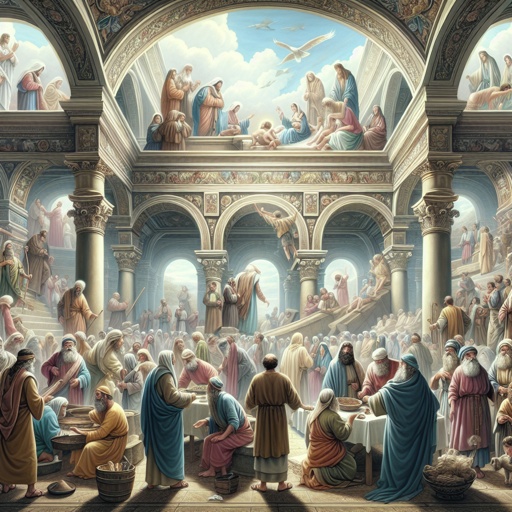
Genesis 21:9 Artwork

Genesis 21:9

Genesis 21:9 - "¶ And Sarah saw the son of Hagar the Egyptian, which she had born unto Abraham, mocking."

"¶ And Sarah saw the son of Hagar the Egyptian, which she had born unto Abraham, mocking." - Genesis 21:9

Genesis 9:21 - "And he drank of the wine, and was drunken; and he was uncovered within his tent."

"And he drank of the wine, and was drunken; and he was uncovered within his tent." - Genesis 9:21

Genesis 21-21

Genesis 1:21

Genesis 1:21

Genesis 21-20

Genesis 21-6

Genesis 21-13

Genesis 21-10

Genesis 21-34

Genesis 21-2

Genesis 21-7
Genesis 21-32

Genesis 21:1

Genesis 21-29

Genesis 21-30

Genesis 21-25

Genesis 21:25

Genesis 15:21

Genesis 21-19

Genesis 24-21

Genesis 21:14

Genesis 21:22

Genesis 28-21

Genesis 21-5

Genesis 17-21

Genesis 18-21