The Weight of Compromise: A Call to Sanctity
"Should we again break thy commandments, and join in affinity with the people of these abominations? wouldest not thou be angry with us till thou hadst consumed us, so that there should be no remnant nor escaping?" - Ezra 9:14
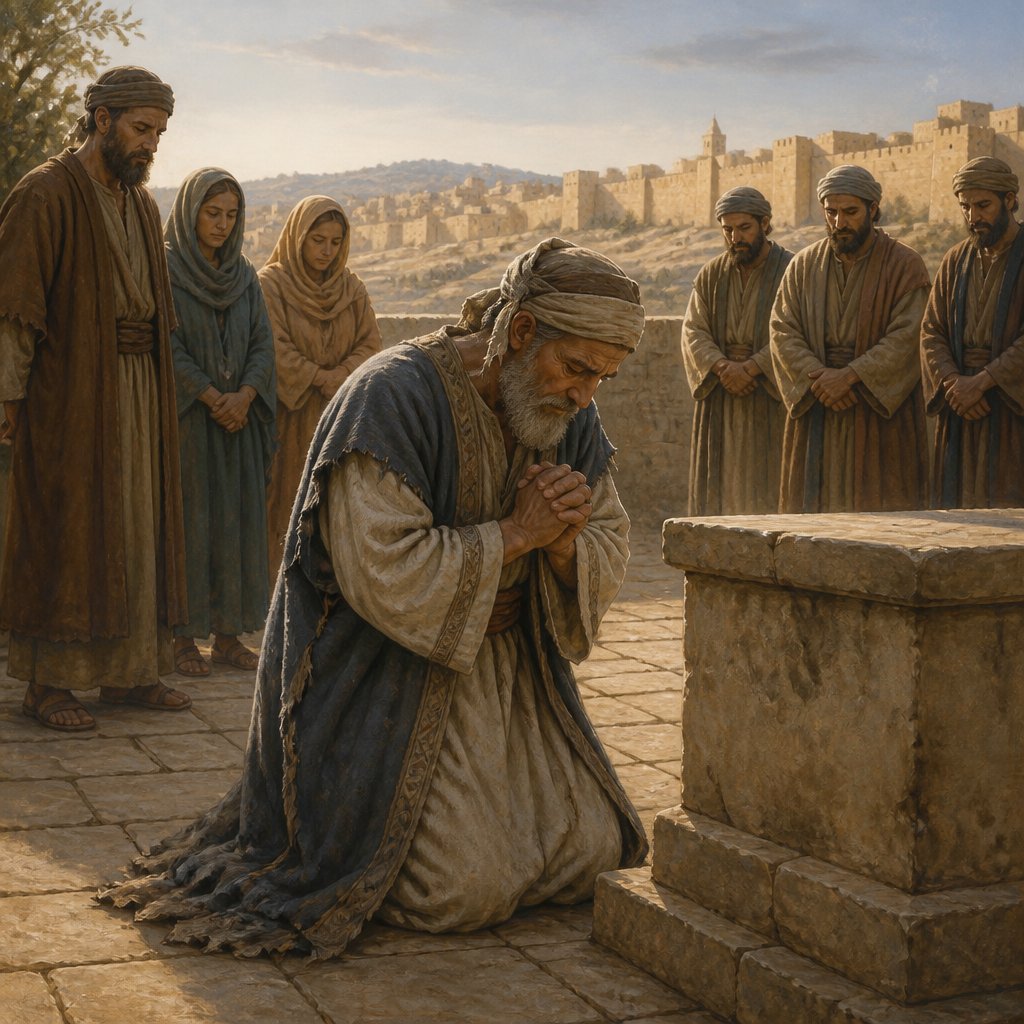
In the book of Ezra, we witness a profound moment of introspection and humility from Ezra and the people of Israel as they grapple with the implications of their actions. In Ezra 9:14, we read, "Should we again break thy commandments, and join in affinity with the people of these abominations? wouldest not thou be angry with us till thou hadst consumed us, so that there should be no remnant nor escaping?" This verse presents a poignant question that bears deep implications for our own spiritual lives today.
The background of Ezra’s concern is crucial to understanding the weight of this verse. The Israelites had returned from Babylonian captivity, yet upon rebuilding their lives and the temple, they faced a new threat—spiritual compromise. Intermarrying with the surrounding pagan cultures was a direct violation of God’s commandments and could lead to the erosion of their identity as God’s chosen people. This was not simply a matter of mingling socially; it was an existential threat to the very essence of their covenant with the Lord. Ezra knows the seriousness of their situation and the consequences of their actions, and it prompts his plea and heartfelt question to the Lord.
When Ezra asks, "Should we again break thy commandments," he emphasizes the danger of returning to previous patterns of sin after having tasted the freedom and restoration offered by God. This question is a reflective mirror for us today. How often do we find ourselves standing at the crossroads of compromise, tempted to rejoin alliances with sin despite having a knowledge of God’s holiness and commands? Each time we disregard God’s word, we weaken our spiritual resolve and invite the very consequences that Ezekiel warns against—the anger of God resulting in spiritual desolation.
Ezra’s fear of complete consumption is stark: "wouldest not thou be angry with us till thou hadst consumed us, so that there should be no remnant nor escaping?" Here, Ezra recognizes the gravity of turning away from God’s commandments. He worries that their disobedience will invoke God's righteous anger to the extent that there would be no one left to carry the promise of restoration. In our own lives, we must ponder the weight of our decisions. When we knowingly engage in behaviors that contradict our faith, we risk losing our place in God’s purpose. Will our affections for the world or for sinful habits lead us to the brink of spiritual ruin?
The nature of sin is such that it deceives us into believing we can manage both God’s commands and the allure of the world. Yet, as we can see throughout Scripture, such dual allegiances lead only to separation from God, diminished blessings, and inevitable consequences. James 4:4 warns, "Ye adulterers and adulteresses, know ye not that the friendship of the world is enmity with God?" Thus, affiliation with sin—like the Israelites' intermarriage with foreign nations—can cause spiritual amnesia, blinding us to the reality of the abominations we align with and the God we ultimately offend.
Ezra’s lamentation serves as both a warning and a reminder, urging us to reflect carefully on our commitments. Are we nurturing any relationships or habits that lead us away from God? Do we find ourselves in spaces that dilute our identity in Christ? Rather than succumb to the allure of cultural moments, we are called to be salt and light, standing firmly on the foundations of God's word.
This passage challenges us to engage in self-examination and repentance. We must ask ourselves, what abominations are we allowing to coexist with our faith? Christ calls us to be a channel of His grace, not a vessel of compromise. Today, let us seek the Lord diligently, ensure our hearts are aligned with His commands, and strive for a life that honors Him wholly. May we, like Ezra, recognize the peril of spiritual complacency, and instead pursue a fervent dedication to our God who is truly worthy of our complete devotion.
Want to reflect more on Ezra 9:14?
Continue your spiritual journey with Bible Chat — an AI-powered tool for exploring God's Word through conversation. Ask questions, discover connections, and deepen your understanding.
Get Our Apps


Ezra 9:14 Artwork
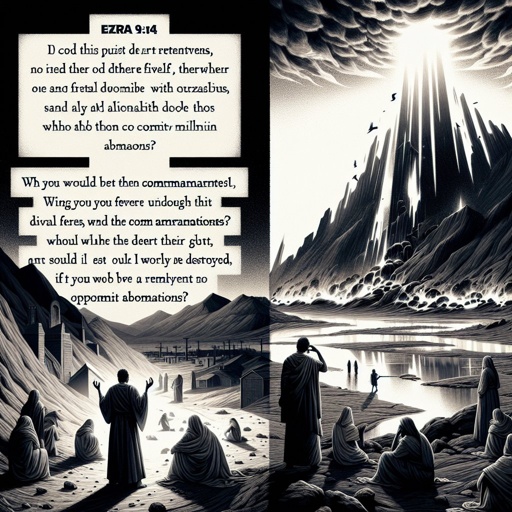
Ezra 9:14 - "Should we again break thy commandments, and join in affinity with the people of these abominations? wouldest not thou be angry with us till thou hadst consumed us, so that there should be no remnant nor escaping?"
"Should we again break thy commandments, and join in affinity with the people of these abominations? wouldest not thou be angry with us till thou hadst consumed us, so that there should be no remnant nor escaping?" - Ezra 9:14

Ezra 9:6

Ezra 3:9

Ezra 9:3

Ezra 9:1

Ezra 9:1

Ezra 9:1

Ezra 9:1-2

Ezra 9:13-15

Ezra 9:1-2

Ezra 2:9 - "The children of Zaccai, seven hundred and threescore."

Ezra 2:14 - "The children of Bigvai, two thousand fifty and six."

Ezra 8:14 - "Of the sons also of Bigvai; Uthai, and Zabbud, and with them seventy males."

Ezra 8:9 - "Of the sons of Joab; Obadiah the son of Jehiel, and with him two hundred and eighteen males."

Ezra 1:9 - "And this is the number of them: thirty chargers of gold, a thousand chargers of silver, nine and twenty knives,"

"The children of Zaccai, seven hundred and threescore." - Ezra 2:9

"The children of Bigvai, two thousand fifty and six." - Ezra 2:14

Ezra 9:10 - "And now, O our God, what shall we say after this? for we have forsaken thy commandments,"

Ezra 5:9 - "Then asked we those elders, and said unto them thus, Who commanded you to build this house, and to make up these walls?"

Ezra 4:9 - "Then wrote Rehum the chancellor, and Shimshai the scribe, and the rest of their companions; the Dinaites, the Apharsathchites, the Tarpelites, the Apharsites, the Archevites, the Babylonians, the Susanchites, the Dehavites, and the Elamites,"

Ezra 4:14 - "Now because we have maintenance from the king's palace, and it was not meet for us to see the king's dishonour, therefore have we sent and certified the king;"

"Of the sons also of Bigvai; Uthai, and Zabbud, and with them seventy males." - Ezra 8:14

Ezra 7:14 - "Forasmuch as thou art sent of the king, and of his seven counsellors, to enquire concerning Judah and Jerusalem, according to the law of thy God which is in thine hand;"

Ezra 9:3 - "And when I heard this thing, I rent my garment and my mantle, and plucked off the hair of my head and of my beard, and sat down astonied."

Ezra 9:9 - "For we were bondmen; yet our God hath not forsaken us in our bondage, but hath extended mercy unto us in the sight of the kings of Persia, to give us a reviving, to set up the house of our God, and to repair the desolations thereof, and to give us a wall in Judah and in Jerusalem."

"Of the sons of Joab; Obadiah the son of Jehiel, and with him two hundred and eighteen males." - Ezra 8:9

Ezra 6:14 - "And the elders of the Jews builded, and they prospered through the prophesying of Haggai the prophet and Zechariah the son of Iddo. And they builded, and finished it, according to the commandment of the God of Israel, and according to the commandment of Cyrus, and Darius, and Artaxerxes king of Persia."

Ezra 3:9 - "Then stood Jeshua with his sons and his brethren, Kadmiel and his sons, the sons of Judah, together, to set forward the workmen in the house of God: the sons of Henadad, with their sons and their brethren the Levites."

Ezra 9:2 - "For they have taken of their daughters for themselves, and for their sons: so that the holy seed have mingled themselves with the people of those lands: yea, the hand of the princes and rulers hath been chief in this trespass."