Strength in Unity: The Legacy of Pahath-Moab
"Of the sons of Pahath-moab; Elihoenai the son of Zerahiah, and with him two hundred males." - Ezra 8:4
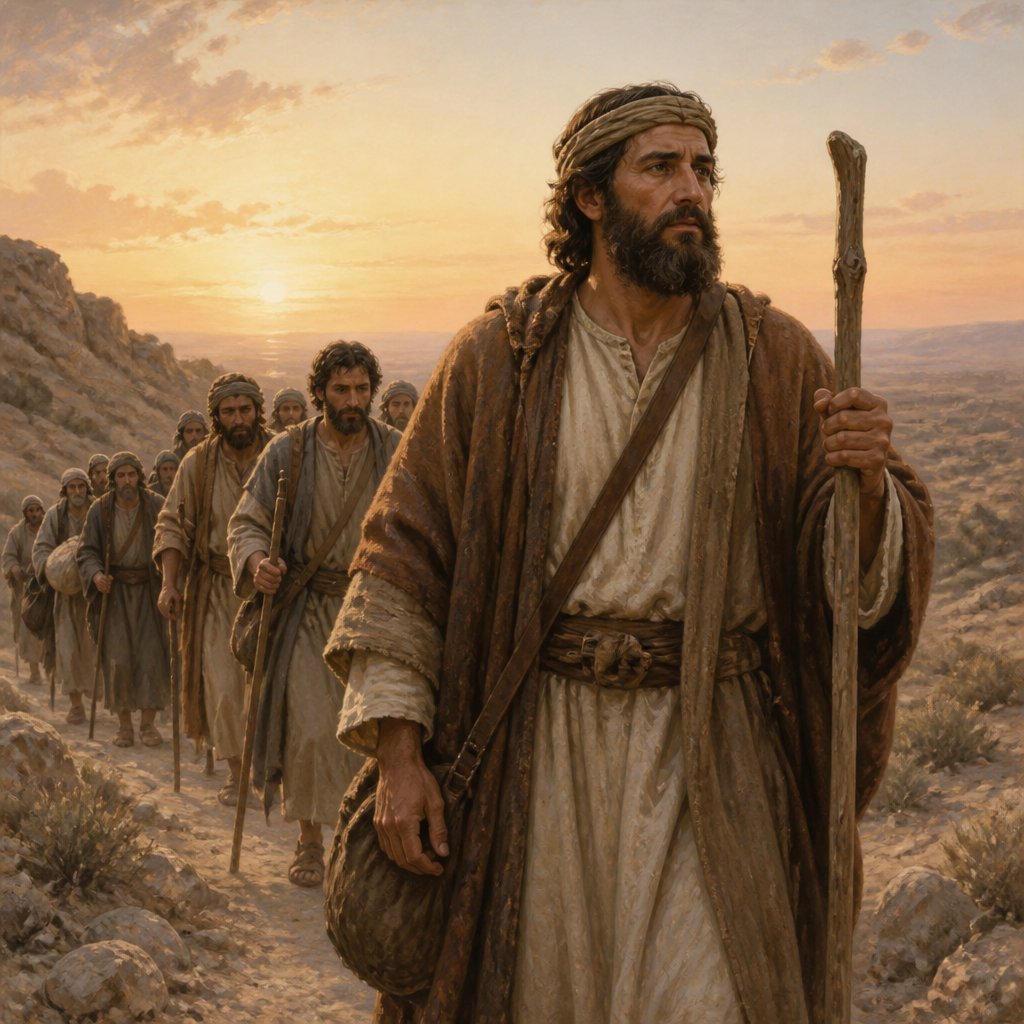
When we delve into the genealogies and lists of names in the Bible, such as in Ezra 8:4, we may find ourselves tempted to skim over these verses, feeling that they hold little relevance to our modern lives. Yet, every passage in Scripture carries profound meaning and lessons. Ezra 8:4 reads, "Of the sons of Pahath-moab; Elihoenai the son of Zerahiah, and with him two hundred males." At first glance, this may appear to be just a list of descendants, but when we unpack it, we see much more.
**Historical Context**
Ezra describes a pivotal moment in Israel's history — the return from exile. Ezra himself was a priest and a scribe who played a crucial role in restoring the law and worship practices among the people. The list of returning exiles is not merely about names; it represents the remnant of God’s faithful people who were willing to embark on a journey back to Jerusalem, to reclaim their identity as a nation devoted to God.
Among these names, we find Elihoenai, son of Zerahiah, from a group known as Pahath-Moab. This name signifies "the governor of Moab," indicating a lineage perhaps marked by leadership and resilience. Each name listed in Ezra symbolizes real individuals with hopes, fears, and a deep longing for home. It can be easy to overlook the significance of their commitment, but we must remember that these men rallied together in unity — motivated by the desire to worship God and restore their community.
**Significance of Numbers**
Elihoenai led two hundred males—significant not just in a numerical sense, but in what it represents: strength in numbers and unity of purpose. In biblical times, a gathering of men was akin to a representation of a strong family or community unit. The collective effort demonstrates how they understood the need for collaboration and solidarity when faced with reconstruction and spiritual renewal. The presence of two hundred men signifies that when God calls us to a task, He often calls a community to respond, not just isolated individuals.
**Faith in Action**
This Scripture also reminds us that the journey of faith often involves both spiritual leadership and collective action. Each family group whose names are mentioned had a role to play in this restoration. Elihoenai's name not only represents him but symbolizes every individual who was part of this movement; together, they are a testament to God’s faithfulness. Their combined strength signifies that when the people of God come together with a unified goal, they can achieve great things. As the body of Christ today, we are called to be active participants in the work of God, not merely spectators.
**Strengthening Community**
In our own lives, we must ask ourselves where we fit into the tapestry of our faith communities. Are we like Elihoenai, leading our friends and families back to spiritual truth? Or are we positioning ourselves as supportive laborers, lending our strengths to those who are leading the charge? There is beauty and strength found in community — when we band together for the purpose of glorifying God, we amplify our individual abilities and influence.
As believers, let us not underestimate the power of unity in the body of Christ. Like the sons of Pahath-Moab, may we come together, recognizing the significance of our individual contributions to the greater work of the Kingdom. While the call may seem daunting, remember that we stand on the shoulders of those who have gone before us, inspiring us to rise up as a community of faith.
**Conclusion**
Let us take to heart the story of Elihoenai, his lineage, and those two hundred faithful males. We too are part of a larger narrative; as we commit ourselves to God and to one another, we will find purpose and strength.
In the spirit of unity, let us embrace the call to action, to share our strengths, and to embark together on the journey laid before us by our faithful God.
Want to reflect more on Ezra 8:4?
Continue your spiritual journey with Bible Chat — an AI-powered tool for exploring God's Word through conversation. Ask questions, discover connections, and deepen your understanding.
Get Our Apps


Ezra 8:4 Artwork

Ezra 8:4 - "Of the sons of Pahath-moab; Elihoenai the son of Zerahiah, and with him two hundred males."
"Of the sons of Pahath-moab; Elihoenai the son of Zerahiah, and with him two hundred males." - Ezra 8:4

Ezra 4:8 - "Rehum the chancellor and Shimshai the scribe wrote a letter against Jerusalem to Artaxerxes the king in this sort:"

Ezra 4:4

Ezra 4:4

Ezra 8:21

Ezra 8:8 - "And of the sons of Shephatiah; Zebadiah the son of Michael, and with him fourscore males."
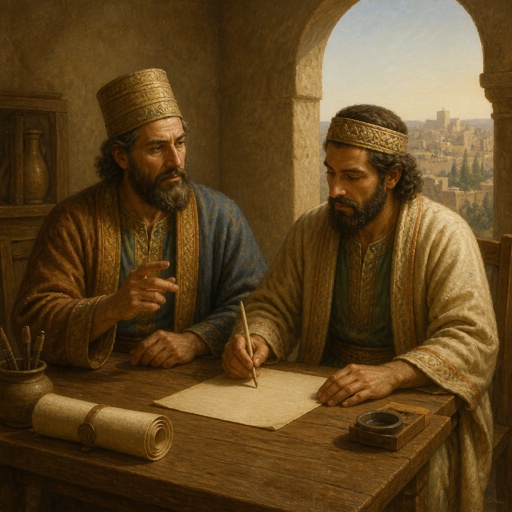
"Rehum the chancellor and Shimshai the scribe wrote a letter against Jerusalem to Artaxerxes the king in this sort:" - Ezra 4:8

Zerubbabel in Ezra chapter 4

Zerubbabel in Ezra chapter 4

Ezra 4:4 - "Then the people of the land weakened the hands of the people of Judah, and troubled them in building,"

Ezra 8:32 - "And we came to Jerusalem, and abode there three days."

Ezra 2:8 - "The children of Zattu, nine hundred forty and five."

Letter to the king in Ezra chapter 4

Nehemiah 8:4 - "And Ezra the scribe stood upon a pulpit of wood, which they had made for the purpose; and beside him stood Mattithiah, and Shema, and Anaiah, and Urijah, and Hilkiah, and Maaseiah, on his right hand; and on his left hand, Pedaiah, and Mishael, and Malchiah, and Hashum, and Hashbadana, Zechariah, and Meshullam."

Ezra 7:4 - "The son of Zerahiah, the son of Uzzi, the son of Bukki,"
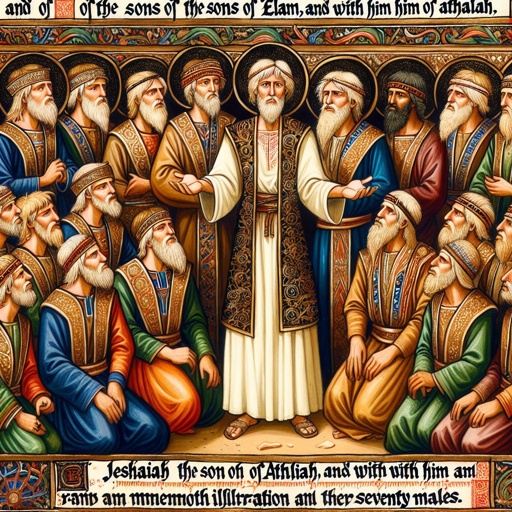
Ezra 8:7 - "And of the sons of Elam; Jeshaiah the son of Athaliah, and with him seventy males."

Ezra 8:10 - "And of the sons of Shelomith; the son of Josiphiah, and with him an hundred and threescore males."
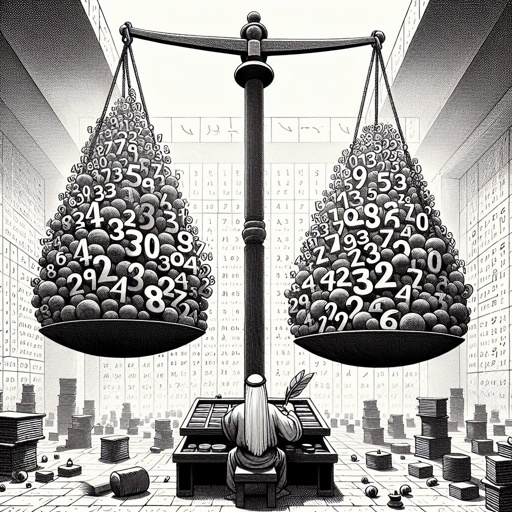
Ezra 8:34 - "By number and by weight of every one: and all the weight was written at that time."

Ezra 8:14 - "Of the sons also of Bigvai; Uthai, and Zabbud, and with them seventy males."

Ezra 8:5 - "Of the sons of Shechaniah; the son of Jahaziel, and with him three hundred males."

Ezra 8:12 - "And of the sons of Azgad; Johanan the son of Hakkatan, and with him an hundred and ten males."

Ezra 7:8 - "And he came to Jerusalem in the fifth month, which was in the seventh year of the king."

Ezra 8:19 - "And Hashabiah, and with him Jeshaiah of the sons of Merari, his brethren and their sons, twenty;"

Ezra 8:6 - "Of the sons also of Adin; Ebed the son of Jonathan, and with him fifty males."

Ezra 8:23 - "So we fasted and besought our God for this: and he was intreated of us."

Ezra 2:4 - "The children of Shephatiah, three hundred seventy and two."

Ezra 8:11 - "And of the sons of Bebai; Zechariah the son of Bebai, and with him twenty and eight males."

Ezra 8:2 - "Of the sons of Phinehas; Gershom: of the sons of Ithamar; Daniel: of the sons of David; Hattush."

"And of the sons of Shephatiah; Zebadiah the son of Michael, and with him fourscore males." - Ezra 8:8