A Sacrificial Offering: Great Expectations in Service to God
"And weighed unto them the silver, and the gold, and the vessels, even the offering of the house of our God, which the king, and his counsellors, and his lords, and all Israel there present, had offered:" - Ezra 8:25
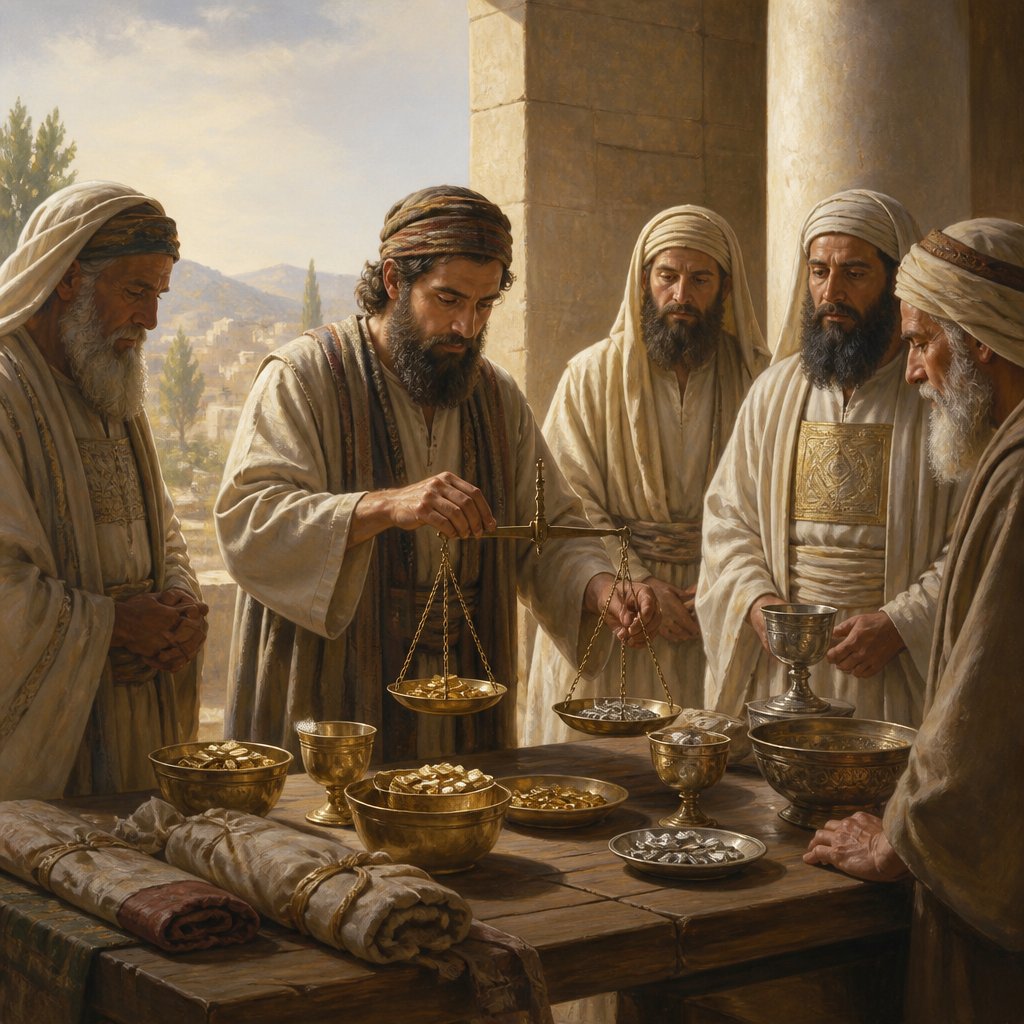
The verse from Ezra 8:25 (KJV) states, "And weighed unto them the silver, and the gold, and the vessels, even the offering of the house of our God, which the king, and his counsellors, and his lords, and all Israel there present, had offered." This moment in scripture captures the significance of offering, accountability, and the communal responsibility we hold as God’s people in the act of worship and service.
### Understanding the Context
Ezra 8 recounts the journey of the Israelites returning from Babylonian exile. Ezra, a scribe and priest, was tasked with leading this group back to Jerusalem with the vital mission of reconstructing their spiritual and physical home, the temple of God. It's essential to grasp that after years of captivity, the return to their land wasn’t merely about physical restoration but also deeply spiritual renewal. The offerings mentioned in this verse reflect not just financial contributions but a heartfelt re-establishment of worship and commitment to the God they serve. They represent trust in God’s provision and a desire to honor Him with their substance.
### Weighing the Offerings
The act of weighing the silver, gold, and vessels conveys an important principle. In the ancient world, weighing was a means of ensuring fairness and transparency in transactions. As Ezra received these gifts, it served as a reminder that God values accountability in our offerings. Each contribution—be it material, spiritual, or relational—matters to God and is acknowledged in His kingdom. The weighing signifies that our sacrifices are of importance to Him and that He desires our offerings to be sincere, proportional to what He has blessed us with, and reflective of a heart stirred by His grace.
### A Communal Effort
Moreover, Ezra’s account highlights the collective involvement of the community. The king, his counselors, lords, and all of Israel were unified in their effort to provide for the house of God. In this serving together, we see the beauty of the body of Christ: each member plays a role in advancing the kingdom of God. When we offer collectively, we demonstrate our commitment to a cause greater than ourselves. It calls us to examine our own participation in our communities and churches. Just as the Israelites came together in unison to support the house of God, we too are encouraged to see our individual contributions as part of a larger tapestry of faith and obedience.
### Offering Beyond Measure
It's also critical to reflect on the nature of the offerings. The Israelites gave not out of obligation, but from a place of reverent worship. In our own lives, do we give to God with that same fervor? Are we maintaining a posture of generosity, whether through our time, talents, resources, or service? In a world that often encourages self-centeredness and scarcity, God calls us to a lifestyle of abundance and selflessness—mirroring the ultimate offering He made through Christ. Our everyday gifts may seem small, but when offered to God with love, they become monumental in the fulfillment of His purposes.
### Conclusion
In conclusion, Ezra 8:25 encourages us to weigh our offerings, both literally and figuratively. Each act of generosity, each time we sacrifice our own interests for the sake of God's work, is a declaration of faith in His provision. Let us strive to give of ourselves as the Israelites did—wholeheartedly, transparently, and in unity. As we gather our resources, may we remember that they are not just for our own gain or even for the building of a temple but for the glorification of God, ensuring that His presence remains among us as we build His kingdom on Earth.
Let our prayer be that we foster a spirit of lavish giving, emulating the generosity of those who came before us, realizing that in our contributions, great expectations and mighty workings of God can take shape.
Want to reflect more on Ezra 8:25?
Continue your spiritual journey with Bible Chat — an AI-powered tool for exploring God's Word through conversation. Ask questions, discover connections, and deepen your understanding.
Get Our Apps


Ezra 8:25 Artwork

Ezra 8:25 - "And weighed unto them the silver, and the gold, and the vessels, even the offering of the house of our God, which the king, and his counsellors, and his lords, and all Israel there present, had offered:"
"And weighed unto them the silver, and the gold, and the vessels, even the offering of the house of our God, which the king, and his counsellors, and his lords, and all Israel there present, had offered:" - Ezra 8:25

Ezra 8:21

Ezra 8:8 - "And of the sons of Shephatiah; Zebadiah the son of Michael, and with him fourscore males."

Ezra 2:25 - "The children of Kirjath-arim, Chephirah, and Beeroth, seven hundred and forty and three."

Ezra 10:25 - "Moreover of Israel: of the sons of Parosh; Ramiah, and Jeziah, and Malchiah, and Miamin, and Eleazar, and Malchijah, and Benaiah."

Ezra 8:32 - "And we came to Jerusalem, and abode there three days."

Ezra 7:25 - "And thou, Ezra, after the wisdom of thy God, that is in thine hand, set magistrates and judges, which may judge all the people that are beyond the river, all such as know the laws of thy God; and teach ye them that know them not."

Ezra 2:8 - "The children of Zattu, nine hundred forty and five."
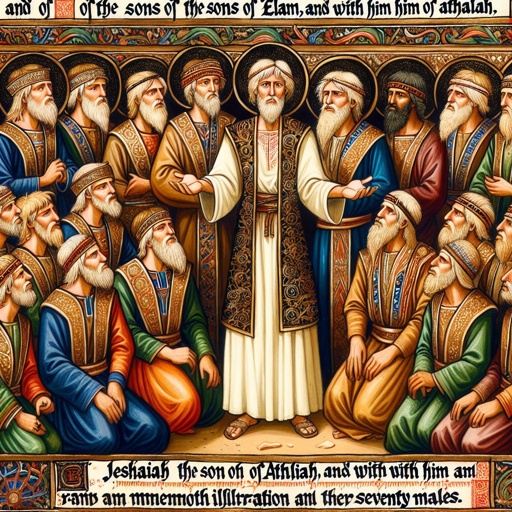
Ezra 8:7 - "And of the sons of Elam; Jeshaiah the son of Athaliah, and with him seventy males."

Ezra 8:10 - "And of the sons of Shelomith; the son of Josiphiah, and with him an hundred and threescore males."
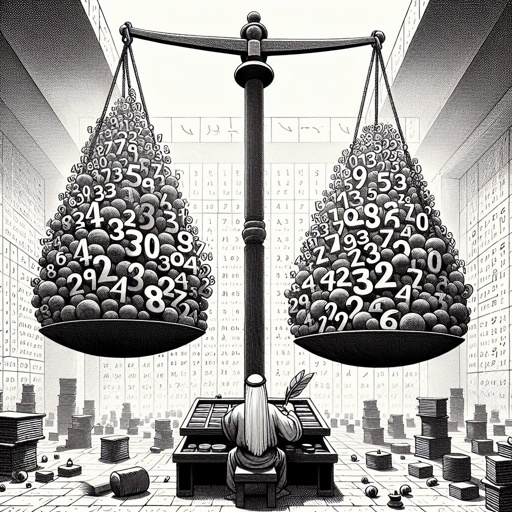
Ezra 8:34 - "By number and by weight of every one: and all the weight was written at that time."

Ezra 8:14 - "Of the sons also of Bigvai; Uthai, and Zabbud, and with them seventy males."

Ezra 8:5 - "Of the sons of Shechaniah; the son of Jahaziel, and with him three hundred males."

Ezra 7:8 - "And he came to Jerusalem in the fifth month, which was in the seventh year of the king."

Ezra 8:12 - "And of the sons of Azgad; Johanan the son of Hakkatan, and with him an hundred and ten males."

Ezra 8:6 - "Of the sons also of Adin; Ebed the son of Jonathan, and with him fifty males."

Ezra 8:19 - "And Hashabiah, and with him Jeshaiah of the sons of Merari, his brethren and their sons, twenty;"

Ezra 8:23 - "So we fasted and besought our God for this: and he was intreated of us."

Ezra 8:11 - "And of the sons of Bebai; Zechariah the son of Bebai, and with him twenty and eight males."

Ezra 8:2 - "Of the sons of Phinehas; Gershom: of the sons of Ithamar; Daniel: of the sons of David; Hattush."

Ezra 8:4 - "Of the sons of Pahath-moab; Elihoenai the son of Zerahiah, and with him two hundred males."

"And of the sons of Shephatiah; Zebadiah the son of Michael, and with him fourscore males." - Ezra 8:8

Ezra 8:9 - "Of the sons of Joab; Obadiah the son of Jehiel, and with him two hundred and eighteen males."

Ezra 8:24 - "¶ Then I separated twelve of the chief of the priests, Sherebiah, Hashabiah, and ten of their brethren with them,"

Ezra 8:13 - "And of the last sons of Adonikam, whose names are these, Eliphelet, Jeiel, and Shemaiah, and with them threescore males."

Ezra 4:8 - "Rehum the chancellor and Shimshai the scribe wrote a letter against Jerusalem to Artaxerxes the king in this sort:"

Ezra 8:3 - "Of the sons of Shechaniah, of the sons of Pharosh; Zechariah: and with him were reckoned by genealogy of the males an hundred and fifty."

Ezra 8:27 - "Also twenty basons of gold, of a thousand drams; and two vessels of fine copper, precious as gold."

Ezra 8:1 - "These are now the chief of their fathers, and this is the genealogy of them that went up with me from Babylon, in the reign of Artaxerxes the king."