When the Walls Seem Immoveable: Trusting God's Timing and Authority
"Give ye now commandment to cause these men to cease, and that this city be not builded, until another commandment shall be given from me." - Ezra 4:21
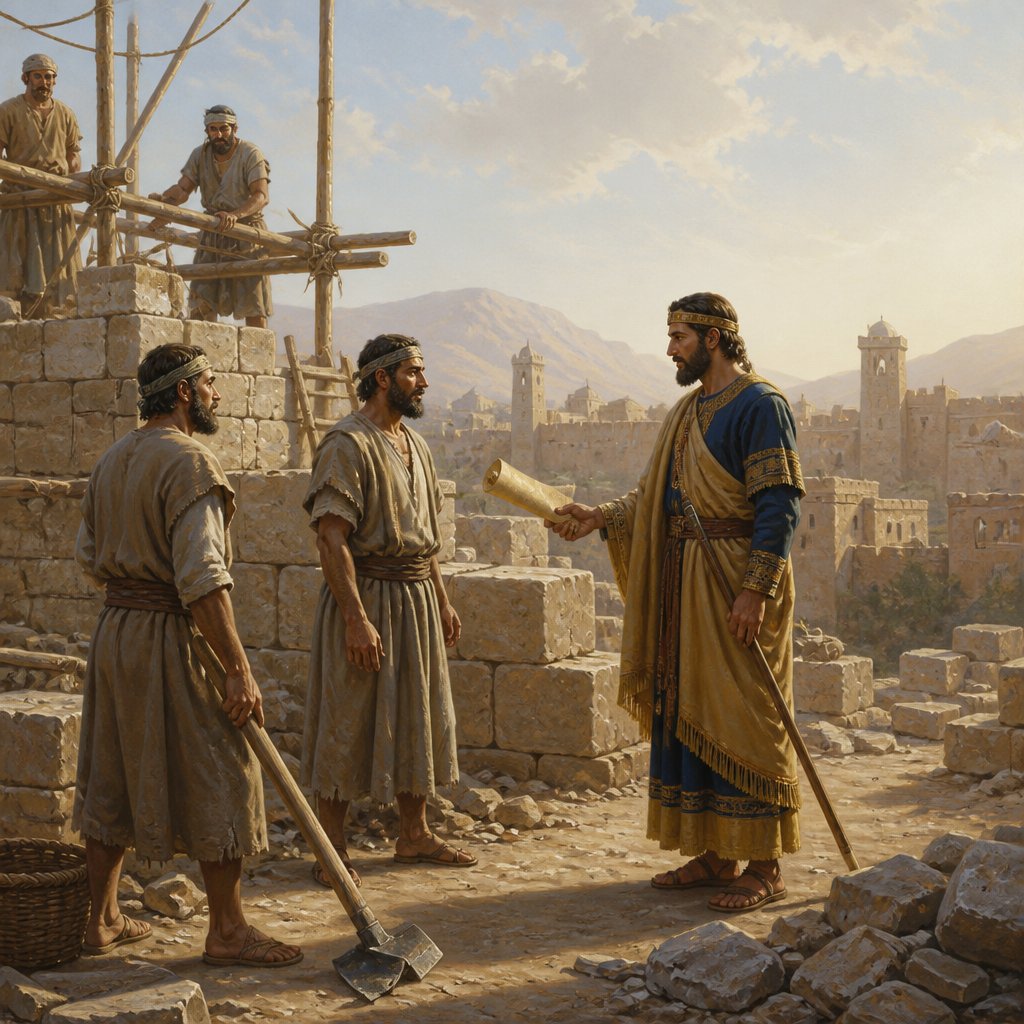
In the grand tapestry of biblical history, we find ourselves drawn into the profound narrative found in Ezra 4:21, which states: "Give ye now commandment to cause these men to cease, and that this city be not builded, until another commandment shall be given from me." At first glance, this verse speaks of a cessation of work, a temporary halt to progress, and a manipulation of authority to erect barriers against rebuilding what was lost. It’s a call to stillness in the face of ambition and purpose. Let us meditate on how this speaks to us today and reflects on God’s sovereignty and perfect timing in our lives.
### The Context of Opposition
The Israelites had returned from Babylonian exile with great hope and determination to rebuild Jerusalem and its temple. However, their efforts faced significant opposition. The local authorities, feeling threatened by the revival of the Jewish nation and its significance, sought to undermine this movement. The edict recorded in Ezra essentially meant that the rebuilding of Jerusalem, a symbol of hope and restoration, was halted by human decree. In many ways, this passage serves as a reminder of the forces we often face when we set out to fulfill God’s purpose in our lives. Opposition to our goals can come in various forms — be it external discouragement, personal failure, or even unforeseen circumstances.
### Reflection on Authority and Timing
In verse 21, we see the exercise of authority that commands an end to the work of rebuilding. Often, we face moments in our lives where we encounter roadblocks that seem insurmountable, moments when we feel that our efforts to move forward are stifled. The authority depicted here is reminiscent of the spiritual authority God holds. It reminds us that we, too, may occasionally find ourselves in a season of waiting, where it appears that all progress has ceased. Yet, we must remember that just as this command came from a human source, every authority is ultimately subject to God’s dominion.
### Finding Peace in Pause
Much like the Israelites, we may see our plans halted. We might be tempted to despair, to question why God would allow such obstacles. Yet, this is where faith comes into play. In our waits, we must actively choose to trust. God’s timing is often not aligned with our expectations. Such interruption can often lead to deeper spiritual growth, calling us to greater reliance on Him.
During these times of stillness, God invites us to lean in closer to Him, to deepen our understanding and reliance on His word. When our walls seem immoveable, our calling is to rest in His presence, praying for wisdom and discernment. We can remind ourselves of Isaiah 40:31: "But they that wait upon the LORD shall renew their strength; they shall mount up with wings as eagles; they shall run, and not be weary; and they shall walk, and not faint." God uses our waiting seasons to prepare us for what He has in store, for His plans are always for our good.
### The Promise of the Future
In this passage, there is confidence in the sovereignty of God. Just as the command to stop the work was given, we trust that there will be another commandment to resume. The same applies in our lives; just as seasons change, so will our circumstances. We are called to remain faithful, even when the path is unclear. If we keep our eyes fixed on Jesus, the author and perfecter of our faith (Hebrews 12:2), and trust in His timing, we can find peace even in inactivity.
In conclusion, Ezra 4:21 teaches us that setbacks are not the end. The stopping point is often just the beginning of God’s preparation for something greater. Let us pray for patience, for wisdom to see beyond the immediate, and for strength to hold on until we receive further instructions from our divine commander. He who began a good work in you will be faithful to complete it (Philippians 1:6). Amen.
Want to reflect more on Ezra 4:21?
Continue your spiritual journey with Bible Chat — an AI-powered tool for exploring God's Word through conversation. Ask questions, discover connections, and deepen your understanding.
Get Our Apps


Ezra 4:21 Artwork

Ezra 4:21 - "Give ye now commandment to cause these men to cease, and that this city be not builded, until another commandment shall be given from me."
"Give ye now commandment to cause these men to cease, and that this city be not builded, until another commandment shall be given from me." - Ezra 4:21

Ezra 8:21

Ezra 4:4

Ezra 4:4

Ezra 2:21 - "The children of Beth-lehem, an hundred twenty and three."

Ezra 10:21 - "And of the sons of Harim; Maaseiah, and Elijah, and Shemaiah, and Jehiel, and Uzziah."

Zerubbabel in Ezra chapter 4

Zerubbabel in Ezra chapter 4

Ezra 4:4 - "Then the people of the land weakened the hands of the people of Judah, and troubled them in building,"

Ezra 7:21 - "And I, even I Artaxerxes the king, do make a decree to all the treasurers which are beyond the river, that whatsoever Ezra the priest, the scribe of the law of the God of heaven, shall require of you, it be done speedily,"

Letter to the king in Ezra chapter 4

Ezra 7:4 - "The son of Zerahiah, the son of Uzzi, the son of Bukki,"

Ezra 2:4 - "The children of Shephatiah, three hundred seventy and two."

"The children of Beth-lehem, an hundred twenty and three." - Ezra 2:21

Ezra 8:4 - "Of the sons of Pahath-moab; Elihoenai the son of Zerahiah, and with him two hundred males."

"And of the sons of Harim; Maaseiah, and Elijah, and Shemaiah, and Jehiel, and Uzziah." - Ezra 10:21

Ezra 4:22 - "Take heed now that ye fail not to do this: why should damage grow to the hurt of the kings?"

Ezra 5:4 - "Then said we unto them after this manner, What are the names of the men that make this building?"

Ezra 4:8 - "Rehum the chancellor and Shimshai the scribe wrote a letter against Jerusalem to Artaxerxes the king in this sort:"

Ezra 10:4 - "Arise; for this matter belongeth unto thee: we also will be with thee: be of good courage, and do it."

"Then the people of the land weakened the hands of the people of Judah, and troubled them in building," - Ezra 4:4

Ezra 4:18 - "The letter which ye sent unto us hath been plainly read before me."

"The son of Zerahiah, the son of Uzzi, the son of Bukki," - Ezra 7:4

Ezra 4:6 - "And in the reign of Ahasuerus, in the beginning of his reign, wrote they unto him an accusation against the inhabitants of Judah and Jerusalem."

Ezra 6:4 - "With three rows of great stones, and a row of new timber: and let the expenses be given out of the king's house:"

Ezra 4:10 - "And the rest of the nations whom the great and noble Asnappar brought over, and set in the cities of Samaria, and the rest that are on this side the river, and at such a time."

Ezra 4:24 - "Then ceased the work of the house of God which is at Jerusalem. So it ceased unto the second year of the reign of Darius king of Persia."

1 Chronicles 4:17 - "And the sons of Ezra were, Jether, and Mered, and Epher, and Jalon: and she bare Miriam, and Shammai, and Ishbah the father of Eshtemoa."

Ezra 4:1 - "Now when the adversaries of Judah and Benjamin heard that the children of the captivity builded the temple unto the LORD God of Israel;"