Restoring the Altar: A Commitment Amidst Fear
"And they set the altar upon his bases; for fear was upon them because of the people of those countries: and they offered burnt offerings thereon unto the LORD, even burnt offerings morning and evening." - Ezra 3:3
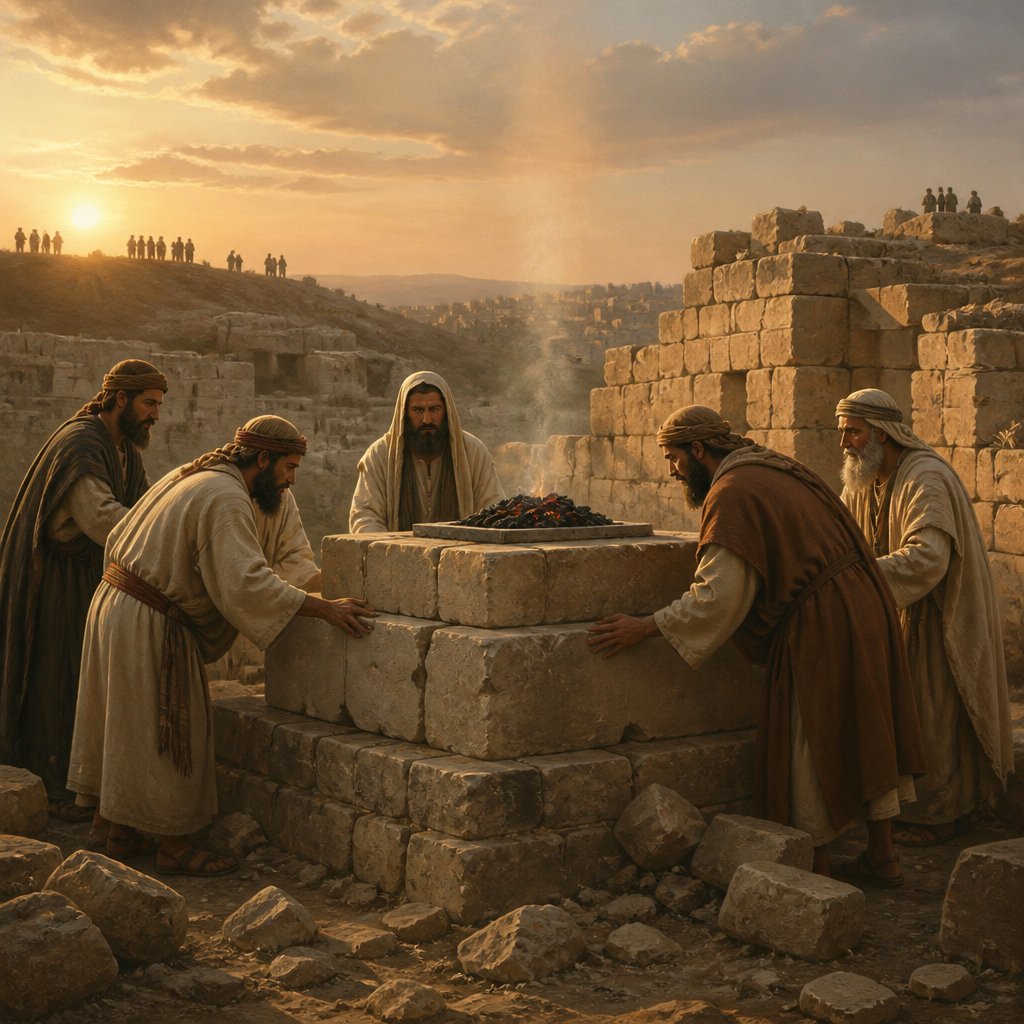
The scene in Ezra 3:3 is one filled with profound significance, emerging from the ruins of a decimated Jerusalem. "And they set the altar upon his bases; for fear was upon them because of the people of those countries: and they offered burnt offerings thereon unto the LORD, even burnt offerings morning and evening." This verse encapsulates the essence of faith, courage, and commitment to worship amidst adversity.
The Israelites returned to Jerusalem after decades of exile, burdened by the memories of destruction and the realities of a hostile surrounding. The mention of the altar that they set upon its bases is not merely architectural; it symbolizes the restoration of their covenant relationship with God. The altar was the place of sacrifice, where they drew near to God, offering expressions of gratitude, repentance, and worship. Rebuilding this altar was paramount for the returning exiles, marking the rekindling of their spiritual identity and communal purpose.
However, the act of erecting the altar was not without its challenges. The verse candidly observes that "fear was upon them because of the people of those countries." The returning exiles faced potential hostility from neighboring peoples who would see their return and their efforts to rebuild as a direct threat. This fear could have paralyzed their resolve and diminished their spirit. Yet, in the face of this apprehension, the Israelites made the deliberate choice to prioritize their relationship with God.
In times of fear, it is natural to retreat, to allow the weight of insecurity to hinder our progress. When fear grips our hearts – whether it’s fear of failure, fear of others’ opinions, or fear of the unknown – we often find ourselves stalling in our spiritual journey. But what we learn from Ezra 3:3 is pivotal: the act of worship can be the catalyst for overcoming fear. The Israelites, instead of withdrawing, offered "burnt offerings morning and evening", which shows us that genuine worship can be a powerful act of faith. They continued to recognize God’s sovereignty, His provision, and His call upon their lives. This persistent worship served to reaffirm their identity as God’s people, despite external threats.
The significance of their offerings cannot be overlooked: they were burnt offerings, a complete sacrifice dedicated to God, reminiscent of total devotion and surrender. Morning and evening, they entered into God’s presence; their commitment to worship was constant, a rhythmic declaration of their reliance on the Almighty despite their circumstances. In essence, they were saying, "No matter what surrounds us, we choose to focus on You, Lord!"
As modern-day believers, we are called to embody this same spirit. The challenges we face – be they societal pressures, individual struggles, or health crises – can provoke fear and trepidation. Yet, in the midst of these trials, God invites us to build altars in our hearts. These altars may manifest as dedicated times of prayer, worship, or study of His Word; they become the places where we meet God, refocusing our hearts and minds away from our fears and toward His unfailing love and power.
Moreover, the accountability and communal aspect of Ezra’s decree to build the altar remind us that we are not alone in our journeys. Just as the Israelites banded together, we, too, are encouraged to lean on our faith communities for support, prayer, and encouragement. We strengthen one another’s resolve to worship amid adversity, fostering an environment where our collective faith can rise above individual fears.
In conclusion, Ezra 3:3 is not just a historical account but a timeless reminder of how our worship can transform our fear into faith. As we set our own altars today—whether in prayer or in service—let us do so with the confidence that God is with us, turning our fear into a foundation for vibrant faith and powerful testimony.
Want to reflect more on Ezra 3:3?
Continue your spiritual journey with Bible Chat — an AI-powered tool for exploring God's Word through conversation. Ask questions, discover connections, and deepen your understanding.
Get Our Apps


Ezra 3:3 Artwork

Ezra 3:3 - "And they set the altar upon his bases; for fear was upon them because of the people of those countries: and they offered burnt offerings thereon unto the LORD, even burnt offerings morning and evening."
"And they set the altar upon his bases; for fear was upon them because of the people of those countries: and they offered burnt offerings thereon unto the LORD, even burnt offerings morning and evening." - Ezra 3:3

Ezra 3:2

Ezra 10:3

Ezra 3:2

Ezra 3:10

Ezra 3:9

Ezra 3:2

Altar rebuilt in Jerusalem. Ezra 3:1-3

Ezra 9:3

Ezra 3:2

Ezra 3:2

Ezra 10:3

Zerubbabel in Ezra chapter 3

Ezra 7:3 - "The son of Amariah, the son of Azariah, the son of Meraioth,"

Ezra 2:3 - "The children of Parosh, two thousand an hundred seventy and two."

Pagan women leave with their children ezra 10:3

Pagan women leave with their children ezra 10:3

Ezra 8:3 - "Of the sons of Shechaniah, of the sons of Pharosh; Zechariah: and with him were reckoned by genealogy of the males an hundred and fifty."

Ezra 3:11 – "With praise and thanksgiving they sang to the Lord: 'He is good; his love toward Israel endures forever.'"

"The son of Amariah, the son of Azariah, the son of Meraioth," - Ezra 7:3

Ezra 3:1 - "And when the seventh month was come, and the children of Israel were in the cities, the people gathered themselves together as one man to Jerusalem."

Ezra 3:4 - "¶ They kept also the feast of tabernacles, as it is written, and offered the daily burnt offerings by number, according to the custom, as the duty of every day required;"

Ezra 3:6 - "From the first day of the seventh month began they to offer burnt offerings unto the LORD. But the foundation of the temple of the LORD was not yet laid."

"The children of Parosh, two thousand an hundred seventy and two." - Ezra 2:3

Ezra 3:13 - "So that the people could not discern the noise of the shout of joy from the noise of the weeping of the people: for the people shouted with a loud shout, and the noise was heard afar off."

Ezra 9:3 - "And when I heard this thing, I rent my garment and my mantle, and plucked off the hair of my head and of my beard, and sat down astonied."

Ezra 3:10 - "And when the builders laid the foundation of the temple of the LORD, they set the priests in their apparel with trumpets, and the Levites the sons of Asaph with cymbals, to praise the LORD, after the ordinance of David king of Israel."

Ezra 3:11 – "With praise and thanksgiving they sang to the Lord: 'He is good; his love toward Israel endures forever.'"

Ezra 3:11 – "With praise and thanksgiving they sang to the Lord: 'He is good; his love toward Israel endures forever.'"