Divine Deliverance: A Call to Freedom
"And afterward Moses and Aaron went in, and told Pharaoh, Thus saith the LORD God of Israel, Let my people go, that they may hold a feast unto me in the wilderness." - Exodus 5:1
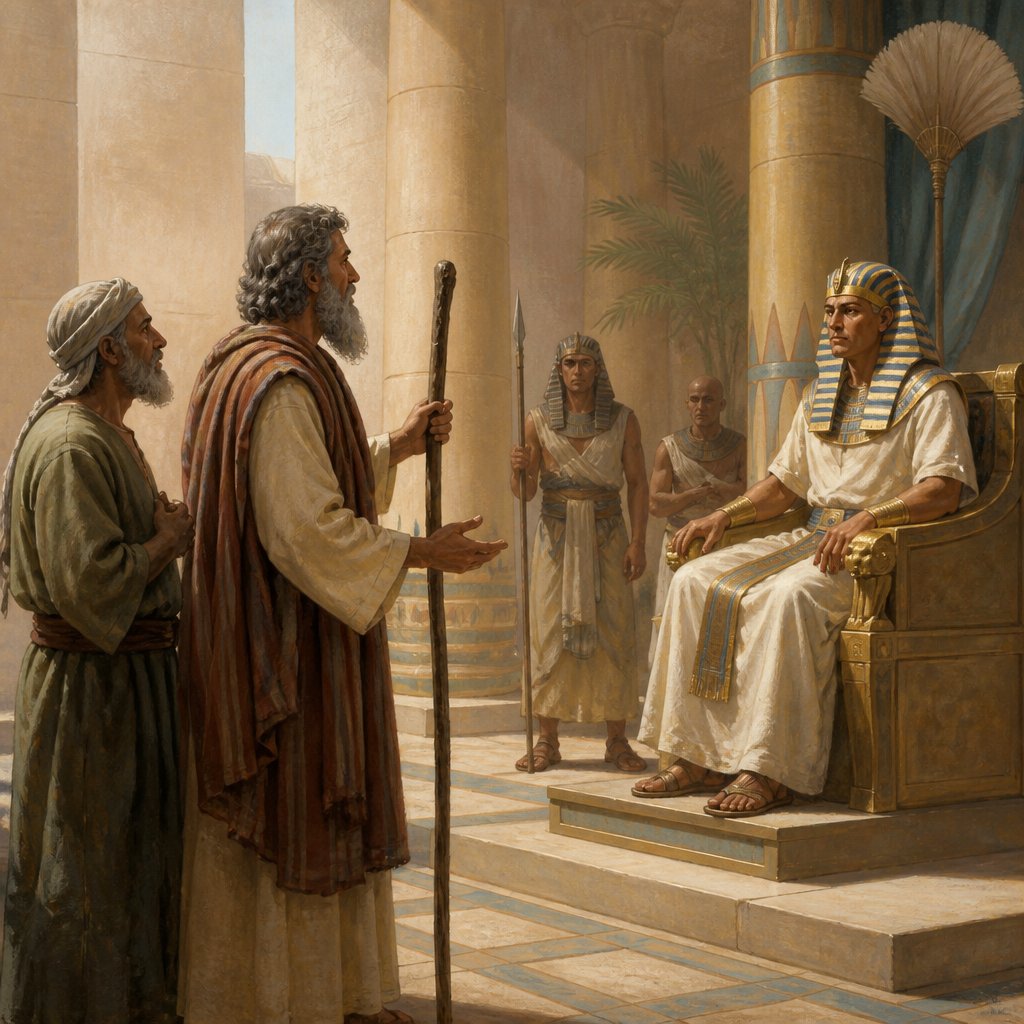
The verse from Exodus 5:1 reads, "And afterward Moses and Aaron went in, and told Pharaoh, Thus saith the LORD God of Israel, Let my people go, that they may hold a feast unto me in the wilderness." This passage encapsulates a pivotal moment in the narrative of the Israelites' journey to freedom. It holds profound significance not only in a historical context but also in our spiritual lives today.
To understand the weight of this proclamation, we must delve into the context surrounding it. The Israelites had been in captivity in Egypt for over 400 years, subjected to harsh labor and oppression. Their cries for deliverance reached the ears of God, who commissioned Moses and Aaron to confront Pharaoh, the embodiment of human authority and oppression. Their request was not merely a plea for freedom; it was a divine command from the Creator Himself. The phrase "Let my people go" resonates as a powerful declaration of liberation, signaling God's intention to reclaim His people from bondage.
The first important aspect of this verse is the authority with which Moses and Aaron approach Pharaoh. They did not come in secret; they entered the court of Pharaoh with the boldness that comes from knowing they carried a divine message. This teaches us that when we approach our challenges—whether they are personal struggles, societal injustices, or spiritual opposition—we must do so with the confidence that comes from God’s authority. Likewise, when we articulate our desires for liberation, healing, or transformation, we should do so as representatives of God's will. It reminds us to stand firm in our faith, emboldened by the knowledge that we are not speaking for ourselves, but for the God who created the heavens and earth.
Secondly, this verse introduces us to the concept of worship. God’s command to Pharaoh was not just about freedom; it was to enable His people to engage in worship—"that they may hold a feast unto me in the wilderness." Worship is a central theme in the lives of God's people. Just as the Israelites were to be liberated from physical captivity to worship, we too are called to release ourselves from spiritual bondage to truly honor God. The wilderness symbolizes a place of testing and transformation, a space that can often feel desolate and challenging. Yet, it is also where we encounter God in profound ways. In times of spiritual wilderness, God does not abandon us; instead, He invites us into a deeper communion through worship.
Moreover, the act of celebrating 'a feast' unto the Lord signifies a joyous occasion. Feasts in the Bible are often times of remembrance, gratitude, and communion with God, engaging not just the heart but also the body in the celebration of God’s goodness. It suggests that our response to liberation should be joyful worship. How often do we allow our present struggles to overshadow our call to worship? Just like the Israelites, we often need to be reminded that worship should be both an act of gratitude and a response to our deliverance, no matter the circumstances in which we find ourselves.
Finally, God's intent was for His people to gather together in worship. Community is vital in our journey with God. Just as Moses and Aaron went together to Pharaoh, we are encouraged to pursue our relationship with God in the company of others. The power of collective faith cannot be underestimated. We need each other to lift our voices, to celebrate, to remember our deliverance from sin and despair, and to worship together.
As we meditate on Exodus 5:1, let us embrace the call to let go of our burdens and step into the freedom God offers. Just as He instructed Moses and Aaron to relay His message, let us be bearers of hope and freedom, proclaiming His goodness to those around us. And wherever we find ourselves—whether in the halls of authority or the quietness of our hearts—may we boldly proclaim, "Let my people go," not just for liberation from physical chains but for the ultimate freedom found in worshiping our God.
Want to reflect more on Exodus 5:1?
Continue your spiritual journey with Bible Chat — an AI-powered tool for exploring God's Word through conversation. Ask questions, discover connections, and deepen your understanding.
Get Our Apps


Exodus 5:1 Artwork

Exodus 5:1 - "And afterward Moses and Aaron went in, and told Pharaoh, Thus saith the LORD God of Israel, Let my people go, that they may hold a feast unto me in the wilderness."
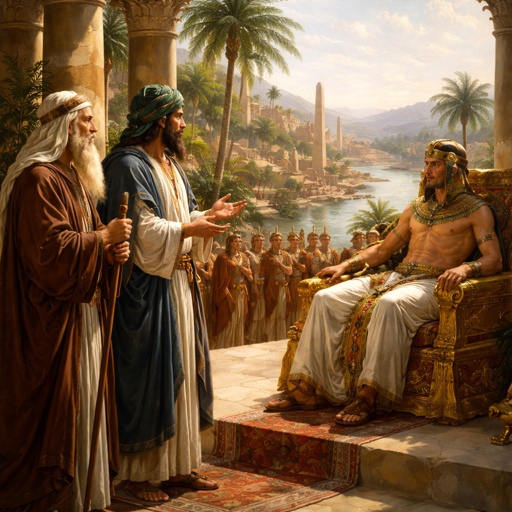
In the context of Exodus 5:1, draw an image of Moses and Aaron standing before a 30 year old Pharaoh and telling him to let the people of Israel go out of Egypt. Pharaoh is sitting on his throne in the open courtyard in Egypt with the Nile River in the background. Moses and Aaron are dressed in Hebrew attire, and Pharaoh is dressed in hid daily Egyptian attire. The time is mid morning.

Exodus 5:1-21 - "Exodus 5:1-21 Afterward Moses and Aaron went to Pharaoh and said, “This is what the Lord, the God of Israel, says: ‘Let my people go, so that they may hold a festival to me in the wilderness.’” Pharaoh said, “Who is the Lord, that I should obey him and let Israel go? I do not know the Lord and I will not let Israel go.” Then they said, “The God of the Hebrews has met with us. Now let us take a three-day journey into the wilderness to offer sacrifices to the Lord our God, or he may strike us with plagues or with the sword.” But the king of Egypt said, “Moses and Aaron, why are you taking the people away from their labor? Get back to your work!” Then Pharaoh said, “Look, the people of the land are now numerous, and you are stopping them from working.” That same day Pharaoh gave this order to the slave drivers and overseers in charge of the people: “You are no longer to supply the people with straw for making bricks; let them go and gather their own straw. But require them to make the same number of bricks as before; don’t reduce the quota. They are lazy; that is why they are crying out, ‘Let us go and sacrifice to our God.’ Make the work harder for the people so that they keep working and pay no attention to lies.” Then the slave drivers and the overseers went out and said to the people, “This is what Pharaoh says: ‘I will not give you any more straw. Go and get your own straw wherever you can find it, but your work will not be reduced at all.’” So the people scattered all over Egypt to gather stubble to use for straw. The slave drivers kept pressing them, saying, “Complete the work required of you for each day, just as when you had straw.” And Pharaoh’s slave drivers beat the Israelite overseers they had appointed, demanding, “Why haven’t you met your quota of bricks yesterday or today, as before?” Then the Israelite overseers went and appealed to Pharaoh: “Why have you treated your servants this way? Your servants are given no straw, yet we are told, ‘Make bricks!’ Your servants are being beaten, but the fault is with your own people.” Pharaoh said, “Lazy, that’s what you are—lazy! That is why you keep saying, ‘Let us go and sacrifice to the Lord.’ Now get to work. You will not be given any straw, yet you must produce your full quota of bricks.” The Israelite overseers realized they were in trouble when they were told, “You are not to reduce the number of bricks required of you for each day.” "
"And afterward Moses and Aaron went in, and told Pharaoh, Thus saith the LORD God of Israel, Let my people go, that they may hold a feast unto me in the wilderness." - Exodus 5:1
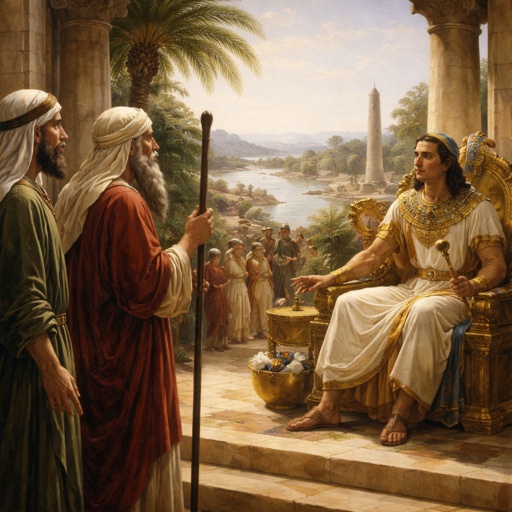
In the context of Exodus 5:1, draw an image of Moses and Aaron standing before a 30 year old Pharaoh and telling him to let the people of Israel go out of Egypt. Pharaoh is sitting on his throne in the open courtyard in Egypt with the Nile River in the background. Moses and Aaron are dressed in Hebrew attire, and Pharaoh is dressed in hid daily Egyptian attire. The time is mid morning. In order to make the narrower than it is high, the view will be looking past Moses and Aaron with Pharaoh's back to the river.
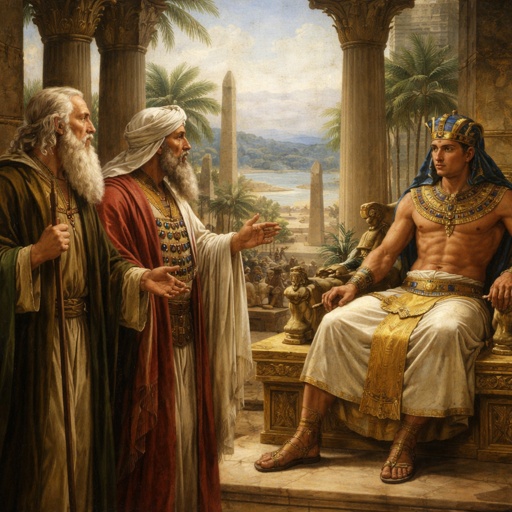
In the context of Exodus 5:1, draw an image of Moses and Aaron standing before a 30 year old Pharaoh and telling him to let the people of Israel go out of Egypt. Pharaoh is sitting on his throne in the open courtyard in Egypt with the Nile River in the background. Moses and Aaron are dressed in Hebrew attire, and Pharaoh is dressed in hid daily Egyptian attire. The time is mid morning. In order to make the narrower than it is high, the view will be looking past Moses and Aaron with Pharaoh's back to the river. Have Moses, Aaron and Pharaoh fill 2/3 of the images' width.
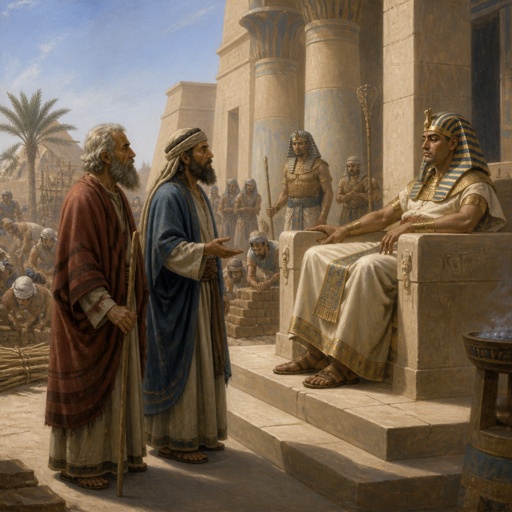
"Exodus 5:1-21 Afterward Moses and Aaron went to Pharaoh and said, “This is what the Lord, the God of Israel, says: ‘Let my people go, so that they may hold a festival to me in the wilderness.’” Pharaoh said, “Who is the Lord, that I should obey him and let Israel go? I do not know the Lord and I will not let Israel go.” Then they said, “The God of the Hebrews has met with us. Now let us take a three-day journey into the wilderness to offer sacrifices to the Lord our God, or he may strike us with plagues or with the sword.” But the king of Egypt said, “Moses and Aaron, why are you taking the people away from their labor? Get back to your work!” Then Pharaoh said, “Look, the people of the land are now numerous, and you are stopping them from working.” That same day Pharaoh gave this order to the slave drivers and overseers in charge of the people: “You are no longer to supply the people with straw for making bricks; let them go and gather their own straw. But require them to make the same number of bricks as before; don’t reduce the quota. They are lazy; that is why they are crying out, ‘Let us go and sacrifice to our God.’ Make the work harder for the people so that they keep working and pay no attention to lies.” Then the slave drivers and the overseers went out and said to the people, “This is what Pharaoh says: ‘I will not give you any more straw. Go and get your own straw wherever you can find it, but your work will not be reduced at all.’” So the people scattered all over Egypt to gather stubble to use for straw. The slave drivers kept pressing them, saying, “Complete the work required of you for each day, just as when you had straw.” And Pharaoh’s slave drivers beat the Israelite overseers they had appointed, demanding, “Why haven’t you met your quota of bricks yesterday or today, as before?” Then the Israelite overseers went and appealed to Pharaoh: “Why have you treated your servants this way? Your servants are given no straw, yet we are told, ‘Make bricks!’ Your servants are being beaten, but the fault is with your own people.” Pharaoh said, “Lazy, that’s what you are—lazy! That is why you keep saying, ‘Let us go and sacrifice to the Lord.’ Now get to work. You will not be given any straw, yet you must produce your full quota of bricks.” The Israelite overseers realized they were in trouble when they were told, “You are not to reduce the number of bricks required of you for each day.” " - Exodus 5:1-21

Exodus 4:1-5

Exodus 22:5

Exodus 22:5

Exodus 22:5

Exodus 1:5 - "And all the souls that came out of the loins of Jacob were seventy souls: for Joseph was in Egypt already."

Exodus 15:5

Exodus 5:5 - "And Pharaoh said, Behold, the people of the land now are many, and ye make them rest from their burdens."
"And all the souls that came out of the loins of Jacob were seventy souls: for Joseph was in Egypt already." - Exodus 1:5

Exodus 15:5 - "The depths have covered them: they sank into the bottom as a stone."

Exodus 34:5 - "And the LORD descended in the cloud, and stood with him there, and proclaimed the name of the LORD."

Exodus 37:5 - "And he put the staves into the rings by the sides of the ark, to bear the ark."

Exodus 28:5 - "And they shall take gold, and blue, and purple, and scarlet, and fine linen."

Exodus 25:5 - "And rams' skins dyed red, and badgers' skins, and shittim wood,"

Exodus 5:6 - "And Pharaoh commanded the same day the taskmasters of the people, and their officers, saying,"

Exodus 30:5 - "And thou shalt make the staves of shittim wood, and overlay them with gold."

Exodus 31:5 - "And in cutting of stones, to set them, and in carving of timber, to work in all manner of workmanship."

Exodus 38:5 - "And he cast four rings for the four ends of the grate of brass, to be places for the staves."

Exodus 5:20 - "¶ And they met Moses and Aaron, who stood in the way, as they came forth from Pharaoh:"

Exodus 9:5 - "And the LORD appointed a set time, saying, To morrow the LORD shall do this thing in the land."

Exodus 27:5 - "And thou shalt put it under the compass of the altar beneath, that the net may be even to the midst of the altar."

Exodus 5:13 - "And the taskmasters hasted them, saying, Fulfil your works, your daily tasks, as when there was straw."

Exodus 24;16

exodus 3