The Cleansing of Hands and Feet: A Reflection on Consecration and Service
"For Aaron and his sons shall wash their hands and their feet thereat:" - Exodus 30:19
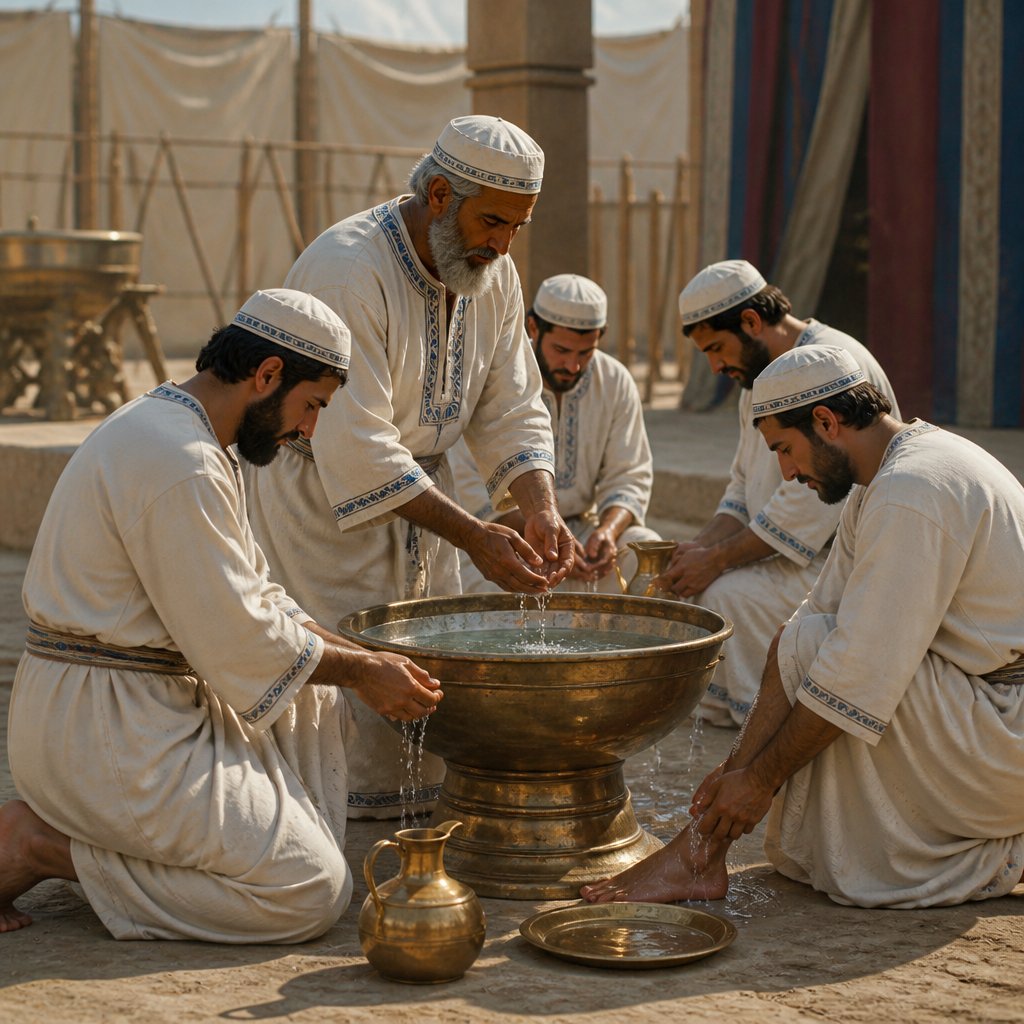
Exodus 30:19 (KJV) states, "For Aaron and his sons shall wash their hands and their feet thereat." This instruction, nestled within the intricate guidelines for the tabernacle's service, holds profound significance not only for the priests of old but for all who are called to serve in the kingdom of God today.
The context of this verse is critical. The Lord is speaking directly to Moses, providing specific instructions on the construction and rituals surrounding the tabernacle, where His presence would dwell among His people. The washing of hands and feet was not merely a physical act of cleanliness but a spiritual preparation for entering into the holy space, a symbol of readiness for service and a reminder of the need for purity.
Consider the role of Aaron and his sons—the first ordained priests of Israel. They are established as intermediaries between God and His people, tasked with performing sacred rituals that would atone for the sins of the nation. The act of washing their hands and feet before service signifies the importance of cleansing oneself of sin, just as we are called to do today. As we approach the presence of God, we must be mindful of our spiritual state and the need to be purified before we can effectively serve Him.
In our lives, what does it mean to ‘wash our hands and feet’? To wash our hands symbolizes the need to cleanse ourselves of our actions. Just as hands symbolize what we do, feet represent where we go. The washing signifies a heart that is willing to acknowledge sin, repent, and turn away from the unclean things in our lives. It is a reminder that before we speak for God or act in His service, we must first submit ourselves to His cleansing power.
In the New Testament, we find a beautiful reflection of this in John 13, when Jesus washes the feet of His disciples. Peter, shocked by the humility of Christ, protests at first, saying, "Thou shalt never wash my feet" (John 13:8, KJV). However, Jesus replies, "If I wash thee not, thou hast no part with me" (John 13:8, KJV). Here, Christ illustrates that true service and communion with Him require humility and a willingness to be cleansed by Him. Just as Aaron and his sons had to wash before entering the tabernacle, so too must we allow Jesus to wash our hearts and lives.
As we meditate on the act of washing, let us also reflect on the significance of the location where this washing took place—‘thereat,’ at the laver of bronze placed specifically outside the tabernacle. The laver represents a transition point between the outer court, accessible to all, and the hallowed inner sanctum of God’s presence. In our journey, we often find ourselves at various thresholds that require us to pause and allow God to cleanse us. We should not rush into His presence without preparing our hearts and lives.
Moreover, let us consider the communal aspect of this act. Aaron and his sons represent the priestly family, signifying that we are a part of a larger body in Christ, called to serve together in unity. The act of washing is not one that we perform in isolation but in community—it reflects our relationships with one another and underscores our collective responsibility to maintain purity and accountability within the body of Christ.
In conclusion, Exodus 30:19 serves as a vital lesson on the necessity of spiritual cleaning in our service. Just as Aaron and his sons were called to wash before entering into service for the Lord, may we open our hearts to the cleansing work of Christ, ensuring that our hands and feet are purified for the tasks He has set before us. Let us remember that we are saved not by our own works, but by His grace—and we must regularly allow that grace to wash over us so that we can fulfill our calling with a heart that is clean and ready to serve.
Want to reflect more on Exodus 30:19?
Continue your spiritual journey with Bible Chat — an AI-powered tool for exploring God's Word through conversation. Ask questions, discover connections, and deepen your understanding.
Get Our Apps


Exodus 30:19 Artwork

Exodus 30:19 - "For Aaron and his sons shall wash their hands and their feet thereat:"
"For Aaron and his sons shall wash their hands and their feet thereat:" - Exodus 30:19

Exodus 26:30

Exodus 28:30-43

Exodus 28:15-30

Exodus 30:30 - "And thou shalt anoint Aaron and his sons, and consecrate them, that they may minister unto me in the priest's office."

Genesis 19-30

Deuteronomy 30:19:

Exodus 16:30 - "So the people rested on the seventh day."

Exodus 30:17 - "¶ And the LORD spake unto Moses, saying,"

Exodus 30:11 - "¶ And the LORD spake unto Moses, saying,"

Exodus 19

Philippians 2:19-30

Exodus 30:22 - "¶ Moreover the LORD spake unto Moses, saying,"

Exodus 8:30 - "And Moses went out from Pharaoh, and intreated the LORD."

Exodus 30:26 - "And thou shalt anoint the tabernacle of the congregation therewith, and the ark of the testimony,"

Exodus 30:27 - "And the table and all his vessels, and the candlestick and his vessels, and the altar of incense,"

Exodus 30:5 - "And thou shalt make the staves of shittim wood, and overlay them with gold."

Exodus 25:30 - "And thou shalt set upon the table shewbread before me alway."

Exodus 2:19

Exodus 30:28 - "And the altar of burnt offering with all his vessels, and the laver and his foot."

The Plague on the Firstborn - Exodus 11, 12:1-30

Matthew 19:30 - "But many that are first shall be last; and the last shall be first."

Exodus 30:24 - "And of cassia five hundred shekels, after the shekel of the sanctuary, and of oil olive an hin:"

The Plague on the Firstborn - Exodus 11, 12:1-30

Genesis 30:19 - "And Leah conceived again, and bare Jacob the sixth son."

Exodus 27:19-20

Exodus 12:1-19

Exodus 9:30 - "But as for thee and thy servants, I know that ye will not yet fear the LORD God."

Exodus 40:30 - "¶ And he set the laver between the tent of the congregation and the altar, and put water there, to wash withal."