The Measure of Abundance: Lessons from the Omer
"Now an omer is the tenth part of an ephah." - Exodus 16:36

In Exodus 16:36, we find a seemingly simple statement: "Now an omer is the tenth part of an ephah." At first glance, this verse may appear to be a mere technical note regarding measurements in ancient Israelite society. However, within this brief verse lies profound truths that can guide our understanding of provision, dependency, and the character of God.
To unpack the significance of this verse, we must first place it within its broader narrative. The Israelites had just been miraculously delivered from slavery in Egypt, embarking on their journey to the Promised Land. Almost immediately, they encountered the challenges of wilderness living, which included a lack of adequate food. In response to their complaints, God provided manna from heaven—a daily bread that sustained them through their desert trek.
The provision of manna was a lesson in both physical and spiritual nourishment. Each omer was a measure that God commanded the Israelites to gather. It was designed to be sufficient for each person’s daily needs. Gathering an omer symbolized trust; they had to rely wholeheartedly on God’s promise to provide for them daily. The specificity of the measurement—an omer as the tenth part of an ephah—carried deeper implications for the Israelites. It inherently communicated a control over the abundance: no one was to gather more than they needed. By limiting the amount to an omer, God was teaching them the importance of moderation and sufficiency in a world that often promotes excess.
Furthermore, this act of gathering daily also cultivated dependency on God. In Exodus 16:17-18, we see that some gathered more than they needed, thinking they could store it up for tomorrow. However, God’s wisdom prevailed; their excess spoiled overnight. This reinforces a beautiful yet challenging principle: God calls us to rely on Him daily for our needs. In a society that prizes self-sufficiency and abundance, the value of dependence can be misunderstood or even overlooked. God is not only our provider but also our sustainer, willing to give us what we need when we need it. This principle echoes in the New Testament with Jesus’ instruction in the Lord’s Prayer: "Give us this day our daily bread" (Matthew 6:11, KJV).
Moreover, understanding the omer in the context of a tenth part of an ephah reminds us of the biblical principle of tithing. Just as an omer is a small portion of a larger measure, our offerings back to God are an acknowledgment that He is the source of all good things in our lives. Tithing isn't merely about financial obligation; it's about recognizing God's sovereignty and thanking Him for His provision. Observing the Israelites' response to God's bounty, we are encouraged to remember that our lives are enriched not by hoarding but by sharing—just as the Israelites were blessed daily when they collected just enough for their needs.
Lastly, let’s reflect on how this verse and the surrounding narrative ground our identities as God’s people. We are called to be like the Israelites, trusting in God’s timing and provision. In moments of uncertainty, when we feel anxious about our circumstances, let us remember the omer. We need not worry about tomorrow; God gives us what we require today—enough to sustain our spirits, fortify our faith, and equip us for His purposes.
In a world that constantly lures us into the trap of measuring success by abundance, let us find our measure in the omer. Each day, let’s open our hearts to God, trusting His provision, living in gratitude, and engaging in community. May we remember that every small portion we receive is a reminder of His greater promise—that He is the Good Shepherd, who leads us in paths of righteousness and provides for our every need.
Want to reflect more on Exodus 16:36?
Continue your spiritual journey with Bible Chat — an AI-powered tool for exploring God's Word through conversation. Ask questions, discover connections, and deepen your understanding.
Get Our Apps


Exodus 16:36 Artwork

Exodus 16:36 - "Now an omer is the tenth part of an ephah."

"Now an omer is the tenth part of an ephah." - Exodus 16:36

Exodus 36:16 - "And he coupled five curtains by themselves, and six curtains by themselves."
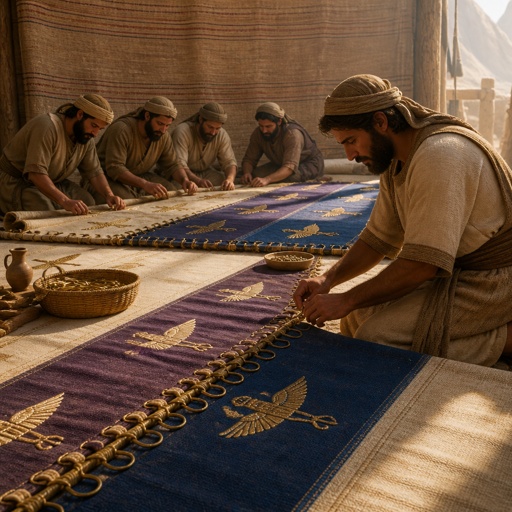
"And he coupled five curtains by themselves, and six curtains by themselves." - Exodus 36:16

Exodus 39:36 - "The table, and all the vessels thereof, and the shewbread,"

Exodus 36:36 - "And he made thereunto four pillars of shittim wood, and overlaid them with gold: their hooks were of gold; and he cast for them four sockets of silver."

Exodus 36:27 - "And for the sides of the tabernacle westward he made six boards."

Exodus 36:7 - "For the stuff they had was sufficient for all the work to make it, and too much."

Exodus 36:28 - "And two boards made he for the corners of the tabernacle in the two sides."

Exodus 36:20 - "¶ And he made boards for the tabernacle of shittim wood, standing up."

Exodus 36:23 - "And he made boards for the tabernacle; twenty boards for the south side southward:"

Exodus 36:21 - "The length of a board was ten cubits, and the breadth of a board one cubit and a half."

Numbers 16:36 - "¶ And the LORD spake unto Moses, saying,"

Exodus 36:18 - "And he made fifty taches of brass to couple the tent together, that it might be one."

Exodus 36:31 - "¶ And he made bars of shittim wood; five for the boards of the one side of the tabernacle,"

Ezekiel 36:16 - "¶ Moreover the word of the LORD came unto me, saying,"

Exodus 36:33 - "And he made the middle bar to shoot through the boards from the one end to the other."

Exodus 36:25 - "And for the other side of the tabernacle, which is toward the north corner, he made twenty boards,"

Exodus 25:36 - "Their knops and their branches shall be of the same: all it shall be one beaten work of pure gold."

"The table, and all the vessels thereof, and the shewbread," - Exodus 39:36

Exodus 36:34 - "And he overlaid the boards with gold, and made their rings of gold to be places for the bars, and overlaid the bars with gold."

Exodus 36:37 - "¶ And he made an hanging for the tabernacle door of blue, and purple, and scarlet, and fine twined linen, of needlework;"

Exodus 36:19 - "And he made a covering for the tent of rams' skins dyed red, and a covering of badgers' skins above that."

Exodus 36:32 - "And five bars for the boards of the other side of the tabernacle, and five bars for the boards of the tabernacle for the sides westward."

Exodus 36:38 - "And the five pillars of it with their hooks: and he overlaid their chapiters and their fillets with gold: but their five sockets were of brass."

Exodus 40:36 - "And when the cloud was taken up from over the tabernacle, the children of Israel went onward in all their journeys:"

Exodus 36:14 - "¶ And he made curtains of goats' hair for the tent over the tabernacle: eleven curtains he made them."

Exodus 28:36 - "¶ And thou shalt make a plate of pure gold, and grave upon it, like the engravings of a signet, HOLINESS TO THE LORD."

Exodus 36:26 - "And their forty sockets of silver; two sockets under one board, and two sockets under another board."

Exodus 36:30 - "And there were eight boards; and their sockets were sixteen sockets of silver, under every board two sockets."