The Courage to Stand: Esther’s Moment of Truth
"¶ Then the king Ahasuerus answered and said unto Esther the queen, Who is he, and where is he, that durst presume in his heart to do so?" - Esther 7:5
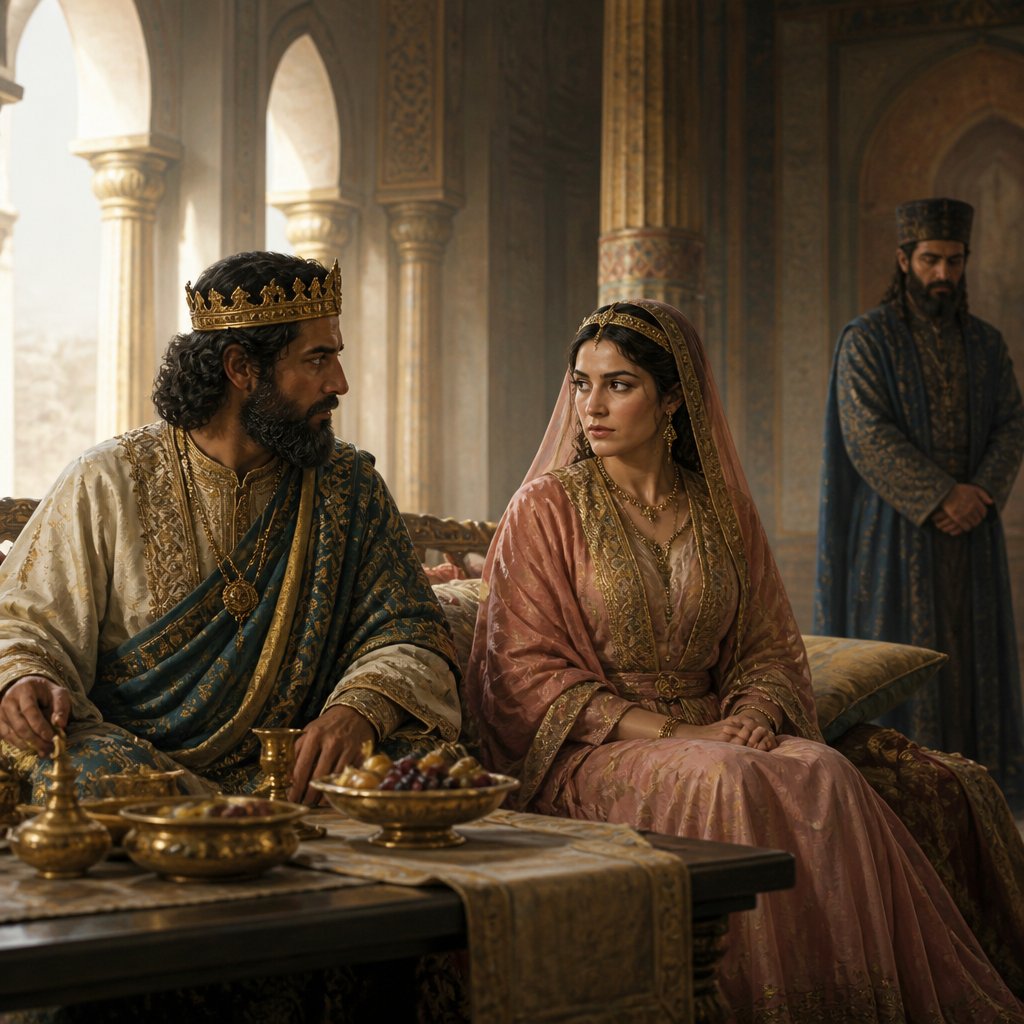
In the dramatic exchange recorded in Esther 7:5, we witness a pivotal moment in the narrative of courage, loyalty, and divine justice. The King Ahasuerus, bewildered and enraged, poses a question that echoes through the ages: "Who is he, and where is he, that durst presume in his heart to do so?" This verse not only marks the climax of Esther’s bravery but also lays bare the dynamics of power, identity, and faith that bind the threads of her story.
To understand the gravity of Ahasuerus' question, we must delve into the backstory. Esther, a Jewish woman who became queen of Persia, found herself in a perilous position when Haman, the King’s advisor, devised a ruthless plan to annihilate the Jewish people. At great personal risk, Esther approached the king unsummoned, which could result in her death, and revealed her Jewish identity and the sinister plot against her people. The courage she displayed in the face of imminent danger raises questions about our own willingness to stand for truth and protect others.
As Ahasuerus demands to know the identity of Esther’s antagonist, we can sense the tension in the room. This moment is not just about individual characters; it is a divine setup, a method God uses to demonstrate His power and deliverance through unexpected circumstances. The question posed by Ahasuerus invites us into a deeper reflection on our own moments of crisis and challenge. Who do we stand up against when injustice raises its head? In our workplaces, communities, and families, do we have the courage to confront those who would harm the vulnerable among us?
Esther’s story illustrates the fundamental concept of divine providence. Every character’s decision, including Esther’s, plays a crucial role in God’s larger plan for His people. Ahasuerus serves as an unwitting instrument of God’s will, while Haman’s pride and ambition led to his downfall. By depicting this interplay between divine sovereignty and human decision-making, the text encourages us to recognize that we are often positioned in critical moments where our choices could lead to significant changes in our circumstances.
Moreover, Esther’s ascent to the throne of Persia after the chaotic and tragic circumstances of exile and oppression showcases God’s unfaltering commitment to His people. As she reveals her Jewish heritage, we are reminded that authentic identity frequently requires us to step outside societal norms. Despite the potential consequences, trusting in God’s purpose grants us the strength to advocate for righteousness. Esther’s strength emanates from her faith, a characteristic each believer is invited to emulate in our times of trial.
When we consider the implications of the king’s confrontation with injustice, we are compelled to reflect on our roles in societal and ethical matters today. The question "Who is he?" not only seeks to identify a perpetrator but prompts us to search our hearts regarding complacency and complicity. As followers of Christ, we are called to act against the pervasive evils that exist in our world, whether they be inequality, oppression, or persecution.
Thus, we are led to embrace the courage of Esther, leveraging our voice to speak out against those who presume harm against the innocent. By actively defending the vulnerable, we participate in God’s redemptive plan for humanity. And let us not overlook the power of prayer as Esther exemplified before her courage-filled actions. Consulting our God in prayer equips us with strength and wisdom.
In small yet significant ways, our lives can echo Esther's bravery. When asked, “Who is he?” let us not falter but rather respond, grounded in faith, and committed to justice. May our hearts be emboldened to act, reminding us that although we may stand against forces much larger than ourselves, we stand not alone—our God stands with us. In every challenge we face, may we embody the spirit of Esther, stepping bravely into the fray, trusting that our voices are powerful tools for change.
Want to reflect more on Esther 7:5?
Continue your spiritual journey with Bible Chat — an AI-powered tool for exploring God's Word through conversation. Ask questions, discover connections, and deepen your understanding.
Get Our Apps


Esther 7:5 Artwork

Esther 7:5 - "¶ Then the king Ahasuerus answered and said unto Esther the queen, Who is he, and where is he, that durst presume in his heart to do so?"
"¶ Then the king Ahasuerus answered and said unto Esther the queen, Who is he, and where is he, that durst presume in his heart to do so?" - Esther 7:5

Esther 5:7 - "Then answered Esther, and said, My petition and my request is;"
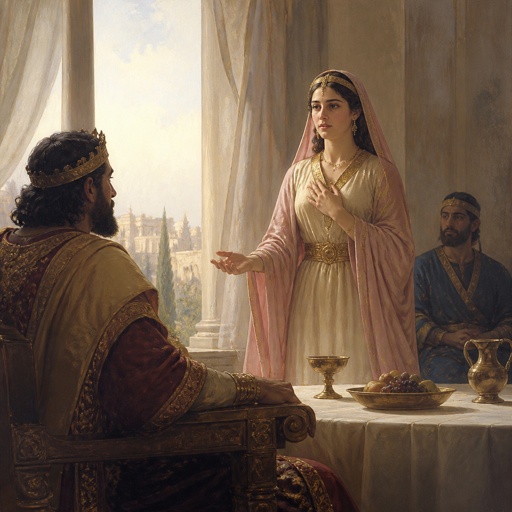
"Then answered Esther, and said, My petition and my request is;" - Esther 5:7

Esther 5:5 - "Then the king said, Cause Haman to make haste, that he may do as Esther hath said. So the king and Haman came to the banquet that Esther had prepared."

Esther 7:1 - "So the king and Haman came to banquet with Esther the queen."

Esther 7:6 - "And Esther said, The adversary and enemy is this wicked Haman. Then Haman was afraid before the king and the queen."

Esther 5:2

Esther 5:2 - "And it was so, when the king saw Esther the queen standing in the court, that she obtained favour in his sight: and the king held out to Esther the golden sceptre that was in his hand. So Esther drew near, and touched the top of the sceptre."

Esther 5:2

Esther 5:2

Esther 7:2 - "And the king said again unto Esther on the second day at the banquet of wine, What is thy petition, queen Esther? and it shall be granted thee: and what is thy request? and it shall be performed, even to the half of the kingdom."

Esther 7:7 - "¶ And the king arising from the banquet of wine in his wrath went into the palace garden: and Haman stood up to make request for his life to Esther the queen; for he saw that there was evil determined against him by the king."

Esther 9:7 - "And Parshandatha, and Dalphon, and Aspatha,"

"So the king and Haman came to banquet with Esther the queen." - Esther 7:1

Esther 8:7 - "¶ Then the king Ahasuerus said unto Esther the queen and to Mordecai the Jew, Behold, I have given Esther the house of Haman, and him they have hanged upon the gallows, because he laid his hand upon the Jews."

Esther 5:4 - "And Esther answered, If it seem good unto the king, let the king and Haman come this day unto the banquet that I have prepared for him."

Esther 5:3 - "Then said the king unto her, What wilt thou, queen Esther? and what is thy request? it shall be even given thee to the half of the kingdom."

Esther 5:2 - "And it was so, when the king saw Esther the queen standing in the court, that she obtained favour in his sight: and the king held out to Esther the golden sceptre that was in his hand. So Esther drew near, and touched the top of the sceptre."
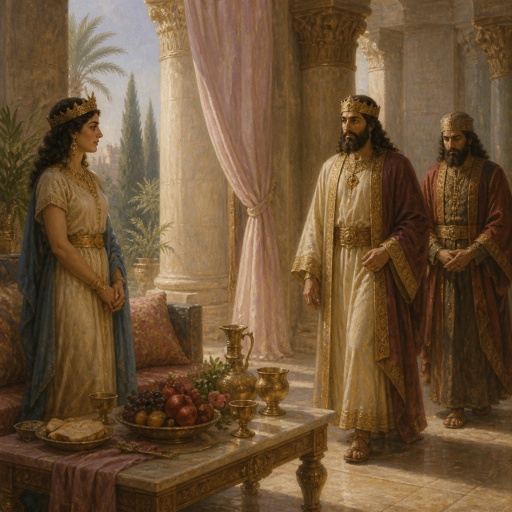
"Then the king said, Cause Haman to make haste, that he may do as Esther hath said. So the king and Haman came to the banquet that Esther had prepared." - Esther 5:5

Esther 4:5 - "Then called Esther for Hatach, one of the king's chamberlains, whom he had appointed to attend upon her, and gave him a commandment to Mordecai, to know what it was, and why it was."

Esther 5:6 - "¶ And the king said unto Esther at the banquet of wine, What is thy petition? and it shall be granted thee: and what is thy request? even to the half of the kingdom it shall be performed."
"And Parshandatha, and Dalphon, and Aspatha," - Esther 9:7

Esther 6:7 - "And Haman answered the king, For the man whom the king delighteth to honour,"

"And Esther said, The adversary and enemy is this wicked Haman. Then Haman was afraid before the king and the queen." - Esther 7:6

Esther 5:12 - "Haman said moreover, Yea, Esther the queen did let no man come in with the king unto the banquet that she had prepared but myself; and to morrow am I invited unto her also with the king."

Esther 7:3 - "Then Esther the queen answered and said, If I have found favour in thy sight, O king, and if it please the king, let my life be given me at my petition, and my people at my request:"

Esther 7:10 - "So they hanged Haman on the gallows that he had prepared for Mordecai. Then was the king's wrath pacified."

Esther 3:5 - "And when Haman saw that Mordecai bowed not, nor did him reverence, then was Haman full of wrath."

Esther 2:7 - "And he brought up Hadassah, that is, Esther, his uncle's daughter: for she had neither father nor mother, and the maid was fair and beautiful; whom Mordecai, when her father and mother were dead, took for his own daughter."