The Power of Persistent Petition: A Study on Esther 7:2
"And the king said again unto Esther on the second day at the banquet of wine, What is thy petition, queen Esther? and it shall be granted thee: and what is thy request? and it shall be performed, even to the half of the kingdom." - Esther 7:2

In the grand narrative of the Book of Esther, we find a profound example of courage, faith, and divine timing. Esther, a Jewish orphan raised in exile, becomes the queen of Persia and finds herself in a perilous position—her people face extermination at the hands of Haman, a high-ranking official. It is in this context that we find Esther’s bold moment of petition to King Ahasuerus. Clinging tightly to the message found in Esther 7:2, "And the king said again unto Esther on the second day at the banquet of wine, What is thy petition, queen Esther? and it shall be granted thee: and what is thy request? and it shall be performed, even to the half of the kingdom," we are invited to reflect on the significance of our requests before God and the divine authority by which our needs are met.
The king’s question to Esther is not merely a formality; it reveals the king’s willingness to respond to her needs. It is an invitation to come forward with boldness, knowing that her request shall be granted. Here, we see the king (who represents earthly authority) extending grace and affirmation to Esther—just as our Heavenly King delights in hearing our petitions. God’s willingness to grant our requests is echoed throughout Scripture, reminding us that He listens with an attentive ear and a loving heart.
Esther’s persistence is particularly noteworthy. On the first day of the banquet, she refrains from revealing her true intentions, an act that reflects her understanding of the weight of her request. She chooses to wait for the right moment. In today’s fast-paced world, the virtue of patience sometimes seems lost amid hurried prayers and immediate expectations. Yet Esther teaches us that there is power in waiting upon God and trusting His timing. As the psalmist reminds us in Psalm 27:14, "Wait on the LORD: be of good courage, and he shall strengthen thine heart: wait, I say, on the LORD."
Moreover, Esther’s approach is both respectful and strategic. She does not present her petition in an abrupt manner; instead, she invites the king to a banquet, creating an atmosphere of intimacy and trust. This reminds us that our prayers and petitions before God should be approached not as demands or urgent cries, but as humble requests grounded in our relationship with Him. Esther knew the stakes yet crafted a gentle yet firm request, understanding that the king’s favor was crucial to the survival of her people.
The king’s awed response—"even to the half of the kingdom"—signifies the depth of Esther’s relationship with him and the assurance of his commitment to her well-being. In our spiritual journey, God extends to us the same assurance. While our earthly requests may seem small in the grand narrative of life, they have immense value in His eyes. God's heart is inclined toward His children, and He promises in James 1:5, "If any of you lack wisdom, let him ask of God, that giveth to all men liberally, and upbraideth not; and it shall be given him."
Let us also recognize that Esther’s resilience is rooted in her identity. She is not merely a queen by chance but a representative of her people and their plight. Her personal identity and purpose compel her into action. In this light, we are encouraged to reflect on our identity as children of God. Each of us has a divinely ordained purpose, and just as Esther’s identity motivated her petition, so too must ours drive us to seek God passionately.
Finally, the essence of Esther 7:2 calls us to a deeper understanding of God as a benevolent king who desires to respond to our needs and longings. In our moments of despair, let us remember to approach Him with the same courage and clarity that characterizes Esther’s requests. Let us persist in seeking Him, confident in the promise that our petitions shall be granted according to His will and timing—even to the half of the kingdom.
Want to reflect more on Esther 7:2?
Continue your spiritual journey with Bible Chat — an AI-powered tool for exploring God's Word through conversation. Ask questions, discover connections, and deepen your understanding.
Get Our Apps


Esther 7:2 Artwork

Esther 7:2 - "And the king said again unto Esther on the second day at the banquet of wine, What is thy petition, queen Esther? and it shall be granted thee: and what is thy request? and it shall be performed, even to the half of the kingdom."

"And the king said again unto Esther on the second day at the banquet of wine, What is thy petition, queen Esther? and it shall be granted thee: and what is thy request? and it shall be performed, even to the half of the kingdom." - Esther 7:2

Esther 5:7 - "Then answered Esther, and said, My petition and my request is;"

Esther 7:1 - "So the king and Haman came to banquet with Esther the queen."

Esther 2:7 - "And he brought up Hadassah, that is, Esther, his uncle's daughter: for she had neither father nor mother, and the maid was fair and beautiful; whom Mordecai, when her father and mother were dead, took for his own daughter."

Esther 7:6 - "And Esther said, The adversary and enemy is this wicked Haman. Then Haman was afraid before the king and the queen."

Esther 7:7 - "¶ And the king arising from the banquet of wine in his wrath went into the palace garden: and Haman stood up to make request for his life to Esther the queen; for he saw that there was evil determined against him by the king."

Esther 9:7 - "And Parshandatha, and Dalphon, and Aspatha,"

Esther 2:22 - "And the thing was known to Mordecai, who told it unto Esther the queen; and Esther certified the king thereof in Mordecai's name."

"So the king and Haman came to banquet with Esther the queen." - Esther 7:1

Esther 8:7 - "¶ Then the king Ahasuerus said unto Esther the queen and to Mordecai the Jew, Behold, I have given Esther the house of Haman, and him they have hanged upon the gallows, because he laid his hand upon the Jews."
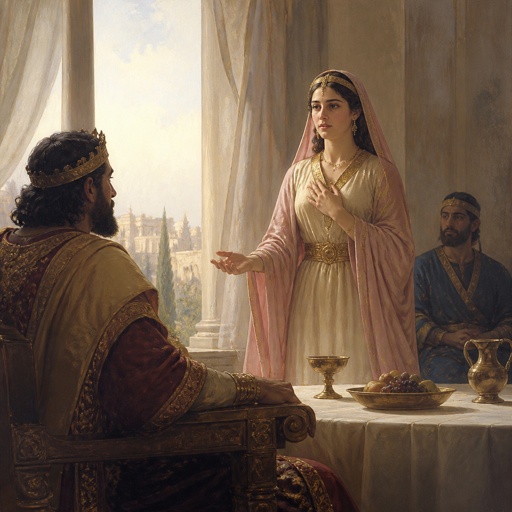
"Then answered Esther, and said, My petition and my request is;" - Esther 5:7

Esther 7:5 - "¶ Then the king Ahasuerus answered and said unto Esther the queen, Who is he, and where is he, that durst presume in his heart to do so?"

Esther 5:2 - "And it was so, when the king saw Esther the queen standing in the court, that she obtained favour in his sight: and the king held out to Esther the golden sceptre that was in his hand. So Esther drew near, and touched the top of the sceptre."

"And Parshandatha, and Dalphon, and Aspatha," - Esther 9:7

Esther 2:20 - "Esther had not yet shewed her kindred nor her people; as Mordecai had charged her: for Esther did the commandment of Mordecai, like as when she was brought up with him."

Esther 5:2

Esther 5:2

Esther 5:2

Esther 2:11 - "And Mordecai walked every day before the court of the women's house, to know how Esther did, and what should become of her."

Esther 6:7 - "And Haman answered the king, For the man whom the king delighteth to honour,"

Esther 2:10 - "Esther had not shewed her people nor her kindred: for Mordecai had charged her that she should not shew it."

"And Esther said, The adversary and enemy is this wicked Haman. Then Haman was afraid before the king and the queen." - Esther 7:6

Esther 7:3 - "Then Esther the queen answered and said, If I have found favour in thy sight, O king, and if it please the king, let my life be given me at my petition, and my people at my request:"

Esther 5:2 - "And it was so, when the king saw Esther the queen standing in the court, that she obtained favour in his sight: and the king held out to Esther the golden sceptre that was in his hand. So Esther drew near, and touched the top of the sceptre."

"And the thing was known to Mordecai, who told it unto Esther the queen; and Esther certified the king thereof in Mordecai's name." - Esther 2:22

Esther 2:16 - "So Esther was taken unto king Ahasuerus into his house royal in the tenth month, which is the month Tebeth, in the seventh year of his reign."

Esther 8:2 - "And the king took off his ring, which he had taken from Haman, and gave it unto Mordecai. And Esther set Mordecai over the house of Haman."

Esther 7:10 - "So they hanged Haman on the gallows that he had prepared for Mordecai. Then was the king's wrath pacified."
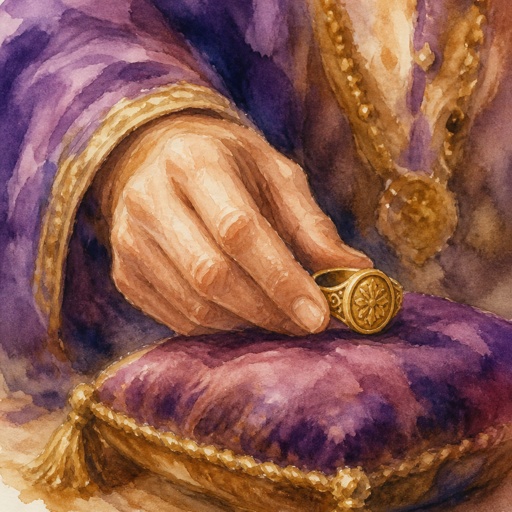
Esther 8:2 focus on the ring