From Plot to Purpose: The Sovereignty of God in Esther 7:10
"So they hanged Haman on the gallows that he had prepared for Mordecai. Then was the king's wrath pacified." - Esther 7:10

In the Book of Esther, we encounter a story rich with themes of courage, divine providence, and ultimate justice. One verse that encapsulates the resolution of this dramatic narrative is Esther 7:10, which states, "So they hanged Haman on the gallows that he had prepared for Mordecai. Then was the king's wrath pacified." This verse serves as a powerful reminder of how God orchestrates events in our lives, often turning schemes of evil into occasions for deliverance and restoration.
Haman, the king’s advisor, represents the pinnacle of hatred and ambition in this story. His plot against Mordecai and the Jewish people encapsulates the malice that can arise from pride and envy. In his desire to eliminate Mordecai, Haman built gallows—an instrument of his own demise. This is where we find a profound truth: the very traps and plans that the enemy lays for us can be turned against him. The gallows intended for Mordecai became the means of Haman’s downfall. God’s justice is not just a response to evil; it is a reminder that He sees our afflictions and will act to preserve His people.
As we reflect on this passage, we are led to consider our own lives. Are there areas where we feel burdened by the weight of injustice? Perhaps we have faced betrayal, hostility, or discrimination, much like Mordecai did. In these moments of despair, we must trust in God’s overarching plan. The story of Esther reminds us that there is a divine timeline at play. Though circumstances may seem bleak, God’s justice is always a heartbeat away.
Haman’s end serves as a cautionary tale. Pride is often the precursor to destruction. When Haman exalted himself and sought to annihilate Mordecai for refusing to bow to him, he set in motion a series of events that would ultimately lead to his own undoing. Proverbs 16:18 warns us, "Pride goeth before destruction, and a haughty spirit before a fall." This verse invites us to examine our own hearts and ambitions—are there areas where pride may lead us astray?
Consider also the role of Esther and Mordecai. Their bravery in the face of adversity and their willingness to act moved God’s hand, facilitating the outcome that resulted in Haman’s execution. This lesson reveals the synergy between divine sovereignty and human responsibility. While God is sovereign, He often works through the faithful and courageous actions of individuals willing to stand against injustice.
In our own lives, we may be called to be ‘Esther’—to speak up when it is difficult, to advocate for those who are unable to fight for themselves, and to trust that God has placed us in our positions for such a time as this (Esther 4:14). There may be moments when the odds seem insurmountable, but let us not forget that God is ultimately in control. Just as He turned Haman’s malicious intent into a means of glorifying His name and delivering His people, He is able to bring good out of our trials and tribulations.
Now, when the king’s wrath was pacified, not only did that signal the end of Haman’s plans, but it also affirmed that God’s purpose prevailed. The complete narrative of Esther teaches us that while God may seem hidden in our darkest moments, His hand is still actively at work, crafting a canvas of grace and redemption. We must trust in His timing and character.
Let us pray: Heavenly Father, help us to trust in Your sovereign plan. When we encounter injustice or face hostility, may we remember Esther’s courage and Mordecai’s resilience. Teach us to recognize our role in Your narrative and to boldly step forward in faith. Thank you for the assurance that no plan of the enemy can thwart Your purposes. In Jesus’ name, Amen.
Want to reflect more on Esther 7:10?
Continue your spiritual journey with Bible Chat — an AI-powered tool for exploring God's Word through conversation. Ask questions, discover connections, and deepen your understanding.
Get Our Apps


Esther 7:10 Artwork

Esther 7:10 - "So they hanged Haman on the gallows that he had prepared for Mordecai. Then was the king's wrath pacified."

"So they hanged Haman on the gallows that he had prepared for Mordecai. Then was the king's wrath pacified." - Esther 7:10

Esther 5:7 - "Then answered Esther, and said, My petition and my request is;"

Esther 7:1 - "So the king and Haman came to banquet with Esther the queen."

Esther 4:10 - "¶ Again Esther spake unto Hatach, and gave him commandment unto Mordecai;"

Esther 7:6 - "And Esther said, The adversary and enemy is this wicked Haman. Then Haman was afraid before the king and the queen."

Esther 7:2 - "And the king said again unto Esther on the second day at the banquet of wine, What is thy petition, queen Esther? and it shall be granted thee: and what is thy request? and it shall be performed, even to the half of the kingdom."

Esther 2:10 - "Esther had not shewed her people nor her kindred: for Mordecai had charged her that she should not shew it."

Esther 7:7 - "¶ And the king arising from the banquet of wine in his wrath went into the palace garden: and Haman stood up to make request for his life to Esther the queen; for he saw that there was evil determined against him by the king."

Esther 9:7 - "And Parshandatha, and Dalphon, and Aspatha,"

"So the king and Haman came to banquet with Esther the queen." - Esther 7:1

Esther 8:7 - "¶ Then the king Ahasuerus said unto Esther the queen and to Mordecai the Jew, Behold, I have given Esther the house of Haman, and him they have hanged upon the gallows, because he laid his hand upon the Jews."
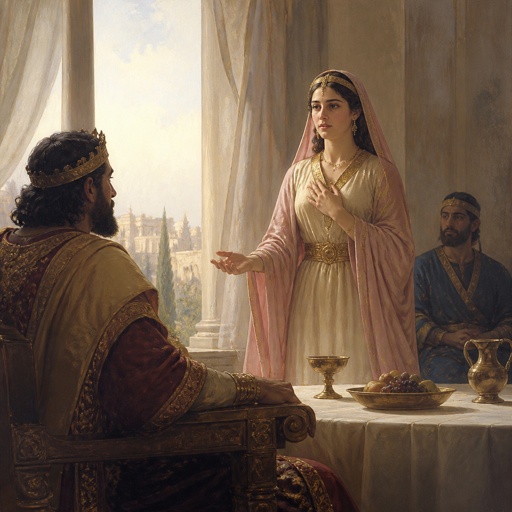
"Then answered Esther, and said, My petition and my request is;" - Esther 5:7

Esther 7:5 - "¶ Then the king Ahasuerus answered and said unto Esther the queen, Who is he, and where is he, that durst presume in his heart to do so?"
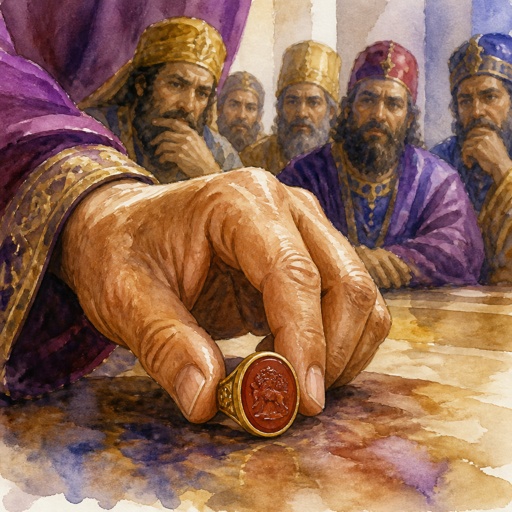
Esther 3:10 focus on ring

"¶ Again Esther spake unto Hatach, and gave him commandment unto Mordecai;" - Esther 4:10
"And Parshandatha, and Dalphon, and Aspatha," - Esther 9:7

Esther 10:1 - "And the king Ahasuerus laid a tribute upon the land, and upon the isles of the sea."

Esther 6:7 - "And Haman answered the king, For the man whom the king delighteth to honour,"

"And Esther said, The adversary and enemy is this wicked Haman. Then Haman was afraid before the king and the queen." - Esther 7:6

Esther 7:3 - "Then Esther the queen answered and said, If I have found favour in thy sight, O king, and if it please the king, let my life be given me at my petition, and my people at my request:"

Esther 9:10 - "The ten sons of Haman the son of Hammedatha, the enemy of the Jews, slew they; but on the spoil laid they not their hand."

Esther 2:7 - "And he brought up Hadassah, that is, Esther, his uncle's daughter: for she had neither father nor mother, and the maid was fair and beautiful; whom Mordecai, when her father and mother were dead, took for his own daughter."

Esther 7:8 - "Then the king returned out of the palace garden into the place of the banquet of wine; and Haman was fallen upon the bed whereon Esther was. Then said the king, Will he force the queen also before me in the house? As the word went out of the king's mouth, they covered Haman's face."

"Esther had not shewed her people nor her kindred: for Mordecai had charged her that she should not shew it." - Esther 2:10

Esther 5:10 - "Nevertheless Haman refrained himself: and when he came home, he sent and called for his friends, and Zeresh his wife."

Esther 3:10 - "And the king took his ring from his hand, and gave it unto Haman the son of Hammedatha the Agagite, the Jews' enemy."

Esther 8:10 - "And he wrote in the king Ahasuerus' name, and sealed it with the king's ring, and sent letters by posts on horseback, and riders on mules, camels, and young dromedaries:"

"¶ Then the king Ahasuerus answered and said unto Esther the queen, Who is he, and where is he, that durst presume in his heart to do so?" - Esther 7:5

Esther 1:7 - "And they gave them drink in vessels of gold, (the vessels being diverse one from another,) and royal wine in abundance, according to the state of the king."