The Peril of Pride: Lessons from Haman's Ambition
"And Haman told them of the glory of his riches, and the multitude of his children, and all the things wherein the king had promoted him, and how he had advanced him above the princes and servants of the king." - Esther 5:11

In the midst of the grand narrative of Esther, we find ourselves confronted with a character who embodies the perils of pride—Haman, the Agagite. The verse we examine, Esther 5:11, reads as follows in the King James Version: "And Haman told them of the glory of his riches, and the multitude of his children, and all the things wherein the king had promoted him, and how he had advanced him above the princes and servants of the king."
Haman's self-aggrandizement stands out starkly in this moment. As he recounts his wealth, his progeny, and his position granted by King Ahasuerus, he unwittingly reveals more about his character than he intends. This passage invites us not only to witness his pride but also to reflect on the deeper spiritual and moral lessons instilled in this Aristotelian tragedy.
### The Illusion of Glory
Haman's account paints a picture of worldly success. He speaks of his riches, his numerous children, and the esteemed position he holds. These accomplishments, while significant in the eyes of the world, underscore a poignant truth: the allure of worldly glory often blinds individuals to their spiritual poverty. Haman does not acknowledge God in his achievements. Instead, every proclamation is a boast that elevates his own status in the eyes of others.
Likewise, we are often tempted to bask in our accomplishments, to take pride in our achievements, and to draw attention to ourselves. In the world’s eyes, success is equated with worthiness. However, as believers, we must remember that true value is found not in the accolades of men but in the humility of serving others and glorifying God. As the Apostle Paul reminds us in 2 Corinthians 12:9, “For my strength is made perfect in weakness.” True glory in our lives comes through our recognition of God’s grace, not our own merit.
### The Cost of Recognition
Haman's focus on his elevation above others—the princes and servants of the king—speaks to a deeper need for recognition. This need can drive individuals to dismantle others' worth in their quest for prominence. Haman’s tale ultimately reveals his dissatisfaction; completely immersed in elevating his own status, he fails to experience satisfaction. His pride is intrinsically tied to his need for validation through recognition.
Yet, we see in the life of Jesus that greatness in the Kingdom of God is not determined by status but by servitude. Matthew 23:11 states, “But he that is greatest among you shall be your servant.” When we position ourselves in service to others, we cultivate true contentment and honor God more than personal glory ever could. The riches and status Haman prides himself on pale in comparison to the fulfillment found in serving God and others.
### The Downward Spiral
In the context of Haman’s life, we must ponder the trajectory of his pride. Ultimately, it leads to his downfall. Haman’s preoccupation with being the most influential blinds him to the schemes of God working through Esther and Mordecai. Pride, as we observe in Haman’s narrative, isolates its possessor, replacing community with rivalry and love with jealousy. The gripping tale is a cautionary tale for believers and is echoed repeatedly in scripture—"Pride goeth before destruction, and an haughty spirit before a fall" (Proverbs 16:18).
The caution offered here extends to us. When we look to human accolades for our identity and worth, we risk building our foundation on a shaky surface, one that is susceptible to collapse. Instead, let us take a humble path, recognizing that as we submit to God’s leadership, He honors us in ways that truly matter.
### Conclusion: Embracing Humility
As we reflect upon Haman’s life and choices, may we heed the warnings implicit within this historical narrative. Let us strive to cultivate humility over pride, to seek God’s glory above our own, and to serve rather than be served. In a world that frequently measures success in terms of wealth, status, and recognition, let us answer the call to humility and service, for in doing so, we become vessels for God’s true glory.
Want to reflect more on Esther 5:11?
Continue your spiritual journey with Bible Chat — an AI-powered tool for exploring God's Word through conversation. Ask questions, discover connections, and deepen your understanding.
Get Our Apps


Esther 5:11 Artwork
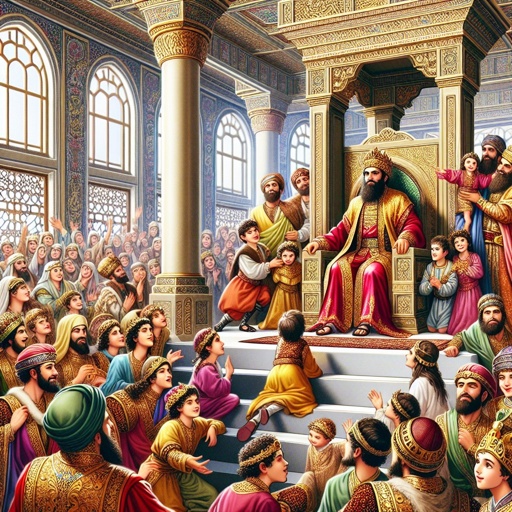
Esther 5:11 - "And Haman told them of the glory of his riches, and the multitude of his children, and all the things wherein the king had promoted him, and how he had advanced him above the princes and servants of the king."

"And Haman told them of the glory of his riches, and the multitude of his children, and all the things wherein the king had promoted him, and how he had advanced him above the princes and servants of the king." - Esther 5:11

Esther 5:5 - "Then the king said, Cause Haman to make haste, that he may do as Esther hath said. So the king and Haman came to the banquet that Esther had prepared."

Esther 5:7 - "Then answered Esther, and said, My petition and my request is;"

Esther 5:2

Esther 5:2 - "And it was so, when the king saw Esther the queen standing in the court, that she obtained favour in his sight: and the king held out to Esther the golden sceptre that was in his hand. So Esther drew near, and touched the top of the sceptre."

Esther 5:2

Esther 5:2

Esther 2:11 - "And Mordecai walked every day before the court of the women's house, to know how Esther did, and what should become of her."
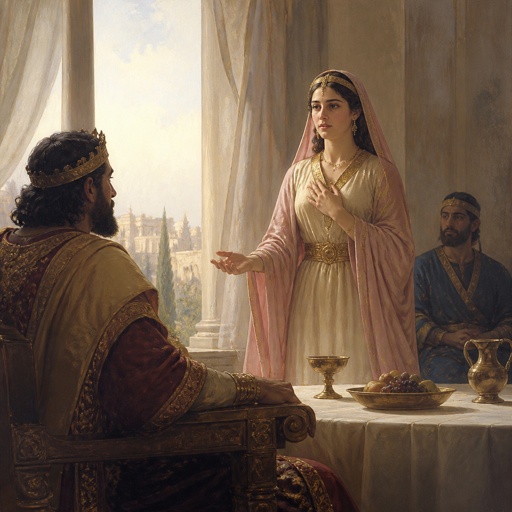
"Then answered Esther, and said, My petition and my request is;" - Esther 5:7

Esther 5:4 - "And Esther answered, If it seem good unto the king, let the king and Haman come this day unto the banquet that I have prepared for him."

Esther 7:5 - "¶ Then the king Ahasuerus answered and said unto Esther the queen, Who is he, and where is he, that durst presume in his heart to do so?"

Esther 5:3 - "Then said the king unto her, What wilt thou, queen Esther? and what is thy request? it shall be even given thee to the half of the kingdom."

Esther 5:2 - "And it was so, when the king saw Esther the queen standing in the court, that she obtained favour in his sight: and the king held out to Esther the golden sceptre that was in his hand. So Esther drew near, and touched the top of the sceptre."
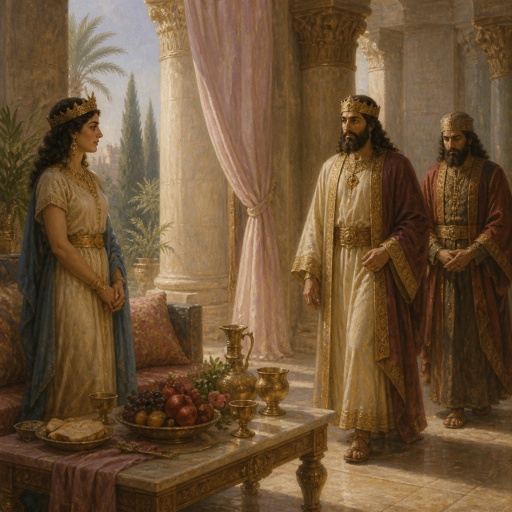
"Then the king said, Cause Haman to make haste, that he may do as Esther hath said. So the king and Haman came to the banquet that Esther had prepared." - Esther 5:5

Esther 4:5 - "Then called Esther for Hatach, one of the king's chamberlains, whom he had appointed to attend upon her, and gave him a commandment to Mordecai, to know what it was, and why it was."

Esther 5:6 - "¶ And the king said unto Esther at the banquet of wine, What is thy petition? and it shall be granted thee: and what is thy request? even to the half of the kingdom it shall be performed."

Esther 5:12 - "Haman said moreover, Yea, Esther the queen did let no man come in with the king unto the banquet that she had prepared but myself; and to morrow am I invited unto her also with the king."

Esther 9:11 - "On that day the number of those that were slain in Shushan the palace was brought before the king."

Esther 3:5 - "And when Haman saw that Mordecai bowed not, nor did him reverence, then was Haman full of wrath."

Esther 5:1 - "Now it came to pass on the third day, that Esther put on her royal apparel, and stood in the inner court of the king's house, over against the king's house: and the king sat upon his royal throne in the royal house, over against the gate of the house."

Song of Solomon 5:11

Esther 1:11 - "To bring Vashti the queen before the king with the crown royal, to shew the people and the princes her beauty: for she was fair to look on."
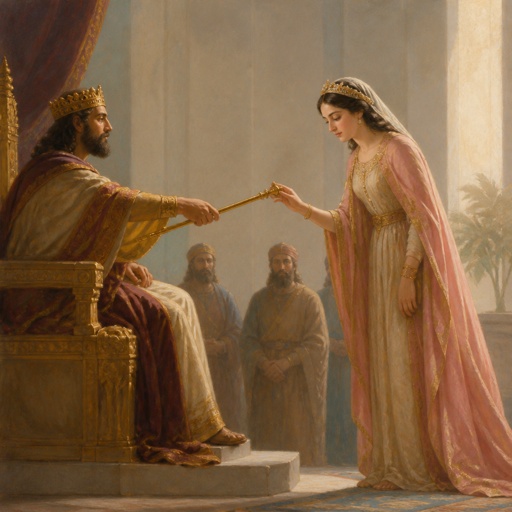
"And it was so, when the king saw Esther the queen standing in the court, that she obtained favour in his sight: and the king held out to Esther the golden sceptre that was in his hand. So Esther drew near, and touched the top of the sceptre." - Esther 5:2

Esther 3:11 - "And the king said unto Haman, The silver is given to thee, the people also, to do with them as it seemeth good to thee."

Esther 6:5 - "And the king's servants said unto him, Behold, Haman standeth in the court. And the king said, Let him come in."

Esther 5:13 - "Yet all this availeth me nothing, so long as I see Mordecai the Jew sitting at the king's gate."

Philippians 2:5-11

"And Mordecai walked every day before the court of the women's house, to know how Esther did, and what should become of her." - Esther 2:11

Esther 2:5 - "¶ Now in Shushan the palace there was a certain Jew, whose name was Mordecai, the son of Jair, the son of Shimei, the son of Kish, a Benjamite;"