Courage in the Waiting: A Call to Stand Firm
"Then Mordecai commanded to answer Esther, Think not with thyself that thou shalt escape in the king's house, more than all the Jews." - Esther 4:13

The book of Esther offers a profound narrative that reflects God's providential care over His people, despite their seemingly dire circumstances. In Esther 4:13, we find a pivotal moment where Mordecai delivers a message to Esther, a message that resonates across generations: "Then Mordecai commanded to answer Esther, Think not with thyself that thou shalt escape in the king's house, more than all the Jews." This verse serves as a clarion call to recognize the gravity of our circumstances and the responsibility that comes with our positions and privileges.
Esther, a Jewish woman who had risen to the position of queen in a foreign land, faced a crisis that threatened her entire people. Haman, a high-ranking official, had plotted the annihilation of the Jews. Mordecai, her cousin and guardian, understood the urgency of the situation and urged her to take action. His words reflect not just a personal concern for Esther's safety but a deeper understanding of the collective plight of the Jewish people.
When Mordecai urged Esther to act, he was challenging her perception of safety and destiny. In the king's palace, where one might expect to find security, she was not immune to the threats that loomed over her people. This poignant reminder underscores an essential truth: we are all called to be agents of change, regardless of our circumstances.
In our own lives, we may find ourselves in positions of influence—be it in our workplaces, communities, or families. The temptation to remain passive, to protect ourselves while others struggle, can be overwhelming. Yet, Mordecai’s message to Esther encourages us to rise above self-interest and embrace our roles as instruments of God’s justice and mercy. We must ask ourselves: are we willing to step out of our comfort zones, knowing that our privilege does not exempt us from the trials that affect those around us?
Mordecai's admonition was also a powerful call to purpose. "For if thou altogether holdest thy peace at this time, then shall there enlargement and deliverance arise to the Jews from another place; but thou and thy father's house shall be destroyed: and who knoweth whether thou art come to the kingdom for such a time as this?" (Esther 4:14 KJV). Here, we see that God’s plan does not hinge on any one person, but He chooses to work through us. God elevates us not merely for our benefit, but for His greater purpose. We are positioned where we are for a reason and at a specific time.
Consider the implications of holding silence when action is required. Mordecai's confidence in God's deliverance did not diminish the urgent responsibility Esther bore. His challenge was clear: by remaining silent, she risked not only her own safety but the fate of her entire people. In today's context, we might see this as a call to speak up against injustice, advocate for those without a voice, and engage in the collective fight against prejudice and condemnation.
In facing challenges in our lives, it is often easy to think that we are alone, that our struggles are uniquely ours. Yet, this story reminds us of our shared humanity and the interconnectedness of our experiences. Each choice we make ripples out, affecting those around us. God’s providence often unfolds through the actions we take to care for others. He invites us to join Him in His redemptive work, motivating us to act where we can make a difference.
As you meditate on Esther's story, reflect on the ways God has positioned you in your own life. What challenges are you facing? Is He calling you to take a stand for those who are marginalized? Like Esther, are you willing to embrace your purpose and courageously respond to the needs of others?
Let us be encouraged not only by Esther’s bravery but also by the assurance that God is with us every step of the way. May we have the courage to speak for justice, the strength to face our fears, and the wisdom to act when it matters most, trusting that we are here for such a time as this.
Want to reflect more on Esther 4:13?
Continue your spiritual journey with Bible Chat — an AI-powered tool for exploring God's Word through conversation. Ask questions, discover connections, and deepen your understanding.
Get Our Apps


Esther 4:13 Artwork

Esther 4:13 - "Then Mordecai commanded to answer Esther, Think not with thyself that thou shalt escape in the king's house, more than all the Jews."

"Then Mordecai commanded to answer Esther, Think not with thyself that thou shalt escape in the king's house, more than all the Jews." - Esther 4:13

Esther 8:4 - "Then the king held out the golden sceptre toward Esther. So Esther arose, and stood before the king,"

Esther 4:15 - "¶ Then Esther bade them return Mordecai this answer,"

Esther 4:9 - "And Hatach came and told Esther the words of Mordecai."

Esther 4:10 - "¶ Again Esther spake unto Hatach, and gave him commandment unto Mordecai;"

Esther 4:17 - "So Mordecai went his way, and did according to all that Esther had commanded him."

Esther 8:4

Esther 4:12 - "And they told to Mordecai Esther's words."

"And Hatach came and told Esther the words of Mordecai." - Esther 4:9

"¶ Then Esther bade them return Mordecai this answer," - Esther 4:15

Esther 5:4 - "And Esther answered, If it seem good unto the king, let the king and Haman come this day unto the banquet that I have prepared for him."

Esther 9:13 - "Then said Esther, If it please the king, let it be granted to the Jews which are in Shushan to do to morrow also according unto this day's decree, and let Haman's ten sons be hanged upon the gallows."

"Then the king held out the golden sceptre toward Esther. So Esther arose, and stood before the king," - Esther 8:4

Esther 4:5 - "Then called Esther for Hatach, one of the king's chamberlains, whom he had appointed to attend upon her, and gave him a commandment to Mordecai, to know what it was, and why it was."

"¶ Again Esther spake unto Hatach, and gave him commandment unto Mordecai;" - Esther 4:10
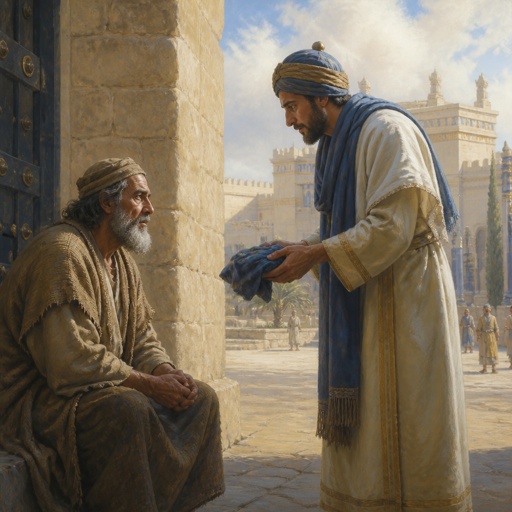
"And they told to Mordecai Esther's words." - Esther 4:12

"So Mordecai went his way, and did according to all that Esther had commanded him." - Esther 4:17

Esther 5:13 - "Yet all this availeth me nothing, so long as I see Mordecai the Jew sitting at the king's gate."
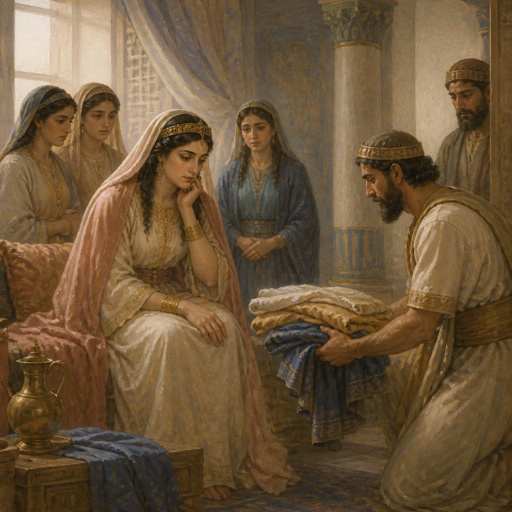
"¶ So Esther's maids and her chamberlains came and told it her. Then was the queen exceedingly grieved; and she sent raiment to clothe Mordecai, and to take away his sackcloth from him: but he received it not." - Esther 4:4

Esther 4:6 - "So Hatach went forth to Mordecai unto the street of the city, which was before the king's gate."

Esther 1:13 - "¶ Then the king said to the wise men, which knew the times, (for so was the king's manner toward all that knew law and judgment:"

Esther 4:4 - "¶ So Esther's maids and her chamberlains came and told it her. Then was the queen exceedingly grieved; and she sent raiment to clothe Mordecai, and to take away his sackcloth from him: but he received it not."

Esther 4:2 - "And came even before the king's gate: for none might enter into the king's gate clothed with sackcloth."

Esther 4:8 - "Also he gave him the copy of the writing of the decree that was given at Shushan to destroy them, to shew it unto Esther, and to declare it unto her, and to charge her that she should go in unto the king, to make supplication unto him, and to make request before him for her people."

Esther 8:13 - "The copy of the writing for a commandment to be given in every province was published unto all people, and that the Jews should be ready against that day to avenge themselves on their enemies."

Esther 2:4 - "And let the maiden which pleaseth the king be queen instead of Vashti. And the thing pleased the king; and he did so."

Esther 9:4 - "For Mordecai was great in the king's house, and his fame went out throughout all the provinces: for this man Mordecai waxed greater and greater."

Esther 2:13 - "Then thus came every maiden unto the king; whatsoever she desired was given her to go with her out of the house of the women unto the king's house."
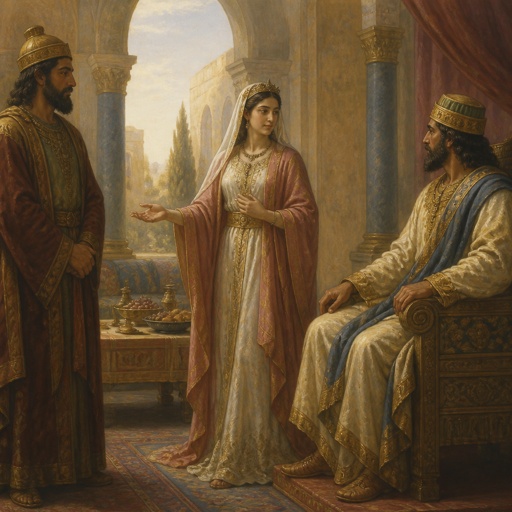
"And Esther answered, If it seem good unto the king, let the king and Haman come this day unto the banquet that I have prepared for him." - Esther 5:4