The Mountain of Curses: A Call to Reflect and Repent
"And these shall stand upon mount Ebal to curse; Reuben, Gad, and Asher, and Zebulun, Dan, and Naphtali." - Deuteronomy 27:13
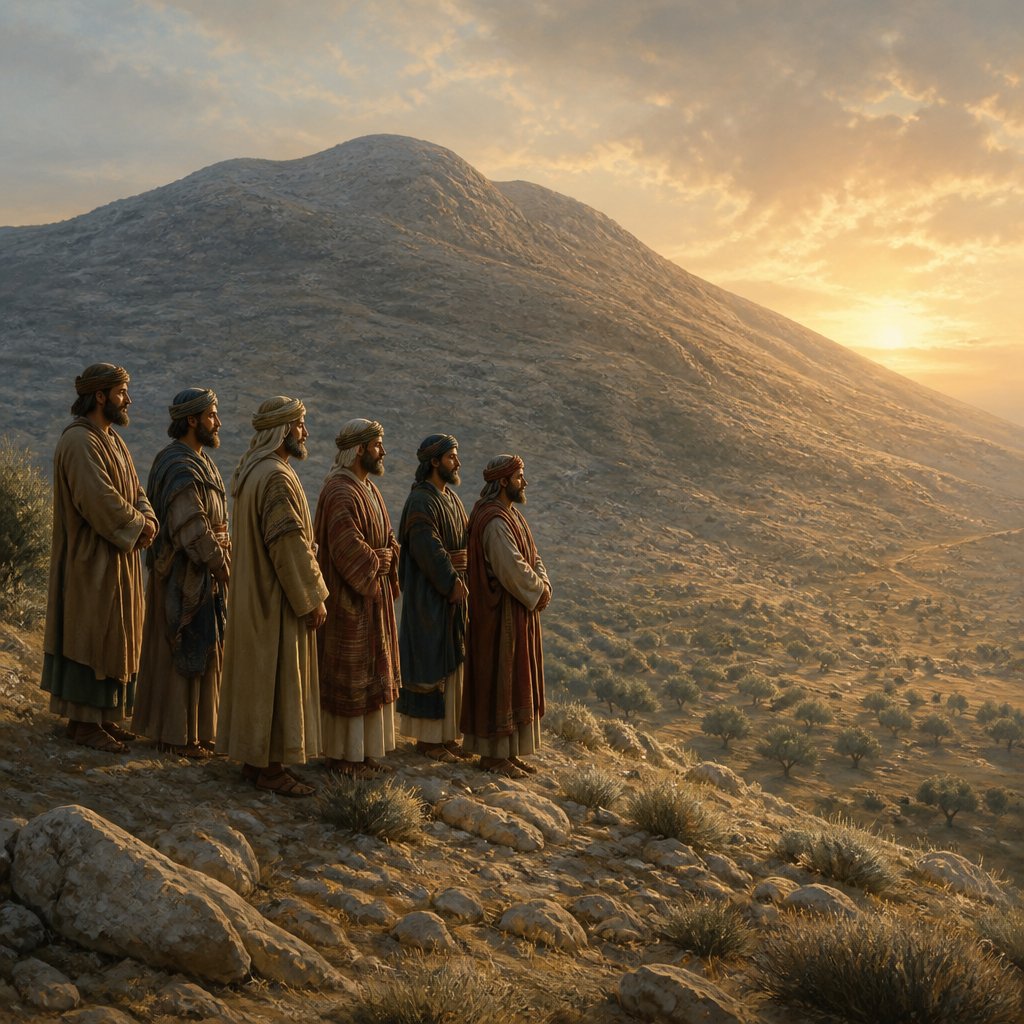
In Deuteronomy 27:13, we find the directive: "And these shall stand upon mount Ebal to curse; Reuben, Gad, and Asher, and Zebulun, Dan, and Naphtali." At first glance, this verse may seem esoteric, a mere historical note pointing to the ancient practice of the Israelites as they entered the Promised Land. However, the depths of this passage reach far beyond its literal meaning. It invites us to reflect on both the blessings and the curses that accompany our fidelity or disobedience to God's commandments.
To understand Mount Ebal's significance we first consider its geographical and relational context. Located opposite Mount Gerizim, where the blessings are pronounced, Mount Ebal represents a stark contrast. The two mountains are emblematic of the choices that lay before the Israelites, the choices that still lie before us today. On one mountain, we find the blessings of obedience; on the other, curses destined for disobedience. Choosing to inhabit one mountain or the other reveals our decision to walk in alignment with God's will or stray into the wilderness of our own making.
The tribes mentioned—Reuben, Gad, Asher, Zebulun, Dan, and Naphtali—represent a significant cross-section of the nation of Israel. Their presence on Mount Ebal indicates not just those who were physically present, but a symbolic touchpoint for all of Israel, and indeed, for all of humanity. Each tribe, standing on that rocky precipice, illustrates the reality that we are all part of a community that is either elevating holiness or perpetuating sin. The call to reflect on our own lives aligns with the tangible act of these tribes facing the consequences of their actions.
Why curse? The pronunciation of curses in scripture plays an essential role in reaffirming God’s covenant. It serves as a stark reminder of the consequences that come with rejecting divine instructions. The act of naming these curses dressed in liturgical language reminds us not only of our failings but also of the mercy that invites us to repentance. It prompts us to reconsider our attitudes, our choices, and our lapses. Mount Ebal is not simply a place of doom; it stands as a testament to God’s holiness and the justice that accompanies it. It whispers into our souls—that the Lord deeply cares about how we choose to live.
When we expose ourselves to the curses mentioned at Mount Ebal, we are confronting the very nature of disobedience. Today, we may not stand physically before a mountain, but we are faced with daily decisions that embody the same dichotomy of blessings and curses. When we choose pride over humility, selfish ambition over service, and love of the world over love of God, we unwittingly step into the shadow of Mount Ebal, elevating the burdens of sin.
Yet, here lies the beauty of God’s kingdom: He invites us to realize our transgressions, to stand in repentance, and to turn our hearts back towards Him. The Lord does not abandon us to the weights of our disobedience. Instead, He beckons us to Mount Gerizim, where blessings and hope abound, reminding us of His steadfast love and redemptive power through Christ.
As you meditate on Deuteronomy 27:13, take time to consider where you are placing your foot today. Are you listening to the messages being pronounced from Mount Ebal? Are there patterns of sin creeping into your life that need repentance? Just as the Israelites had the opportunity to choose blessing over curse, so do we. The choice is ours to make; may we always strive to climb higher—to reach the peaks of faithfulness, living under the grace and blessing of Almighty God.
Want to reflect more on Deuteronomy 27:13?
Continue your spiritual journey with Bible Chat — an AI-powered tool for exploring God's Word through conversation. Ask questions, discover connections, and deepen your understanding.
Get Our Apps


Deuteronomy 27:13 Artwork

Deuteronomy 27:13 - "And these shall stand upon mount Ebal to curse; Reuben, Gad, and Asher, and Zebulun, Dan, and Naphtali."
"And these shall stand upon mount Ebal to curse; Reuben, Gad, and Asher, and Zebulun, Dan, and Naphtali." - Deuteronomy 27:13

Deuteronomy 27:11 - "¶ And Moses charged the people the same day, saying,"

Deuteronomy 27:14 - "¶ And the Levites shall speak, and say unto all the men of Israel with a loud voice,"

Deuteronomy 27:8 - "And thou shalt write upon the stones all the words of this law very plainly."

Deuteronomy 22:27 - "For he found her in the field, and the betrothed damsel cried, and there was none to save her."

Deuteronomy 29:27 - "And the anger of the LORD was kindled against this land, to bring upon it all the curses that are written in this book:"

Deuteronomy 27:21 - "Cursed be he that lieth with any manner of beast. And all the people shall say, Amen."

Deuteronomy 27:17 - "Cursed be he that removeth his neighbour's landmark. And all the people shall say, Amen."

Deuteronomy 27:23 - "Cursed be he that lieth with his mother in law. And all the people shall say, Amen."

Deuteronomy 27:24 - "Cursed be he that smiteth his neighbour secretly. And all the people shall say, Amen."

Deuteronomy 28:27 - "The LORD will smite thee with the botch of Egypt, and with the emerods, and with the scab, and with the itch, whereof thou canst not be healed."

Deuteronomy 27:19 - "Cursed be he that perverteth the judgment of the stranger, fatherless, and widow. And all the people shall say, Amen."

Deuteronomy 11:27 - "A blessing, if ye obey the commandments of the LORD your God, which I command you this day:"

Deuteronomy 27:18 - "Cursed be he that maketh the blind to wander out of the way. And all the people shall say, Amen."

Deuteronomy 27:26 - "Cursed be he that confirmeth not all the words of this law to do them. And all the people shall say, Amen."

Deuteronomy 27:16 - "Cursed be he that setteth light by his father or his mother. And all the people shall say, Amen."

Deuteronomy 27:7 - "And thou shalt offer peace offerings, and shalt eat there, and rejoice before the LORD thy God."

Deuteronomy 27:25 - "Cursed be he that taketh reward to slay an innocent person. And all the people shall say, Amen."

Luke 13:28-27

Luke 13:28-27

Psalm 27:13-14

Luke 13:28-27

Deuteronomy 27:1 - "And Moses with the elders of Israel commanded the people, saying, Keep all the commandments which I command you this day."

"¶ And Moses charged the people the same day, saying," - Deuteronomy 27:11

Deuteronomy 14:13 - "And the glede, and the kite, and the vulture after his kind,"

Deuteronomy 18:13 - "Thou shalt be perfect with the LORD thy God."

Deuteronomy 9:27 - "Remember thy servants, Abraham, Isaac, and Jacob; look not unto the stubbornness of this people, nor to their wickedness, nor to their sin:"

Deuteronomy 14:27 - "And the Levite that is within thy gates; thou shalt not forsake him; for he hath no part nor inheritance with thee."

Deuteronomy 17:13 - "And all the people shall hear, and fear, and do no more presumptuously."