Nourishment in Sacrifice: Lessons from the Ox
"¶ Thou shalt not muzzle the ox when he treadeth out the corn." - Deuteronomy 25:4
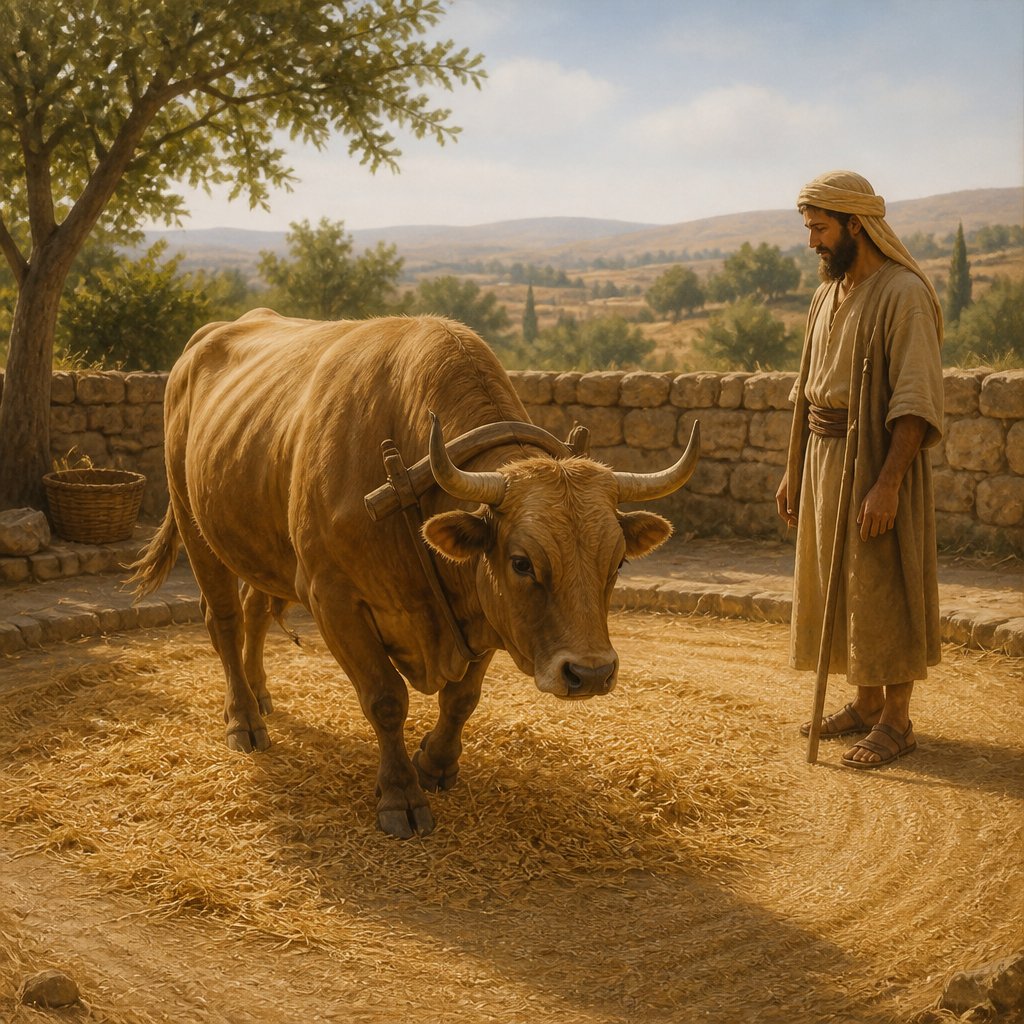
In Deuteronomy 25:4, we find a seemingly straightforward directive: "Thou shalt not muzzle the ox when he treadeth out the corn." At first glance, this command may appear to be merely agrarian advice given to the Israelites about their work animals. However, upon deeper reflection, we discover profound implications about justice, compassion, and the theological symbolism that permeates God’s Word.
In ancient agrarian societies, oxen were vital to the farming process, especially in harvesting grain. The act of treading out corn involved the ox walking over the harvested grain, separating the edible grain from the chaff. During this work, it was common for the ox to eat the grain while laboring. By instructing His people not to muzzle the ox, God established a principle of dignity and sustenance for those that serve.
This command teaches us several essential truths:
**1. Care for Those Who Labor:**
The Lord’s concern extends beyond just oxen. The principle here is one of moral and social justice. God is asserting that those who work should be allowed to benefit from their labor. Just as the oxen are not to be deprived of grain, we must ensure that those among us who labor—workers in our churches, communities, and workplaces—are treated fairly and justly. This is a call for us to reflect on how we support workers and promote fairness in our interactions with one another. Paul echoes this principle in 1 Timothy 5:18, where he states, "For the scripture saith, Thou shalt not muzzle the ox that treadeth out the corn. And, The laborer is worthy of his reward." We are reminded that God expects us to care for the needs of those who serve us while pointing them toward a greater truth concerning the Kingdom.
**2. Compassion as a Divine Attribute:**
God’s prohibition against muzzling the ox reveals His character as compassionate and just. This compassion is woven throughout Scripture, where God advocates for the underrepresented and vulnerable. Deuteronomy reminds us that a caring and merciful heart reflects God’s own nature. As we observe the way we treat those around us—particularly those we consider to be in lower positions or who provide for our needs—we should be compelled by love and empathy. In fact, this reflects the heart of God, who does not overlook any of His creation, whether human or animal.
**3. A Foreshadowing of Our Redeemer:**
The image of the ox treading out the corn can be likened to the work of Christ. Jesus came to serve, not to be served (Mark 10:45). He offered His own life as a sacrifice for our sake, allowing us, His creation, to partake in the blessings of salvation. He reminds us through His actions that selfless service should be our calling too. The ox, a creature tasked with labor, reflects the sacrificial love founded in divine calling and serves to remind us of our responsibility to those who serve in our midst.
**4. The Principle of Provision:**
Ultimately, the refusal to muzzle the ox speaks to a God who provides. He desires that His creation, whether they toil in the fields or work in our midst, finds nourishment, rest, and reward. When we deprive individuals of what is rightfully theirs for our gain, we not only dishonor them but also disrespect God’s command and provision.
In concluding this investigation of Deuteronomy 25:4, we must ask ourselves how these principles echo in our daily lives. Are we conscious of the rights and dignity of others? Are we providing for those who labor for us? And ultimately, are we mirroring the compassion of Christ even to the least of these?
As we meditate on this verse, let us commit to being advocates of justice, channels of God’s compassion, and stewards of the provision that comes from above. Let the example of the un-muzzled ox guide our interactions, reminding us that, just as we feed those who serve, so too are we nourished by the grace of the One who serves us daily.
Want to reflect more on Deuteronomy 25:4?
Continue your spiritual journey with Bible Chat — an AI-powered tool for exploring God's Word through conversation. Ask questions, discover connections, and deepen your understanding.
Get Our Apps


Deuteronomy 25:4 Artwork

Deuteronomy 25:4 - "¶ Thou shalt not muzzle the ox when he treadeth out the corn."
"¶ Thou shalt not muzzle the ox when he treadeth out the corn." - Deuteronomy 25:4
Deuteronomy 4:25 - "¶ When thou shalt beget children, and children's children, and ye shall have remained long in the land, and shall corrupt yourselves, and make a graven image, or the likeness of any thing, and shall do evil in the sight of the LORD thy God, to provoke him to anger:"

Deuteronomy 25:13 - "¶ Thou shalt not have in thy bag divers weights, a great and a small."

Deuteronomy 31:25 - "That Moses commanded the Levites, which bare the ark of the covenant of the LORD, saying,"

Deuteronomy 25:14 - "Thou shalt not have in thine house divers measures, a great and a small."

Deuteronomy 33:25 - "Thy shoes shall be iron and brass; and as thy days, so shall thy strength be."

Deuteronomy 25:10 - "And his name shall be called in Israel, The house of him that hath his shoe loosed."

Deuteronomy 25:16 - "For all that do such things, and all that do unrighteously, are an abomination unto the LORD thy God."

Deuteronomy 27:25 - "Cursed be he that taketh reward to slay an innocent person. And all the people shall say, Amen."

Deuteronomy 26:4-10

Deuteronomy 25:17 - "¶ Remember what Amalek did unto thee by the way, when ye were come forth out of Egypt;"

Deuteronomy 26:4-10

Genesis 25-4

Deuteronomy 3:25 - "I pray thee, let me go over, and see the good land that is beyond Jordan, that goodly mountain, and Lebanon."

Deuteronomy 4:4 - "But ye that did cleave unto the LORD your God are alive every one of you this day."

Deuteronomy 25:1 - "If there be a controversy between men, and they come unto judgment, that the judges may judge them; then they shall justify the righteous, and condemn the wicked."

Deuteronomy 32:25 - "The sword without, and terror within, shall destroy both the young man and the virgin, the suckling also with the man of gray hairs."

Deuteronomy 25:8 - "Then the elders of his city shall call him, and speak unto him: and if he stand to it, and say, I like not to take her;"

Deuteronomy 22:25 - "¶ But if a man find a betrothed damsel in the field, and the man force her, and lie with her: then the man only that lay with her shall die:"

Deuteronomy 6:25 - "And it shall be our righteousness, if we observe to do all these commandments before the LORD our God, as he hath commanded us."

Deuteronomy 25:6 - "And it shall be, that the firstborn which she beareth shall succeed in the name of his brother which is dead, that his name be not put out of Israel."

Deuteronomy 34:1-4 – Moses views the Promised Land from Mount Nebo.

Deuteronomy 34:1-4 – Moses views the Promised Land from Mount Nebo.

Deuteronomy 34:1-4 – Moses views the Promised Land from Mount Nebo.

Deuteronomy 4:44 - "¶ And this is the law which Moses set before the children of Israel:"

Deuteronomy 12:25 - "Thou shalt not eat it; that it may go well with thee, and with thy children after thee, when thou shalt do that which is right in the sight of the LORD."

Deuteronomy 33:4 - "Moses commanded us a law, even the inheritance of the congregation of Jacob."

Deuteronomy 12:4 - "Ye shall not do so unto the LORD your God."

Deuteronomy 34:1-4 – Moses views the Promised Land from Mount Nebo.